
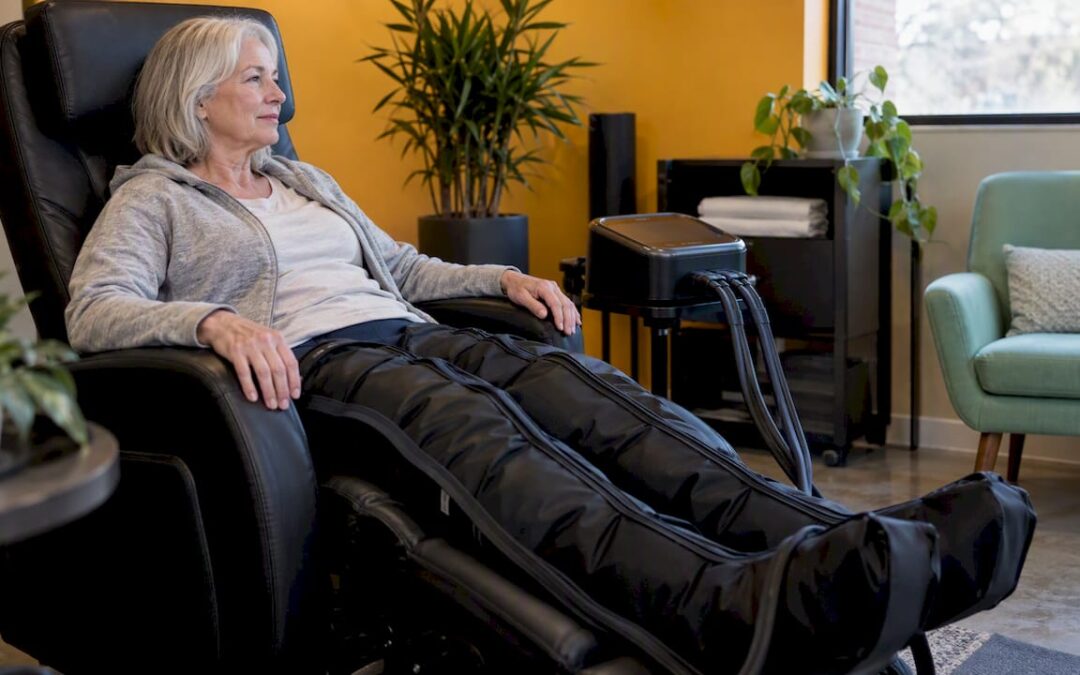
Compression therapy eases the aching, heaviness and swelling that varicose veins cause, but it does not remove the veins or fix the valve problem behind them. Graduated stockings are the standard first step. Compression boots (pneumatic devices) are a second option, mainly for people who can’t move around much or whose stockings haven’t controlled swelling. This guide explains how each works, how to choose and use them, who should check with a clinician first, and when it is time to look at a procedure instead.
TL;DR
- Compression squeezes the legs to push blood back toward the heart. It can relieve pain, swelling and heaviness, according to the National Heart, Lung, and Blood Institute.
- It treats symptoms only. The same source says most providers now recommend procedures to correct the reflux that causes varicose veins.
- Stockings are worn through the day. Boots inflate and release in cycles during a seated or reclined session.
- Get stockings properly measured, and talk to a clinician before starting if you have artery disease, heart failure or nerve damage in the legs.
- If you have osteopenia or osteoporosis, ask your doctor before using pneumatic compression on your legs.
Table of Contents
- How compression helps varicose veins
- Compression stockings vs. compression boots
- What compression can’t do
- Choosing and wearing compression stockings
- Using compression boots for varicose veins
- Downsides and who should check first
- When to move beyond compression
- Our perspective
- Compression and bone-health support at OsteoStrong
- FAQ
- Sources
How compression helps varicose veins
Varicose veins form when the one-way valves inside leg veins weaken. Blood slips backward and pools, the vein stretches, and the leg feels heavy, achy or swollen by evening. Compression works from the outside. Elastic stockings or bandages put gentle pressure on the leg, which the NHLBI says may relieve pain, swelling and heaviness.
The mechanism is simple. A review of medical treatment for venous disease notes that compression increases venous return and reduces ambulatory pressure, meaning less blood stays trapped in the lower leg while you walk and stand. Squeeze the leg a little, and the veins carry the load more efficiently.
There is also trial evidence for the device version. A 2016 randomized controlled study found that sequential pneumatic compression increased venous blood flow, reduced pain and improved quality of life in women with varicose veins. That is one small study, so treat it as encouraging rather than definitive.
Symptoms compression can ease
People most often notice relief from:
- Aching or throbbing in the calves after standing
- A heavy, tired feeling in the legs
- Ankle and foot swelling that builds through the day
- Discomfort during long flights, desk days or shifts on your feet
Compression does not change how the veins look. Bulging, twisted veins will still be visible under the stocking.
Compression stockings vs. compression boots
The two are often lumped together, but they work differently and suit different people.
| Compression stockings | Compression boots (pneumatic) | |
|---|---|---|
| How they work | Constant graduated pressure from elastic fabric | Air chambers inflate and deflate in sequence |
| When used | Put on in the morning, taken off at day’s end | Sessions while sitting or lying down |
| Best for | Daily symptom control, long days on your feet | Limited mobility, or swelling that stockings haven’t controlled |
| Main limit | Hard to put on, can irritate skin | Not worn while walking; needs a device or clinic access |
The Society for Vascular Surgery’s patient resource describes it this way: elastic stockings are typically put on in the morning and removed at the end of the day, while pneumatic devices use intermittent compression to decrease fluid in the lower legs and venous hypertension.
Intermittent pneumatic compression is considered particularly useful for patients with restricted mobility, or when bandages or stockings have failed to control edema. The same logic applies to people with reduced calf muscle function, for example from immobility or a stiff ankle, which a postthrombotic syndrome review lists as a good fit for pneumatic devices.
In practice, many people use both: stockings for the daytime, a boot session in the evening to help move fluid out of tired legs. If you are curious how clinics use sequential compression more broadly, our guide to lymphatic compression therapy covers the technique, and our overview of medical uses of compression therapy covers the evidence.
What compression can’t do
This is the part many articles gloss over. Compression is a management tool. The NHLBI states plainly that compression therapy only relieves symptoms and that most providers now recommend procedures to correct the reflux problem causing varicose veins. Those procedures can block or destroy the faulty vein so blood no longer pools in it.

That doesn’t make compression pointless. A 2024 review describes it as a conservative approach for patients whose ambulatory status or medical conditions warrant it, or who prefer conservative treatment, including as a trial period before deciding on definitive care. It is a reasonable place to start, and a sensible companion to treatment afterward.
It also won’t clear visible surface veins. If the cosmetic side is what bothers you, a vein specialist or a clinic offering spider vein treatment can explain which procedures target the surface veins and which address the deeper reflux. Get the underlying cause assessed first, because treating only what you see can miss what is driving it.
Choosing and wearing compression stockings
Get measured, then pick a pressure class
Fit matters more than brand. Stockings that are too tight cut in; too loose and they do nothing. England’s NHS decision-support material says stockings should be measured and fitted by a healthcare professional, such as a pharmacist or specialist nurse. In the U.S., a medical supply store with trained fitters or a vascular clinic does the same job.

In the United States, compression is classed by pressure in mm Hg: light (under 20), Class I or moderate (21 to 30), Class II or high (31 to 40), and Class III or very high (over 40). Light support is the over-the-counter range. Higher classes are usually chosen with a clinician, because the right level depends on your symptoms and your arteries.
Daily habits that help
- Put stockings on first thing in the morning, before the legs swell.
- Smooth out wrinkles and folds, which can dig into the skin.
- Check your skin each evening for redness or marks.
- Wash them as the maker directs, since elastic wears out.
- Walk. Calf muscle contractions are the body’s own vein pump, and stockings work best alongside movement.
- Raise your legs above heart level when resting.
Using compression boots for varicose veins
Compression boots are sleeves that wrap the foot, calf and sometimes the thigh, filling with air in sequence from the ankle upward. A session is typically a seated or reclined stretch of time, which is why they suit people who struggle with stockings or can’t walk much.
A few practical points:
- Boots help with swelling and heaviness. They are not a cure and don’t replace stockings for daytime support.
- Pressure settings should be comfortable, never painful. Stop if you feel numbness, sharp pain or tingling.
- Consumer devices vary widely. A clinic session lets someone check your history before the first run.
- Our guide to compression boot contraindications lists who should not use them, and our compression therapy cost comparison helps you weigh buying a unit against sessions.
Downsides and who should check first
Common side effects
Compression isn’t risk-free. The NHLBI notes that stockings can cause discomfort, itching, skin irritation or swelling. Most of these problems come from poor fit, folds, or skin that is already dry or fragile. Switching size or style often solves it.
Conditions that call for a clinician’s okay
Some conditions make compression unsafe or require modification. A review of compression for venous ulcers lists contraindications including advanced peripheral arterial disease (ABPI under 0.8), uncontrolled congestive heart failure and advanced peripheral neuropathy. ABPI is a simple ankle-to-arm blood pressure comparison that shows whether your leg arteries are delivering enough blood.
Even with partial artery disease, there is nuance. For an ABPI of 0.6 to 0.8, the postthrombotic review says modified compression using stiff material at reduced pressure (under 40 mm Hg), under careful control may be used. That is a decision for a vascular clinician, not something to improvise at home.
See a professional before starting if you have:
- Cold, pale or painful legs when walking (possible artery disease)
- Heart failure or unexplained leg swelling on both sides
- Numbness or reduced feeling in your feet, as with diabetic neuropathy
- Open sores, skin infection or a suspected blood clot
If you have osteopenia or osteoporosis
Low bone density does not make stockings off-limits, but it does call for a quick conversation. Some pneumatic compression device makers list osteopenia and osteoporosis as precautions, meaning the settings or use may need adjusting. Bones aren’t the issue with a light, even squeeze from a stocking, but strong or aggressive pneumatic pressure on fragile legs is worth running past your doctor first. Tell whoever fits your stockings or runs your boot session about your bone density result, and ask whether a lower pressure or shorter session is wise.
When to move beyond compression
Compression is a fine starting point, but some signs mean you should get the legs examined. The NHLBI advises talking to a healthcare provider if you think you may have varicose veins, and contacting one right away if the veins suddenly get worse, bleed or develop a sore.
Also worth an appointment:
- Symptoms that persist or worsen despite consistent stocking use
- Skin darkening, hardening or itchy rashes around the ankle
- One leg suddenly swollen, warm or tender, which can signal a clot and needs urgent care
A vascular specialist can scan the legs with ultrasound to see where blood is flowing backward and discuss procedures that close or remove the faulty vein. Many people then keep wearing compression for comfort during recovery.
Our perspective
We don’t treat vein disease, and we won’t pretend otherwise. We are a bone-health and wellness center, and most of the people who come to us have osteopenia or osteoporosis. They also tell us their legs ache, swell or feel heavy, and they ask whether compression is something they can add safely.
Our view is practical. Compression is a comfort and circulation tool, and it works best when the person using it knows its limits. Varicose veins need a proper diagnosis, and compression should never delay that. Once a clinician has cleared you, a session-based approach has real advantages: someone checks your history, sets a comfortable pressure and watches how your legs respond, which matters when your bones are fragile and you want to avoid guesswork.
We also think circulation and bone health belong in the same conversation. Our core protocol is one short, supervised osteogenic loading session per week, and we add recovery therapies around it where they suit the client. For legs that feel tired, compression therapy is one of those options. We’d rather you understand what each therapy does and doesn’t do than oversell any of them.
— Aaron
Compression and bone-health support at OsteoStrong
If you live near Rancho Cordova, El Dorado Hills or Granite Bay and want help with leg comfort alongside your bone-density plan, we offer compression therapy as one of our wellness services. It sits next to our weekly osteogenic loading sessions, which are supervised and non-pharmaceutical. Check with your doctor about your veins first, then talk with our team about what fits your health history. Our guide on osteogenic loading for osteoporosis explains what a typical weekly session looks like.
FAQ
Does compression therapy get rid of varicose veins?
No. It relieves symptoms such as pain, swelling and heaviness, but it doesn’t repair the faulty valves. The NHLBI says most providers now recommend procedures to correct the reflux behind varicose veins. Compression is still useful as a first step, a bridge, or an aid after treatment.
Are compression boots good for varicose veins?
They can help with swelling and heavy legs, and a small randomized study found sequential pneumatic compression improved blood flow and pain in women with varicose veins. They are especially suited to people with limited mobility or stubborn swelling. They don’t replace a diagnosis, and they aren’t safe for everyone, so check with a clinician first.
Is there a downside to wearing compression socks?
Yes. Discomfort, itching, skin irritation and swelling can occur, usually from poor fit or fragile skin. People with advanced arterial disease, uncontrolled heart failure or severe neuropathy should not use them without medical guidance. A professional fitting reduces most problems.
Can I use compression if I have osteoporosis or osteopenia?
Often yes, but tell your doctor first. Light stockings put little force on the bones, while strong pneumatic pressure is something device makers list as a precaution for low bone density. Ask for a comfortable, moderate setting and stop if anything hurts.
Sources
- Varicose Veins, NHLBI, NIH
- Effect of sequential pneumatic compression therapy on women with varicose veins
- Medical Treatment for Postthrombotic Syndrome
- Lower Extremity Venous Disease and Treatment, Society for Vascular Surgery
- Compression therapy for venous leg ulcers
- Compression therapy in the management of varicose veins
- NHS England decision support tool: varicose veins