

Yes, in many cases you can. Research shows measurable bone density gains are possible with the right combination of progressive resistance training, targeted nutrition, and hormonal evaluation, and many more people can at least stabilize their bone loss entirely. Medication becomes the priority only when fracture risk crosses specific clinical thresholds, not simply because a scan shows osteopenia.
TL;DR:
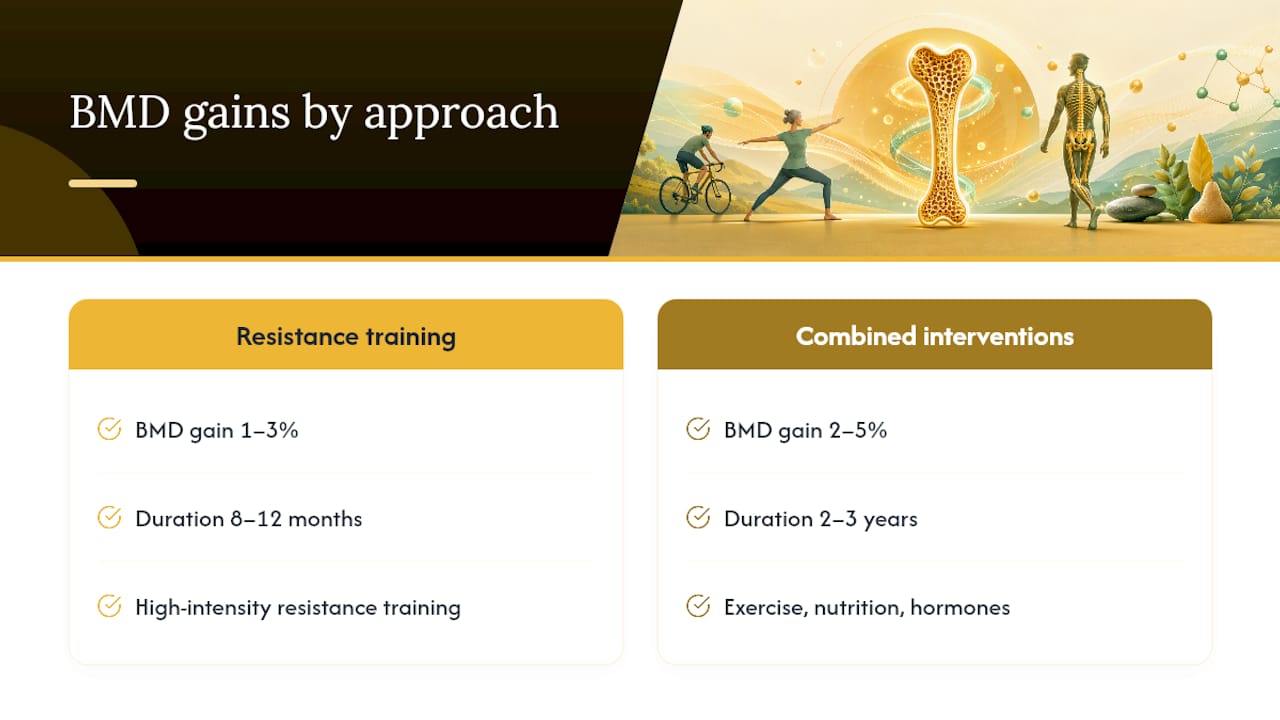
- Bone density improvements through resistance training are slow, typically resulting in 1% to 3% gains over 8 to 12 months.
- High-intensity, supervised resistance exercises targeting the spine and hips are among the most effective non-drug methods for reversing bone loss.
- Achieving a 2% to 5% increase in bone mineral density over two to three years can significantly reduce fracture risk, even if T-scores don’t fully normalize.
- Successful management combines heavy resistance training, impact-loading activities, balanced nutrition with calcium and vitamin D, and regular monitoring of bone health.
- Pharmacological treatment is recommended only when fracture risk thresholds are exceeded or if bone density worsens despite lifestyle efforts.
Table of Contents
- Can You Reverse Osteopenia With Exercise and Diet Alone?
- What Does the Research Actually Say About Reversing Bone Loss?
- How Do You Build a Workout Plan That Actually Strengthens Bone?
- What Should You Eat to Rebuild Bone Density?
- How Do Doctors Decide If You Need Medication Instead of Lifestyle Changes?
- When Is Medication the Right Call, and What Are the Options?
- Your Step-by-Step Plan for Addressing Osteopenia
- How Does Supervised Osteogenic Loading Fit Into This Picture?
- Do Emerging Therapies Like PEMF and Red Light Actually Help Bone Density?
- What Happens If You Ignore Osteopenia Altogether?
- A Realistic Take on Reversing Bone Loss
- Where to Learn More About Bone Health and Osteopenia
- Sources
Can You Reverse Osteopenia With Exercise and Diet Alone?
A T-score between -1.0 and -2.5 on a DXA scan defines osteopenia. That range sits between normal bone density and osteoporosis, and it’s wide enough that two people with the same diagnosis can have very different risk levels and very different paths forward.
Reversal is real, but it’s slow, and the numbers matter more than the label. According to Mayo Clinic, bone mineral density can improve by 1% to 3% over 8 to 12 months with high-intensity resistance training, and by a small percentage over several years when exercise, nutrition, and hormonal optimization are combined. That’s not a typo, and it’s not disappointing once you understand bone biology. Bone remodels in cycles that take months to complete: old bone gets broken down by cells called osteoclasts, then rebuilt by osteoblasts. You cannot rush that cycle with intensity alone.
Statistic Callout: A 2% to 5% BMD gain over two to three years sounds modest, but it can shift someone from an osteopenia T-score toward the normal range, and it corresponds to a meaningful drop in fracture risk, according to Mayo Clinic.
The honest goal isn’t always a perfect T-score. It’s fracture risk reduction. Cleveland Clinic notes that some people do regain bone density in the typical range with early treatment, but even those who don’t fully normalize their scan results still lower their odds of a hip or spine fracture substantially through the same interventions. That distinction changes how you should measure success: track trends across repeat scans, not a single number.
What Does the Research Actually Say About Reversing Bone Loss?
The strongest non-drug evidence for building bone comes from a body of trials often referred to as LIFTMOR-style research, which tested heavy, supervised resistance training in postmenopausal women. According to StatPearls, high-intensity, heavy-load resistance training increased spine bone density and ranks among the most effective non-pharmacologic interventions available for osteopenia and early bone loss.
That’s a striking finding, because for decades the standard advice for people with fragile bones was gentle activity and caution around heavy lifting. The data flipped that assumption.
A few other findings round out the evidence picture:
- A published case report followed a postmenopausal woman who reversed bone mineral density loss over two years through diet changes and increased osteogenic exercise, documented in PMC.
- StatPearls outlines FRAX thresholds, specifically a 10-year hip fracture risk of 3% or higher or a major osteoporotic fracture risk of 20% or higher, as the trigger points clinicians use to recommend medication.
- The same case report noted no adverse effects from the lifestyle-based approach over the two-year study period.
Statistic Callout: The case report is a single patient, not a randomized trial, so treat it as a proof of concept rather than a guarantee. Its value is showing that a structured lifestyle change over two years can move BMD in the right direction, which lines up with the broader resistance-training evidence rather than contradicting it.
The limitation worth naming plainly: most of the strongest resistance-training data comes from supervised, high-intensity programs, not casual gym routines. Intensity and supervision appear to matter as much as simply “exercising more.”
How Do You Build a Workout Plan That Actually Strengthens Bone?
Bone responds to mechanical stress the same way muscle does. Load it beyond what it’s used to, and specialized cells sense that strain and trigger new bone formation, according to patient education from the American Academy of Orthopaedic Surgeons. Walking rarely provides enough stimulus on its own. Your skeleton needs a reason to adapt.
Progressive, heavy resistance training performed at high relative intensity, often in the range of 80% to 85% of your one-rep max, twice weekly, has been used safely in supervised trial settings to increase spine bone density without raising fracture risk in postmenopausal women. That intensity range surprises most people who assume “osteopenia” means “lift light.”
Here’s a realistic weekly structure to discuss with a physical therapist or qualified trainer:
- Two heavy resistance sessions per week targeting major muscle groups, especially the deadlift, squat, and overhead press patterns, since these load the spine and hip where fractures matter most.
- One to two impact-loading sessions, such as supervised jump training, stair climbing, or a sport you already enjoy, to add ground reaction force beyond what lifting alone provides.
- Daily balance work, even five minutes of single-leg stands or tai chi movements, since a fall is often more dangerous than the bone density number itself.
- A deload or lighter week every four to six weeks to let joints and connective tissue recover while bone continues adapting.
- Reassessment every eight to twelve weeks to progress load, form, or volume based on how your body responds.
Weighted vests deserve a mention here. Adding external load during walking or bodyweight exercises increases the mechanical stimulus your skeleton experiences, and some osteogenic loading devices work on a similar principle, applying brief, high-force loads through the skeleton in a controlled setting. Progressive overload and supervision matter for these tools just as much as for barbell training, since jumping straight to a heavy vest without conditioning invites joint strain rather than bone gain.
Pro Tip: Don’t chase intensity in week one. Most fracture risk during a new exercise program comes from poor form or overly ambitious loading, not from the exercise itself. Spend the first two to three weeks building movement quality before adding meaningful weight.
If you’ve had a prior fragility fracture, have significant balance issues, or haven’t strength trained in years, get a movement screen from a physical therapist before starting a heavy-load program. Osteopenia doesn’t disqualify you from lifting. It just means your program should be built by someone who understands bone loading, not copied from a general fitness plan.
What Should You Eat to Rebuild Bone Density?
Nutrition without the right exercise stimulus won’t rebuild bone, and heavy training without adequate raw material won’t either. You need both.
Calcium is the obvious starting point, and food should be your first source. The NIH Office of Dietary Supplements recommends most adults target 1,000 to 1,200 milligrams daily, ideally from dairy, leafy greens, fortified foods, or canned fish with bones. If you need a supplement to close the gap, calcium citrate tends to be better tolerated than calcium carbonate and absorbs well regardless of when you take it. Splitting doses, say 500 milligrams at two separate meals rather than 1,000 milligrams at once, improves absorption since your body can only process so much calcium at a time.
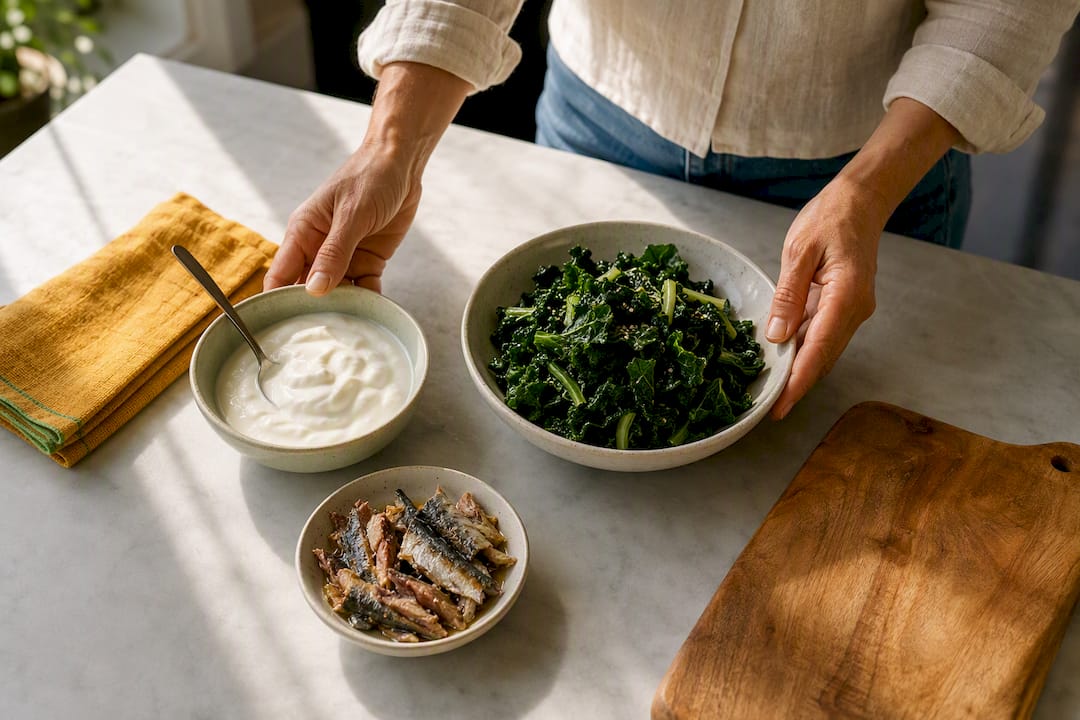
Vitamin D works alongside calcium, not instead of it. Without adequate vitamin D, dietary or supplemental calcium can’t be absorbed efficiently, according to Mayo Clinic. Ask your doctor for a 25(OH)D blood test rather than guessing at a dose. Levels vary enormously by geography, skin tone, and time spent outdoors, and dosing should be individualized rather than pulled from a generic supplement label.
Protein gets underrated in bone health conversations. Bone is roughly a third collagen by volume, and inadequate protein intake undermines the matrix that minerals attach to. Aim for approximately 1.0 to 1.2 grams per kilogram of body weight daily, spread across meals rather than loaded into one sitting.
A few more pieces worth knowing:
- Vitamin K2 appears to help direct calcium toward bone rather than soft tissue, based on findings from the case report on lifestyle-driven BMD reversal, though larger trials are still needed to confirm the size of the effect.
- Magnesium supports the enzymatic processes involved in bone mineralization and is often overlooked next to calcium.
- High-oxalate foods like spinach and swiss chard can bind calcium in the gut and reduce its absorption when eaten at the same meal as your main calcium source. You don’t need to avoid them, just don’t rely on them as your calcium strategy.
Statistic Callout: The same case report that documented BMD reversal paired dietary changes, including reduced high-oxalate intake and increased K2-containing foods, with resistance training over two years. It’s a small sample, but it illustrates the food-and-exercise combination outperforming either approach alone.
If you take thyroid medication, proton pump inhibitors, or corticosteroids, talk to your doctor before adding calcium supplements, since interactions and absorption timing can vary. Nutrition changes for osteopenia are rarely risky, but they’re not universally one-size-fits-all either.
How Do Doctors Decide If You Need Medication Instead of Lifestyle Changes?
A DXA scan gives you two numbers that get confused constantly: your T-score compares your bone density to a healthy young adult, while your Z-score compares it to people your own age. T-score is what defines osteopenia and osteoporosis. Z-score helps flag whether something unusual, like a hidden metabolic condition, might be driving unexpectedly low density in a younger patient.
FRAX takes that scan data and combines it with age, weight, fracture history, family history, and lifestyle factors to estimate your 10-year fracture probability. It’s a calculator, not a diagnosis, but it’s the tool that actually drives the medication conversation.
- A FRAX-calculated 10-year hip fracture risk of 3% or higher, or a major osteoporotic fracture risk of 20% or higher, is the commonly used threshold for recommending pharmacologic therapy, according to Mayo Clinic.
- StatPearls notes that many patients with osteopenia can avoid medication entirely if their FRAX score is low and they commit to a structured, evidence-based lifestyle program.
- Repeat DXA scans are typically spaced one to two years apart, since bone remodeling is too slow for more frequent scanning to show meaningful change.
- Vertebral imaging or additional lab work, including thyroid and vitamin D panels, may be added when a clinician suspects a secondary cause behind unexpectedly rapid bone loss.
A “meaningful response” to your clinician usually means a stable or improving T-score on repeat scan, no new fractures, and FRAX risk holding steady or dropping. It doesn’t require hitting a normal T-score to count as success.
When Is Medication the Right Call, and What Are the Options?
Certain situations move a patient from lifestyle-first to medication-now, regardless of how disciplined their exercise and nutrition habits are.
- A prior fragility fracture, meaning a break from a fall at standing height or less, generally shifts the conversation toward treatment even at osteopenia-range T-scores.
- Meeting or exceeding the FRAX thresholds discussed above (3% hip fracture risk or 20% major osteoporotic fracture risk).
- Rapid bone density decline between scans despite consistent lifestyle intervention.
- Underlying conditions or medications, like long-term corticosteroid use, that accelerate bone loss independent of activity level.
When medication is warranted, three drug categories come up most often. Bisphosphonates slow the cells that break down bone and remain the most commonly prescribed first-line option. Denosumab works through a different pathway to reduce bone breakdown and is given as a periodic injection. Anabolic agents, reserved for higher-risk cases, actively stimulate new bone formation rather than just slowing loss.
Every option carries its own safety checklist: kidney function and calcium levels get monitored before and during bisphosphonate or denosumab therapy, and dental evaluation matters because these drugs are linked to rare jaw complications in specific circumstances. None of this should happen without a conversation weighing your personal fracture risk against the medication’s risk profile. Shared decision-making with your physician, not a blanket rule, decides what’s right here.
Your Step-by-Step Plan for Addressing Osteopenia
You don’t need to overhaul your life overnight. You need a sequence.
- Confirm your DXA results and get a FRAX score calculated so you know your actual 10-year fracture risk, not just your T-score.
- Request baseline labs, including vitamin D, calcium, and thyroid function, to rule out anything accelerating bone loss.
- Start a structured program combining twice-weekly heavy resistance training with the calcium, vitamin D, and protein targets covered above.
- Repeat your DXA scan on the schedule your clinician recommends, typically one to two years out, rather than checking obsessively.
- Revisit medication only if your FRAX crosses threshold, your scan shows continued decline, or you sustain a fragility fracture.
Bring specific questions to your next appointment: What’s my current FRAX score? Should I be tested for secondary causes of bone loss? What does a meaningful improvement look like on my next scan?
Pro Tip: Set two timelines with your doctor: a short-term one (three to six months) measuring adherence to exercise and nutrition, and a long-term one (one to three years) measuring actual BMD change. Judging yourself against the long-term number too early is the fastest way to lose motivation over something that was never going to move that fast.
How Does Supervised Osteogenic Loading Fit Into This Picture?
Mechanical loading is the common thread running through nearly every intervention discussed here, from heavy squats to weighted vests. One approach applies that same principle in a supervised, in-person format: brief sessions of osteogenic loading designed to deliver a concentrated mechanical stimulus to the skeleton, once weekly, alongside adjunct modalities like PEMF mats, red light therapy, and vibration plates.
This kind of supervised session tends to appeal to people who want expert guidance on load progression without designing a home barbell program themselves, or who are earlier in their fitness journey and want a structured entry point before attempting heavier free-weight training independently. It’s not a replacement for the resistance training evidence described above. It’s another route to the same mechanical loading principle, applied in a monitored setting.
…
If you’re weighing whether a supervised, membership-based option fits your situation better than a home program, Osteostrong’s Rancho Cordova location offers a look at what a session actually involves before you commit.
Do Emerging Therapies Like PEMF and Red Light Actually Help Bone Density?
Interest in adjunct therapies for bone health has grown alongside the resistance-training evidence, and it’s worth separating what’s promising from what’s proven. Pulsed electromagnetic field (PEMF) therapy and red light therapy are both marketed as bone-supportive tools, and both operate on plausible biological mechanisms, electrical stimulation and cellular photobiomodulation, respectively, that researchers have studied in orthopedic contexts for decades.
The honest picture: neither PEMF nor red light therapy carries the kind of large-scale, randomized evidence that heavy resistance training does for bone density specifically. They’re best understood as adjuncts that may support the broader picture of tissue recovery, circulation, and inflammation management around your exercise program, not as standalone bone-building solutions with numbers to rival LIFTMOR-style resistance training. Anyone considering these tools should know their contraindications too. Certain medications, skin conditions, or implanted devices can make red light therapy inappropriate for some people, which is worth checking before adding it to a routine.
Vibration plate training and whole-body compression therapy fall into a similar category. They can support circulation, muscle recovery between heavy training sessions, and general mobility, which indirectly supports a consistent exercise habit. Treat all of these as supporting players around your core program of resistance training, adequate protein and calcium, and vitamin D optimization, not as substitutes for it.
What Happens If You Ignore Osteopenia Altogether?
Osteopenia doesn’t hurt, which is exactly why it’s dangerous to dismiss. Bone density loss produces no symptoms until a fracture happens, and by then the bone has often thinned considerably further than it was at diagnosis.
Left unaddressed, osteopenia frequently progresses to osteoporosis, particularly in postmenopausal women where estrogen decline accelerates bone turnover. Once a fragility fracture occurs, whether it’s a wrist, hip, or vertebral compression fracture, subsequent fracture risk rises substantially, and hip fractures in older adults carry serious complications, including prolonged mobility loss and increased mortality risk within the following year.
There’s a risk on the other end of the spectrum too: overcorrecting. Jumping into maximal-intensity resistance training without proper progression, skipping the movement-quality phase, or attempting impact loading with poor balance can cause the very fracture you’re trying to prevent, particularly in someone who hasn’t strength trained in years. This is precisely why supervision matters during the early months of a new program, and why FRAX and DXA monitoring exist. You want enough mechanical stress to stimulate bone formation without exceeding what your current bone and joint structure can safely handle. The sweet spot is real, and it’s why “just lift heavy” isn’t complete advice without the progression and supervision built around it.
A Realistic Take on Reversing Bone Loss
Most people diagnosed with osteopenia want a clean timeline: do this for six months, get a normal T-score. That’s not how bone works, and pretending otherwise sets people up to quit right when their program is actually working.
What the evidence actually supports is less dramatic and more durable. Small, sustained gains in bone density, paired with meaningful drops in fracture risk, are the realistic win here, even for people who never see their T-score cross back into the normal range. That’s not a consolation prize. A lower fracture risk is the outcome that actually protects your independence as you age.
Progress toward that outcome, especially once you’re adding heavy load or impact training, benefits from professional eyes on your form and progression. This isn’t a program to guess your way through with a fitness influencer’s video.
There’s an emotional weight to this diagnosis that clinical guidelines don’t address well. Getting an osteopenia result can feel like your body quietly betrayed you. It didn’t. It’s giving you information early enough to act on it, which is a genuine advantage over finding out after a fracture. Treat this as a multiyear commitment, not a sprint, and give the process the time bone biology actually requires.
— Aaron
Where to Learn More About Bone Health and Osteopenia
- StatPearls’ overview of osteopenia covers clinical diagnostic criteria and treatment thresholds in depth.
- Mayo Clinic’s osteopenia FAQ explains expected bone density changes and outlook.
- The NIH’s overview of osteoporosis provides foundational bone health education.
- The PMC case report documents a real example of lifestyle-driven bone density reversal.
- Cleveland Clinic’s osteopenia guide offers patient-focused framing on outlook and treatment.
This article is general information, not a substitute for advice from a qualified doctor. Consult a qualified healthcare professional about your own circumstances before acting on anything here.
Sources
- Reversal of Bone Mineral Density Loss Through Lifestyle Changes: A Case Report — PMC
- StatPearls — Osteopenia
- NIH ODS — Calcium: Health Professional Fact Sheet