
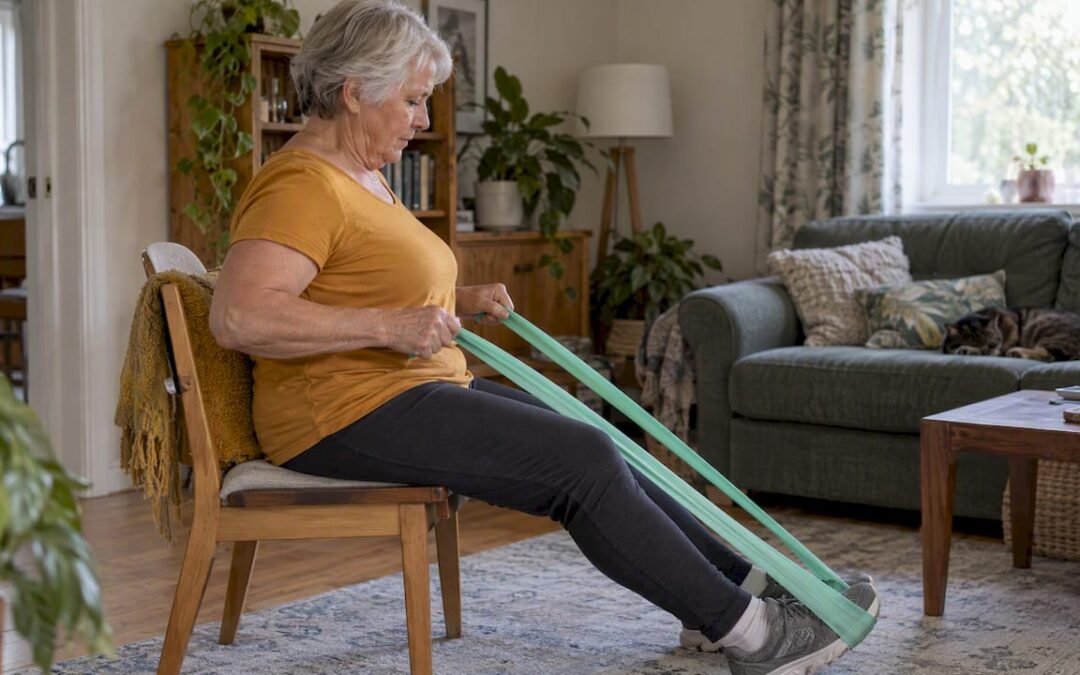
Resistance bands are a reasonable, low-cost tool for people with osteoporosis or osteopenia, as long as you choose the right band, move slowly, and keep your spine out of forward bending. Bands build muscle and can support bone, but they are one piece of a bigger plan. That plan also includes balance work, nutrition, and, for many people, heavier loading than a band can provide.
Below you will find what the research says, a simple routine, the mistakes that cause trouble, and an honest look at where bands stop being enough.
TL;DR
- Progressive elastic band training improved bone mineral density in postmenopausal women in trials lasting 12 to 24 weeks, with sessions at least twice a week.
- Use a band that feels hard by rep 8 to 12. If you can easily do more than 12, move up to a stronger band.
- Avoid loaded forward bending of the spine, especially if you have had a vertebral fracture or are at high risk of one.
- Bands are a good start, but bone responds to higher loads. Supervised, higher-intensity loading is the next step for many people.
Table of Contents
- What the research says about bands and bone
- Why bands help: muscle, posture, and falls
- Choosing and setting up your band
- A starter routine with resistance bands
- Protect your spine
- Where bands fall short
- Add balance work and good nutrition
- Our perspective
- Supervised loading in Rancho Cordova, El Dorado Hills, and Granite Bay
- Quick checklist before you start
- FAQ
- Sources
What the research says about bands and bone
A 2024 meta-analysis of elastic band training in older women looked at bone mineral density, muscle mass, and body composition. It reported that progressive band programs improved whole-body bone density and muscle mass index in postmenopausal women, with benefits showing up after 12 to 24 weeks of training at least twice weekly. A separate 24-week trial in elderly women tested band training against body composition, bone density, and functional fitness.
Two cautions belong next to those results. Most of these trials are in postmenopausal or elderly women, and many are in other countries, so they do not prove the same result for every person. And “progressive” is the key word. A band you never change will stop challenging your body.
The larger picture comes from guidelines. A review of exercise guidance for frailty and fragility fractures found that most guidelines recommend individually tailored, multicomponent programs, discourage long periods of sitting, and pair exercise with good nutrition. Bands fit well inside that kind of program. They do not replace it.
Why bands help: muscle, posture, and falls
Bone gets stronger when muscles pull on it with real force. Resistance exercise puts weight on specific muscles, and strong muscles help you stand tall and move with confidence, as Mayo Clinic Press explains. Bands are useful because they are cheap, light, and easy to scale.
They also support the thing that actually causes most fractures: falls. The UK consensus statement on exercise for osteoporosis stresses that inactivity is more dangerous than supervised exercise and that the goal is to build a program of good movements that improve strength and balance, which lowers fall risk. If fear of fracture has kept you on the couch, that is the point to take seriously.
Bands work best on the areas where osteoporotic fractures tend to happen: hips, back muscles, and shoulders. Stronger glutes and thighs help you get out of a chair and catch yourself. Stronger upper-back muscles help you hold a taller posture. Our daily posture plan pairs well with the pulling exercises below.
Choosing and setting up your band
Most people do well with a long flat band or a tube band with handles. Buy two strengths, one lighter and one heavier, because your legs are stronger than your arms and will need a stronger band.
Check the band each time. Look for nicks and thin spots. A band that snaps back can hit your face or hands.
Anchor it safely. Use a door anchor made for bands, or loop it under a foot. Stand on a non-slip floor, and keep a sturdy chair or counter within reach if balance is a concern.

Pick your resistance by the rep count. The Bone Health & Osteoporosis Foundation says resistance work is effective when it is progressive, so if you easily complete more than 12 repetitions, increase the band’s resistance. If you cannot keep controlled form for 8 to 12 repetitions, the band is too strong.

A starter routine with resistance bands
Do this two or three times a week on non-consecutive days, which matches the twice-weekly minimum in the trials above. Start with one set of 8 to 12 repetitions and build to two sets over several weeks.
- Seated or standing row. Loop the band around a post or door anchor at chest height. Pull your elbows back and squeeze your shoulder blades gently together. Keep your ribs stacked over your hips, and do not lean back.
- Standing hip extension. Hold a counter for balance with the band looped around both ankles. Move one leg straight back without arching your lower back. Return slowly.
- Sit-to-stand with a band above the knees. Sit on a firm chair with the band just above your knees. Press your knees out against it as you stand up tall, then lower slowly. This builds glutes and thighs and mimics a daily task.
- Standing hip abduction. Hold a counter and move one leg out to the side against the band. Keep your toes forward and your torso upright.
- Band pull-apart. Hold the band at chest height with straight arms. Pull it apart, draw your shoulder blades back, and return slowly.
- Overhead press (light band). Stand on the band and press the handles up from shoulder height. Stop if you feel any pinch in the shoulder.
The slow return matters. Practitioners point out that the lowering phase, when you let the band back slowly, is where much of the muscle loading happens. Letting the band snap back wastes the exercise and risks injury.
What soreness should and should not feel like
Mild muscle soreness for a day or two is normal. Pain during the movement is a sign to stop or change the form. Sharp back pain, especially after a movement you have not done before, is a reason to stop and call your doctor. It can signal a vertebral fracture.
Protect your spine
If you have had a spinal fracture, or your doctor has told you your risk of one is high, the rules change. The International Osteoporosis Foundation advises people at high fracture risk to avoid trunk flexion exercises, because bending the spine forward under load may raise the risk of a vertebral fracture.
In practice, that means:
- No toe touches or sit-ups with a band held in your hands.
- No bent-over rows where you round your back. Use a seated or standing row with an upright torso.
- Think “tall spine.” Back extension and core stabilization exercises are the safer direction.
- Move slowly. Jerky movements are riskier, especially when you are tired near the end of a set.
If you want a gentler practice to combine with bands, one yoga teacher resource covers 3 to 4 yoga postures chosen for osteoporosis and spinal fracture precautions. It is written in Portuguese, but the posture photos are easy to follow. Whatever you try, have a physical therapist check your form. Someone with a spinal fracture needs different modifications than someone with osteopenia in the hip.
Our guide to exercises to avoid with osteoporosis goes through more movements to skip, and our osteoporosis exercise guidelines lay out a safe general framework.
Where bands fall short
Bands are gentle, which is their strength and their limit. Bone responds to load that is high enough, and a stretchy band gives you far less force than a loaded squat or deadlift. In the LIFTMOR trial, older adults at risk of osteoporosis did high-intensity deadlifts and squats at 80 to 85% of their one-repetition maximum. Adherence was high at 77.8%, with few adverse events, provided the training was supervised.
That is why professionals do not tell people to rely on one activity. Walking and swimming are good for the heart but, according to the RACGP osteoporosis exercise guidance, do not stimulate the hip and spine much on their own. Programs that combine resistance, balance, and functional exercise are the standard to aim for. If you swim, read our note on why swimming laps need loading.
And for the question many people ask: are deadlifts good for osteoporosis? They can be, for people who are able to do them, but only with an exercise professional checking form. People at high risk of spine fracture need back-safe versions. Our page on high-impact exercise for osteoporosis covers how to think about higher forces safely.
Add balance work and good nutrition
Bands build strength. Balance training keeps you upright. Both matter, because falls are the main cause of fragility fractures. Start with our guide to balance training for seniors, and see Tai Chi for osteoporosis if you prefer a group class. Our fall prevention actions page covers home and clinic steps.
Nutrition supports all of it. According to Mayo Clinic, the recommended calcium intake is 1,000 mg a day for most adults 19 to 50 and men 51 to 70, and 1,200 mg for women 51 and older and men 71 and older. Vitamin D is 600 IU a day for adults 19 to 70, and 800 IU after 71. Our foods to avoid with osteoporosis guide covers the rest. Ask your doctor before starting supplements.
Our perspective
We see many people come in after months of careful band work and walking who feel stuck. They are doing the right thing and they are not wrong to. Bands are a very good start, especially for building the habit and the muscle that protects you from falls.
What we have learned is that most people with osteoporosis or osteopenia are not weak because they are lazy. They are cautious, and rightly so. The trouble is that caution can slide into avoiding load altogether, and bone needs load to adapt. That is why we built our work around osteogenic loading: a brief, supervised session once a week on equipment that lets you apply a meaningful load in a controlled position, without the form risks of free weights.
Our view is simple. Use bands at home for strength and consistency. Add balance work. Then, if you want measurable progress on bone, talk to your doctor about supervised loading. Keep your medical team in the loop, because no exercise program replaces the medication decisions your doctor may recommend.
— Aaron
Supervised loading in Rancho Cordova, El Dorado Hills, and Granite Bay
If you would like to go beyond bands, our centers in Rancho Cordova, El Dorado Hills, and Granite Bay offer osteogenic loading, a non-pharmaceutical protocol that takes one brief supervised session a week. Our team guides each session, and results are tracked so you can see how you are progressing. For how the approach works, see our overview of weekly osteogenic loading for osteoporosis and the evidence behind it. Pricing is not published online, so contact the center nearest you.
Quick checklist before you start
- Get your doctor’s okay, and ask whether you have any movement restrictions from a prior fracture.
- Pick one light and one heavier band, and check them for wear.
- Keep the spine tall. Skip forward-bending moves with load.
- Move slowly in both directions.
- Aim for 8 to 12 reps that feel hard by the end, and step up the band when 12 gets easy.
- Train two or three days a week, with rest days between.
- Stop if you feel sharp pain, and call your doctor about new back pain.
FAQ
Can resistance bands improve bone density in osteoporosis?
They can help. A meta-analysis found improved bone density and muscle mass in postmenopausal women using progressive band training for 12 to 24 weeks. Results vary, and bands provide less force than heavier loading, so talk to your doctor about the full plan.
What is the best exercise for osteopenia in the lower back?
Safe choices focus on spinal extension and core stabilization rather than forward bending. A seated row with a tall posture is a good example. Have a physical therapist tailor the exercises to you, especially if you have had a spinal fracture.
How often should I use resistance bands?
Two or three non-consecutive days a week is a sensible target, since the trials reporting bone benefits used sessions at least twice weekly. Use 8 to 12 repetitions and raise the band’s resistance when you can do more than 12 easily.
Are resistance bands safe if I have had a fracture?
Often yes, with changes. Exercise is generally better than inactivity, but after a spine or hip fracture you should get specific guidance from your doctor or a physical therapist first. They can tell you which movements to avoid and which band strength fits you.
Sources
- Effects of resistance training with elastic bands on bone mineral density: a meta-analysis (PMC)
- 24 weeks of elastic-band resistance training in elderly women
- Exercise to Prevent and Manage Frailty and Fragility Fractures (PMC)
- Strong, steady and straight: UK consensus statement (PMC)
- Exercising when you have osteoporosis, Mayo Clinic Press
- Bone Health & Osteoporosis Foundation: Exercise and Safe Movement
- International Osteoporosis Foundation: Exercise for individuals with osteoporosis
- RACGP: Exercise for general bone health maintenance
- Mayo Clinic: Bone health