

Does red light therapy actually work for bone density?
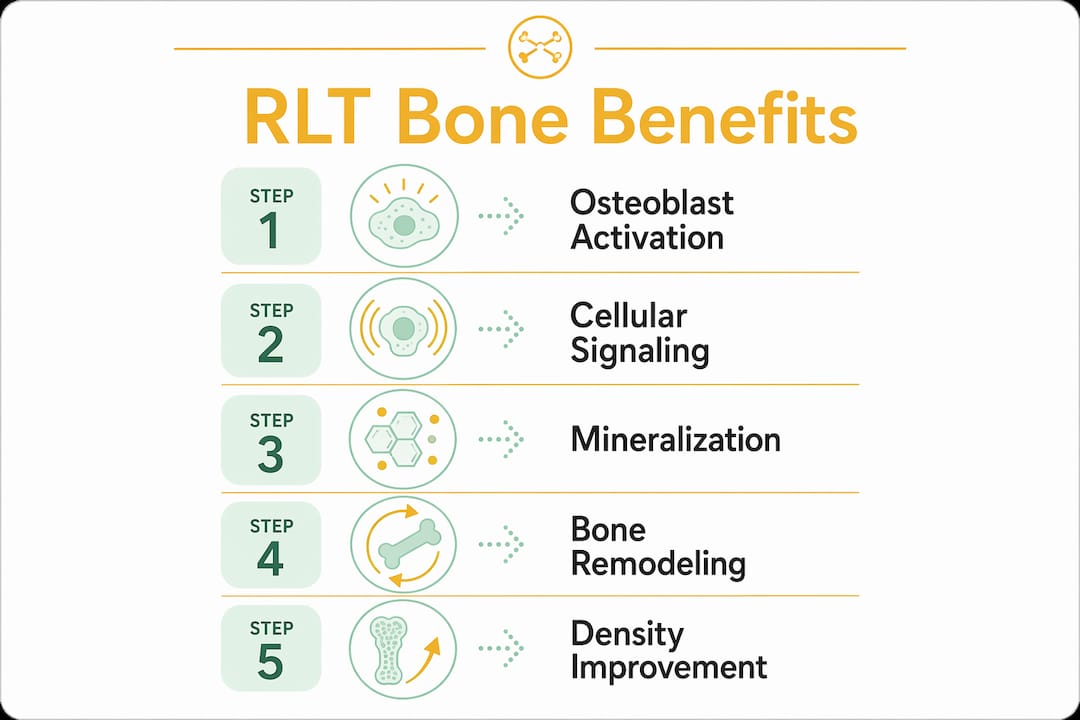
Red light therapy for bone density works by stimulating osteoblasts, the cells that build new bone, through a process called photobiomodulation (PBM). Near-infrared light around 850nm is able to penetrate through soft tissue to reach bone surfaces where it can stimulate cellular energy production. That extra cellular energy fuels collagen synthesis and mineral deposition, the two core steps in new bone formation.
The honest framing: RLT is a promising adjunct, not a replacement for standard osteoporosis care. Clinical evidence from human trials is still limited, though preclinical data is consistent and the biological mechanism is well-established. Expert consensus, including cautions from clinicians about device variability and dosing, places RLT firmly in the “complement your current treatment” category.
Key facts at a glance:
- Near-infrared wavelengths (~850nm) are preferred over standard red light for bone applications because of deeper tissue penetration
- RLT reduces inflammation and increases local circulation via VEGF-driven neovascularization, improving the bone repair environment
- Device quality varies widely; underpowered consumer panels may not deliver therapeutic doses to bone
- RLT should be combined with weight-bearing exercise, adequate calcium and vitamin D, and prescribed medications where indicated
- Changes in bone density typically require several months of consistent therapy before becoming detectable on scans.
What the science says about light therapy for bone health
The strongest evidence comes from preclinical models. A 2013 controlled study by Medalha et al. evaluated photobiomodulation’s effect on bone mineral density in ovariectomized rats, a standard model for post-menopausal osteoporosis. PBM-treated groups showed a significant increase in bone mineral density, improved trabecular architecture, and higher bone volume fraction. Results were dose-dependent, meaning optimal parameters mattered.
At the cellular level, in vitro studies show near-infrared light increases alkaline phosphatase and osteocalcin expression in osteoblasts, both markers of active bone formation. PBM also modulates osteoclast activity, reducing bone breakdown while simultaneously supporting bone building. Enhanced neovascularization via VEGF improves the local environment for mineralization and growth factor delivery.
| Study / Source | Wavelength | Model | Key Outcome |
|---|---|---|---|
| Medalha et al. 2013 | ~850nm NIR | Ovariectomized rats | Increased BMD, improved trabecular architecture |
| LED-PBM systematic review | 630–850nm near-infrared | In vitro osteoblasts | Upregulated ALP, osteocalcin (OCN), and improved calcium deposition |
| NIR phototherapy systematic review | ~850nm near-infrared | In vivo / in vitro | Deep tissue penetration; bone regeneration acceleration |
| Umbrella review of RCTs | 810–850nm near-infrared | Human RCTs | Significant PBM effects across musculoskeletal outcomes; moderate certainty |
The gap in the evidence is human RCTs specifically targeting osteoporosis prevention. Clinicians note that large-scale, high-quality trials are still needed before RLT can be considered a confirmed primary therapy for bone density. That said, the mechanism is well-characterized, and the preclinical data is unusually consistent for an emerging therapy.
Pro Tip: Device wavelength matters more than brand name. For bone applications, confirm your device emits near-infrared light at 810–850nm, not just visible red light at 630–660nm. Standard red light does not penetrate deeply enough to reach most bone tissue.
Benefits and safe use guidelines for osteoporosis patients
RLT offers several clinically relevant benefits for people managing osteoporosis or low bone density. Osteoblast activation is the primary mechanism, but the downstream effects extend further: reduced local inflammation, pain relief at fracture-prone sites, and accelerated fracture healing are all supported by the evidence base. For older adults who may be managing chronic pain alongside bone loss, the anti-inflammatory effect alone can improve quality of life and exercise tolerance.

The safety profile is genuinely favorable. Mild skin irritation and eye discomfort are the most commonly reported side effects. Protective eyewear is non-negotiable during sessions, since direct NIR exposure to the eyes carries real risk of damage. Beyond that, the risk profile for most adults is low.
Recommended protocol for bone density support:
- Wavelength: 850nm near-infrared
- Target areas: Lumbar spine, hip/femoral neck, and wrists (the three sites most vulnerable to osteoporotic fracture)
- Session duration: 15–20 minutes per target area
- Device distance: 4–8 inches from the skin
- Frequency: 5 sessions per week for the first 3 months, then 3–4 sessions per week for maintenance
- Always wear protective eyewear rated for NIR wavelengths
- Avoid broken or irritated skin in the treatment area until healed
Pro Tip: Consistency beats intensity. Missing sessions breaks the cumulative cellular signaling that drives bone remodeling. Set a fixed schedule and treat it like a medication, not an optional add-on.
Device quality is a real concern. Market variability in RLT device potency means many consumer panels deliver insufficient power density to reach bone tissue. Under-dosing produces no benefit; overdosing can inhibit cellular response or cause tissue damage. Both extremes are avoidable with calibrated, clinically supervised use.
How to integrate red light therapy into a bone-healthy lifestyle
RLT works best as one layer in a broader bone health strategy, not as a standalone fix. The foundational interventions remain weight-bearing exercise, adequate calcium and vitamin D intake, and prescribed medications such as bisphosphonates or teriparatide where a physician has indicated them. RLT complements these approaches by providing cellular-level support for bone remodeling that drugs and exercise alone do not directly address.
Practical integration strategies:
- Schedule RLT sessions on the same days as weight-bearing exercise to capitalize on the post-exercise bone remodeling window
- Confirm calcium and vitamin D levels with your physician before starting RLT, since mineralization requires adequate raw materials
- Track progress with DEXA scans at 6–12 month intervals; bone remodeling is slow and changes will not appear on earlier scans
- Discuss RLT with your prescribing physician before starting, particularly if you are on bisphosphonates or have active fractures
- Consider pairing RLT with vibration plate therapy or PEMF, both of which have independent evidence for bone health support
Local providers for bone density treatment near El Dorado Hills
Two providers in the greater Sacramento area serve El Dorado Hills residents seeking red light therapy for bone density improvement.
| Provider | Services Offered | Specialization | Positioning | Rating |
|---|---|---|---|---|
| Excel Medicine | Red light therapy, PEMF, hormone optimization, advanced biomarker labs, peptide therapy, IV therapy, medical weight loss | Physician-led longevity and regenerative medicine; comprehensive wellness | Personalized membership plans integrating biomarker data with RLT and hormonal care | 4.9★ (32 reviews) |
| OsteoStrong Rancho Cordova East | Osteogenic loading (Spectrum Circuit), red light therapy, PEMF mats, vibration plates, BioCharger, hydromassage | Bone density and balance improvement; technology-driven bone health | Weekly sessions using patented loading devices alongside adjunctive modalities | 5★ (25 reviews) |
Excel Medicine is a physician-led clinic serving El Dorado Hills and the surrounding area, combining advanced biomarker labs with red light therapy inside personalized membership plans priced from $99 to $325+ per month. The integration of hormone optimization and RLT in a single program suits patients whose bone loss is tied to hormonal changes, particularly post-menopausal women or those on androgen deprivation therapy.
OsteoStrong Rancho Cordova East takes a different approach. Its core offering is osteogenic loading via patented Spectrum Circuit devices, which apply brief, high-magnitude forces to the skeleton to stimulate bone growth. Red light therapy, PEMF mats, and vibration plates are available as adjunctive modalities within the same visit. For patients whose primary goal is bone density improvement rather than broader longevity optimization, the focused, bone-first model at OsteoStrong Rancho Cordova East is the stronger fit.
Risks and contraindications specific to bone density treatment
Most adults tolerate RLT well, but specific situations warrant caution. Active malignancy near the treatment site is a firm contraindication; NIR light promotes cell proliferation and increased local circulation, which could theoretically accelerate tumor growth. Patients with a history of bone cancer or metastatic disease should not use RLT over affected areas without explicit oncologist approval.
Photosensitizing medications, including certain antibiotics (tetracyclines, fluoroquinolones) and some diuretics, increase sensitivity to light exposure and raise the risk of skin reactions. Anyone taking these drugs should consult their prescribing physician before starting RLT. Patients with active skin conditions, open wounds, or recent surgical sites in the target area should wait until the tissue has fully healed.
Pregnancy is generally listed as a precaution rather than an absolute contraindication, but clinical guidance on RLT during pregnancy is limited. The conservative approach is to avoid treatment over the abdomen and lower back until more data exists. For older adults with pacemakers or implanted electronic devices, check with the device manufacturer before using high-power NIR panels at close range.
What the FDA says about red light therapy for bone health
The FDA has cleared specific red light and near-infrared devices for pain relief, wound healing, and adjunctive musculoskeletal applications under the 510(k) pathway. Cleared devices have demonstrated safety and substantial equivalence to predicate devices, but FDA clearance is not the same as FDA approval for treating osteoporosis specifically. No RLT device currently carries FDA approval as a primary treatment for osteoporosis or low bone mineral density.
The distinction matters practically. A cleared device used in a clinical setting has passed safety review; an uncleared consumer device has not. When choosing a provider or purchasing a home device, confirm the device has FDA clearance for a relevant indication. The Cleveland Clinic and Stanford Medicine both characterize RLT as an emerging therapy with genuine biological evidence, while noting that more large-scale clinical trials are needed before it enters standard treatment guidelines for bone conditions.
Osteostrong’s approach to bone density in El Dorado Hills
If you are looking for a program built specifically around bone density, Osteostrong offers something the typical wellness clinic does not: a weekly osteogenic loading session using patented Spectrum Circuit devices, designed to deliver the mechanical stimulus that drives bone growth, combined with red light therapy, PEMF mats, vibration plates, and BioCharger sessions under one roof.

The model is straightforward. You come in once a week for a brief osteogenic loading session, then layer in adjunctive therapies like red light and PEMF at the same visit. For El Dorado Hills residents who want a bone-focused wellness program that goes beyond a single modality, Osteostrong Rancho Cordova East is the closest option with that specific combination. Learn more about the full range of bone health therapies available to support your treatment plan.
Key Takeaways
Red light therapy for bone density works through osteoblast stimulation and enhanced mineralization, but requires consistent near-infrared dosing at 810–850nm over 6–12 months to produce measurable DEXA scan changes.
| Point | Details |
|---|---|
| Wavelength specificity | Use 850nm near-infrared, not standard red light; only NIR penetrates deeply enough to reach most bone tissue. |
| Treatment protocol | Apply 15–20 minutes per target area, 4–8 inches from skin, 3–5 sessions per week for sustained effect. |
| Timeline for results | Bone remodeling is slow; allow 6–12 months before reassessing with a DEXA scan. |
| RLT is adjunctive | Combine with weight-bearing exercise, calcium, vitamin D, and prescribed medications for best outcomes. |
| Local option | Osteostrong Rancho Cordova East pairs weekly osteogenic loading with red light therapy and PEMF for a bone-focused program. |