
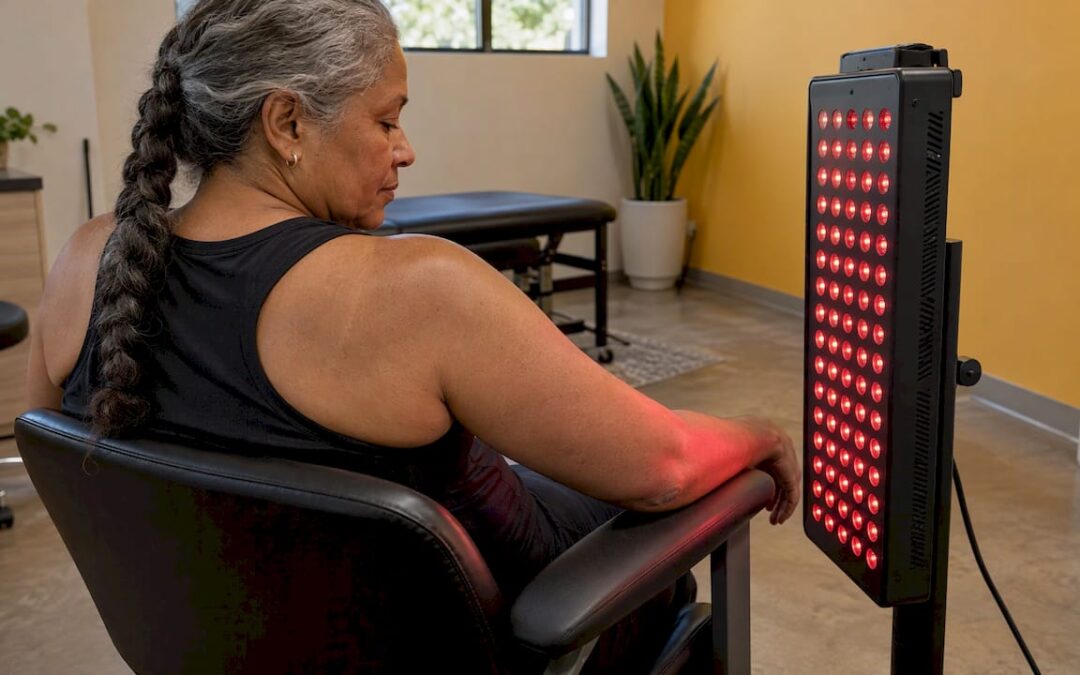
Red light therapy, also called photobiomodulation, has been tested in human trials as a way to reduce tendon pain and support function, and it appears to work best as a partner to a progressive exercise plan rather than a stand-alone fix. If you have osteopenia or osteoporosis, that pairing matters: the same kind of controlled loading that rehabilitates tendons is also what your bones respond to. This guide walks through what the studies measured, which doses and schedules they used, what to ask before you start, and how red light fits next to weekly bone loading.
TL;DR
- Human trials of red and near-infrared light on tendinopathy mostly measure pain and function, and a 2021 review of 17 randomized trials found it may be useful alone or alongside exercise.
- Pooled lower-limb data showed pain reductions of about 13 mm on a 100-mm scale, and about 18 mm when light was added to exercise.
- Dose, wavelength and schedule matter. Studies varied widely, so a consistent, supervised protocol beats guesswork.
- Tendons respond to load. Exercise stays the foundation, and red light is an add-on to it.
- With low bone density, you can combine red light sessions with weekly osteogenic loading. Sudden severe pain, a pop, or inability to bear weight needs a doctor first.
Table of Contents
- What red light therapy is doing in a tendon
- What human studies show
- Dose, wavelength and schedule: why the details matter
- Exercise first, light as the partner
- Osteopenia and osteoporosis: what changes for you
- Where to apply light, and where not to
- Perspective
- Making red light part of a weekly routine
- A simple plan to bring to your appointment
- FAQ
- Sources
What red light therapy is doing in a tendon
Red light therapy uses low-intensity red and near-infrared light, delivered by lasers or LED panels, to deliver energy to tissue without heating it enough to burn. Researchers describe the proposed mechanism as light being absorbed by an enzyme in the cell’s energy machinery, cytochrome c oxidase. A 2022 review of low-level laser therapy in tendon repair describes this as the first step in a chain that may influence inflammation, collagen production and cell activity.
Why does this matter for tendons? They have a limited blood supply compared with muscle, so they heal slowly and often stay sore for months. Any approach that may support the repair environment while you rebuild strength is of interest to people who have been stuck with an Achilles, elbow, shoulder or knee tendon problem.
A note on terms: tendonitis implies inflammation of a tendon, while tendinopathy is the broader word clinicians and researchers use for a tendon that is painful, thickened and not coping with load. Studies use the second term, and so does this article.
What human studies show
The most useful way to read the research is to ask what was actually measured. Almost all human trials measure pain and function, because those are what patients feel. Few can measure the tendon’s internal structure directly.
Pain and function in tendinopathy
A 2021 systematic review in BMC Sports Science, Medicine and Rehabilitation pooled 17 randomized trials with 835 people with tendinopathy. Its authors concluded that red and near-infrared light may be useful as a stand-alone or exercise-adjunctive treatment, with evidence ranging from very low to moderate quality for pain and function.
A 2022 meta-analysis of lower-extremity tendinopathy (think Achilles, patellar tendon, plantar fascia) reported pain reductions of 13.15 mm on a 100-mm visual scale when treatment finished, and 12.56 mm at 4 to 12 weeks afterward. When laser at a recommended dose was added to exercise and compared with exercise alone, the extra pain reduction was 18.15 mm at completion and 15.90 mm at 4 to 9 weeks.

For the shoulder, a 2019 review of photobiomodulation in shoulder tendinopathy found that 11 of 15 studies addressing pain favored light therapy. After setting aside studies that used doses below the World Association for Photobiomodulation Therapy recommendations, 10 of 11 reported statistically significant pain reduction. The lesson is practical: dose is not a detail.
Can it rebuild a torn tendon?
This is the question behind “can red light therapy rebuild tendons?” and the honest answer is that human trials look at how people feel and move, not at rebuilt tissue under a microscope.
In a 2022 randomized trial of 34 men with an acute Achilles rupture treated without surgery, those who received light therapy alongside conservative care had lower walking pain at weeks 12 and 16 than the comparison group.
The regeneration signals come from the laboratory. A 2026 systematic review of 36 preclinical studies reported improved inflammatory markers, collagen ratios and load-bearing strength in animal and cell models. Those findings explain why researchers are interested, and they are a reason human research continues, but they describe lab models rather than people.
So a fair summary for a reader: red light is studied as a way to help you hurt less and move better while the tendon is rehabilitated. It is not a substitute for protecting a torn tendon, and a suspected tear needs a clinician to examine it.
Dose, wavelength and schedule: why the details matter
If you have ever read a product page promising results from “10 minutes a day,” the studies suggest the picture is more specific than that.
- Wavelength: The tendon-repair review describes commonly studied wavelengths of roughly 600 to 1,000 nm, mostly in the near-infrared range, which penetrates deeper than visible red.
- Dose: The 2021 review found near-infrared doses of 0.5 to 5 J/cm² across its trials, while the 2022 tendon review describes doses of 3 to 10 J/cm². A joule per square centimeter is a unit of energy delivered to a patch of skin, so it depends on both power and time.
- Schedule: In the Achilles rupture trial, a combined device (904-nm laser, 858-nm infrared diodes and 658-nm red diodes) was used twice weekly for eight weeks during immobilization, followed by twice-weekly rehabilitation for 12 weeks.
- Coverage and time: Authors of a 2022 musculoskeletal photobiomodulation review stress that wavelength, dose, exposure time and area covered all influence outcome. They describe a dose-response window, where too little may do nothing and too much may blunt the effect, rather than a single prescription for everyone.
The 2021 review also notes that many trials reported their treatment variables incompletely, and that specific clinical protocols are not yet standardized. In plain terms: the settings you see in a forum thread are not a validated prescription. Consistent sessions, correct distance from the device and a known output are what make a protocol repeatable. If you want to understand dose in more depth, see our guides to red light therapy dosage for bone health and photobiomodulation benefits and dosage.
How long until you notice a change?
No single timeline fits every tendon. Trials generally ran for several weeks, such as the eight-week treatment phase described above, and tendons are slow tissue, so changes in how a tendon feels are usually judged over weeks rather than days. If you are not improving after a reasonable stretch of consistent work, or you are getting worse, that is the moment to have the tendon assessed rather than to add more sessions.
Exercise first, light as the partner
The strongest message in the research is that tendons need load. The 2021 review identifies load management and heavy strength and plyometric training as important in managing tendinopathy, and presents light therapy as a possible adjunct to exercise rehabilitation.
A 2020 living systematic review of 29 Achilles treatment trials concluded that active treatment appeared preferable to wait-and-see for midportion Achilles tendinopathy, and presented calf-muscle exercise as a practical starting option.
That is good news if you have thin bones, because progressive loading is also what your skeleton responds to. A practical way to think about it:
- Keep moving the tendon under guided load. A physical therapist or physician can set the exercise for your specific tendon.
- Add red light on a regular schedule so that the tendon gets consistent exposure while you build strength.
- Keep bone loading in the week. Strong bones and strong tendons are built by the same principle: brief, well-controlled force.
Timing around exercise is a common question. We cover it in red light therapy before or after a workout.
Osteopenia and osteoporosis: what changes for you
Tendon trouble and low bone density often show up together, because both become more common with age and with less activity. Two points are worth keeping in mind.
Protect your bones while you rehab. Heavy, uncontrolled exercise is not the answer when you have osteoporosis. The goal is progressive, supervised loading at a level your skeleton and tendon can handle. Our overview of weekly osteogenic loading for osteoporosis explains how a short weekly session is structured, and what the evidence says about osteogenic loading covers the research.
Know who should avoid red light. The 2022 musculoskeletal review lists active carcinoma and infection as contraindications, and says the abdomen, chest and pelvis should be avoided during pregnancy. It also cautions that broad safety statements are not proof of zero risk for every device or every patient. Eye protection matters too, which we explain in red light therapy and your eyes. If you take medicines that make skin sensitive to light, or have a condition you are unsure about, speak to your doctor before starting. Our contraindications guide lists the groups in more detail.

When to see a doctor first
Get a medical evaluation rather than starting any therapy if you have a sudden sharp pain, a pop or snap, visible bruising or a gap in the tendon, swelling that rises quickly, or you cannot put weight on the leg or lift the arm. With osteoporosis, sudden pain after a minor fall can also mean a fracture, which needs imaging, not a light panel. Also see your doctor if pain wakes you at night, or if tendon pain has not eased after several weeks of sensible activity changes.
Where to apply light, and where not to
People also ask where red light should not be placed. From the safety sources above, the practical rules are:
- Do not shine it into your eyes, and wear the goggles supplied for the device.
- Do not use it over a known active cancer or an area of infection.
- If you are pregnant, avoid the abdomen, chest and pelvis.
- Keep to the dose and time you were given. More is not better, because of the biphasic response described in the research: both too little and too much can reduce the effect.
- Stop and get advice if skin becomes irritated or pain increases.
For what a session looks like in practice, see red light therapy sessions with osteogenic loading, and for what people report, red light therapy before and after.
Perspective
Most people who ask us about red light and tendons are really asking a bigger question: how do I keep moving without hurting my bones or my joints? Our answer starts with load. Tendons and bones both get stronger when they are challenged briefly, safely and consistently, and that is the thinking behind everything we do.
Our clients come in once a week for osteogenic loading, a short supervised session designed to stimulate bone growth. Around that, we offer red light therapy and other recovery tools, including PEMF mats, compression therapy, vibration plates and hydromassage lounges. We like red light because the human research on pain and function is encouraging, and because it fits easily next to the weekly work of building strength.
What we care about is a routine you can repeat. A protocol that is supervised, steady and matched to your situation will serve you better than a device on a shelf and a guess at the dose. If you have osteopenia or osteoporosis, bring tendon pain into the same conversation as your bone health, and let your doctor rule out anything that needs medical attention first.
Aaron
Making red light part of a weekly routine
At our centers in Rancho Cordova, El Dorado Hills and Granite Bay, we offer red light therapy alongside osteogenic loading, our non-pharmaceutical protocol built around one brief supervised session per week. If you are managing low bone density and want your recovery tools and your bone work in one place, that combination is what we designed the visit around. You can see the centers and the loading program at Osteogenic Loading.
If you want to understand the bone side first, our pages on osteogenic loading results and red light therapy for bone density are good starting points. For joint-related questions, read red light therapy for arthritis and bone health and why dose and supervision matter for inflammation.
A simple plan to bring to your appointment
If you are deciding whether red light belongs in your tendon recovery, these questions keep the conversation concrete:
- Has a clinician confirmed the diagnosis, and ruled out a tear or a stress fracture?
- What exercise progression is right for this tendon and for my bone density?
- What wavelength, dose and schedule will the sessions use, and how long before we review how the tendon feels?
- Which areas should be avoided given my health history and medicines?
- How will we track progress, for example pain on a 0 to 10 scale, walking distance or the ability to climb stairs?
Writing your pain score and a simple function measure down before the first session gives you something real to compare against after several weeks.
FAQ
Can red light therapy help tendonitis?
Human trials suggest it can reduce tendon pain, especially when added to exercise. A 2022 meta-analysis found pain reductions of roughly 13 mm on a 100-mm scale in lower-limb tendinopathy. The research is strongest for pain and function, so pair sessions with a guided strengthening plan.
Can red light therapy rebuild tendons?
Laboratory and animal studies report better collagen organization and tendon strength after light treatment, which is why researchers keep studying it. In people, trials mainly measure pain and function. For a torn tendon, a clinician needs to guide treatment, and light therapy is considered as an addition.
How long does it take for red light therapy to work on tendonitis?
Trials typically ran for several weeks, such as twice-weekly sessions over eight weeks in one Achilles study. Tendons are slow tissue, so judge change over weeks. If you are getting worse or see no change after consistent work, have the tendon reassessed.
Where should you not put red light therapy?
Keep it away from your eyes and from areas with active cancer or infection. During pregnancy, avoid the abdomen, chest and pelvis. Follow the dose and time you were given, and ask your doctor if you take light-sensitizing medicines.
Is red light therapy safe with osteoporosis?
Osteoporosis is not listed among the contraindications in the safety review we used. Your tendon pain after a minor fall could signal a fracture, though, so get a medical evaluation for sudden or severe pain before starting any therapy.
Sources
- The effect of low-level red and near-infrared photobiomodulation on tendinopathy, BMC Sports Science, Medicine and Rehabilitation, 2021
- Efficacy of low-level laser therapy in patients with lower-extremity tendinopathy, 2022
- Photobiomodulation reduces pain in patients with shoulder tendinopathy, 2019
- Photobiomodulation associated with conservative treatment in acute Achilles tendon rupture, 2022
- Photobiomodulation enhances tendon regeneration: a systematic review of preclinical studies, 2026
- The functions and mechanisms of low-level laser therapy in tendon repair, 2022
- Low-intensity laser and LED (photobiomodulation therapy) in musculoskeletal disorders, 2022
- Which treatment is most effective for patients with Achilles tendinopathy? A living systematic review, 2020
Trackbacks/Pingbacks