
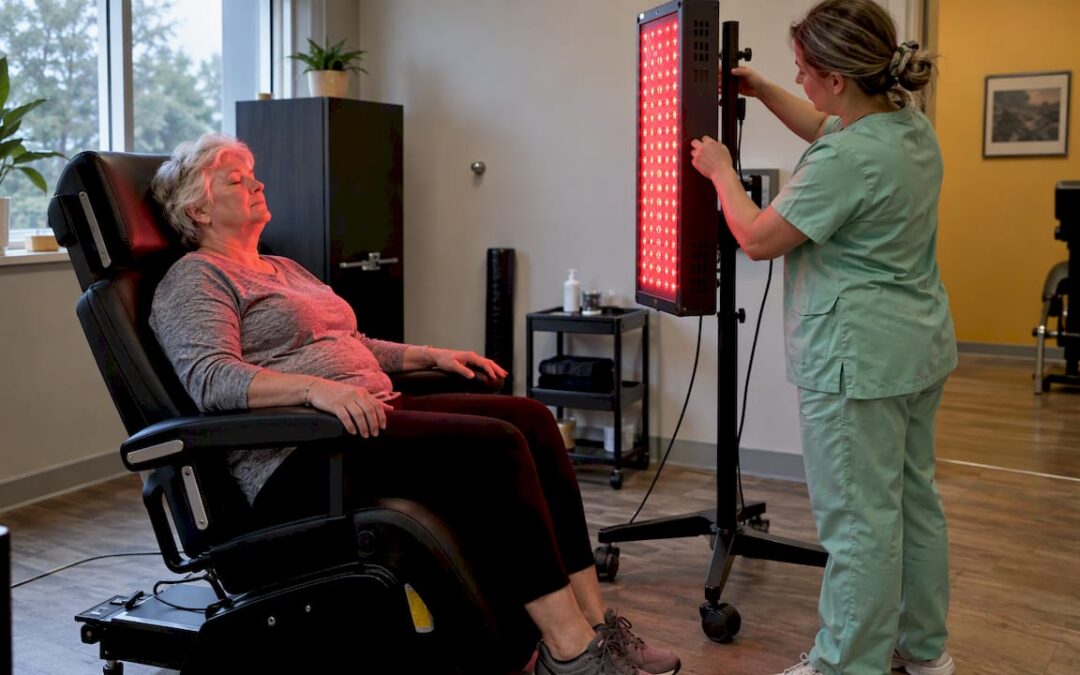
Red light tends to be less disruptive to your circadian rhythm than blue or white light, which makes it a reasonable choice for the hour before bed. It is not a proven sleep inducer: clinical trials show subjective improvements for many people but mixed results on objective measures like sleep onset and total sleep time. One important consideration is intensity: at high levels, red light can still suppress melatonin, so dimming it is recommended for safety.
TL;DR:
- Red light suppresses melatonin significantly less than blue or white light at typical low intensities, making it a gentler evening option.
- High-intensity red light can still inhibit melatonin and may cause increased alertness or negative mood in some individuals.
- Using red light 60 to 120 minutes before bed for 20 to 30 minutes may improve perceived sleep quality, but objective sleep improvements are inconsistent.
- Brightness control is critical, as red light at high levels can resemble blue light’s disruptive effects, and devices should have adjustable settings.
- Red light is best used as part of a broader wind-down routine, with supervision and proper timing to reduce risks and maximize potential benefits.
Table of Contents
- What the science says: trials, mechanisms, and biomarkers
- How red light compares to blue, white, and other colors for evening use
- How to use red light safely and effectively
- Limitations, harms, and contraindications
- Practical evening routines and a device-selection checklist
- OsteoStrong clinical perspective and proof points
- Where red light fits among sleep tools
- Our supervised red-light therapy and osteogenic loading sessions
- FAQ
- Sources
What the science says: trials, mechanisms, and biomarkers
Your circadian clock reads light through specialized cells in the retina called intrinsically photosensitive retinal ganglion cells, or ipRGCs. These cells are most sensitive to short wavelengths, the blue end of the spectrum, which is why a phone screen at 11 p.m. does more to delay sleep than a dim lamp. Red light sits at the opposite end of the visible spectrum, and ipRGCs respond to it far more weakly. That difference in receptor sensitivity is the physiological basis for treating red light as a gentler option in the evening, according to mechanistic research on wavelength-dependent melatonin responses.

The clinical picture is more mixed than the mechanism alone suggests. A controlled study of pre-bed red-light exposure found that one-hour sessions produced different effects depending on the group and the dose: some participants fell asleep faster, while others experienced more microarousals and reported worse mood during the night, showing variability in response to red light exposure according to a study on red light’s effects on sleep and mood. That same research found results depended heavily on individual variability and on how light exposure interacted with mood, not just on wavelength.
A separate randomized, sham-controlled trial tested a near-infrared and red-light collar worn on the neck, used every other night for a short daily session in the hour before bedtime over several weeks. Participants reported better relaxation and perceived sleep quality, but actigraphy, the objective measure of movement and sleep patterns, showed no meaningful difference between the active and sham groups, according to the randomized sham-controlled NIR trial. That gap between how people feel and what a tracker records shows up repeatedly in this research.
Biomarkers help explain part of the picture:
- Melatonin: blue light reliably suppresses nighttime melatonin, while red light at typical low intensities does not significantly change it, based on comparative wavelength research.
- Cortisol and alpha-amylase: both blue and red light can influence these stress-related markers under certain exposure conditions, though the pathways differ from melatonin regulation.
- Skin-level effects: red and near-infrared light applied to skin may work through non-visual mechanisms like localized warming and nitric oxide release rather than through the eyes at all.
Red light suppresses melatonin far less than blue light at matched, commonly used brightness levels, according to research on wavelength-dependent melatonin suppression. That single finding is the strongest, most consistent piece of evidence in this field. What remains preliminary is whether that biological advantage translates into dependably better sleep for most people, since the trials above show real variation in outcomes and sample sizes have generally been small.
How red light compares to blue, white, and other colors for evening use
Not all light is equal in the hours before bed, and the differences are large enough to change your evening habits. Blue light is the most disruptive: it strongly suppresses melatonin and produces an alerting effect that works against your body’s wind-down signals. Screens, overhead LEDs, and most “daylight” or “cool white” bulbs carry a heavy blue component, which is why public health guidance consistently flags blue wavelengths as the one to avoid closest to bedtime, per archived CDC and NIOSH guidance on light and circadian effects.
White light’s impact depends entirely on its composition. A “warm white” bulb with less blue content behaves more gently than a cool white or daylight-balanced bulb at the same brightness, so the label on the box matters less than the actual spectral mix and how bright the room feels.
Red light tends to have the weakest effect on melatonin among common light colors, but that advantage is conditional on intensity, not guaranteed by color alone. At high output, red light can still suppress melatonin in controlled studies, meaning a bright red light is not automatically safe just because it isn’t blue.
A few practical comparisons for the evening window:
- Blue and cool white light: strongest alerting effect, avoid in the hour or two before bed.
- Standard warm white light: moderate impact, better than blue but still worth dimming.
- Dim red or amber light: among the gentlest options for melatonin at low brightness.
- Green light: generally low impact at dim settings, a reasonable alternative to red where red isn’t available.
The practical rule that falls out of this comparison is simple: color matters, but brightness is the variable you control most easily, and it often matters more.
How to use red light safely and effectively
If you want to test red light as part of your evening routine, a short trial with clear parameters works better than open-ended use. Most of the research behind this guidance comes from small, short trials, so treat the numbers below as a starting protocol rather than a fixed prescription.
- Time it right. Start your red-light exposure roughly 60 to 120 minutes before your target bedtime, giving your body a transition window instead of a hard light switch into darkness, a timing window supported by practical guidance from UAB.
- Keep sessions short. Aim for about 20 to 30 minutes per session, used nightly or every other night, which matches the duration used in several clinical trials.
- Trial it for 2 to 4 weeks. Short exposures rarely show results after one or two nights, so give the routine a few weeks before judging whether it helps, tracking changes the whole time.
- Choose longer wavelengths. Devices studied in human trials generally fall in the 600 to 700-plus nanometer range for red light, with near-infrared devices (roughly 700 to 1,100 nm) working through different, deeper tissue mechanisms rather than through the retina.
- Keep intensity low. Perceived brightness is your simplest safety cue: if the light feels glaring or hard to look near, it’s too bright. High-intensity red light exposure has been shown to reduce melatonin in some studies, so dimmer is better for a circadian-hygiene goal.
- Avoid direct eye exposure. Position the device so light reaches the room or your skin rather than shining straight into your eyes, especially with higher-powered panels.
- Track your results. Keep a short sleep diary noting time to fall asleep, number of nighttime wakings, and a simple 1 to 5 rating of how rested you feel, so you have real data instead of a vague impression after a month.
Pro Tip: If you’re not sure whether your device is too bright, sit a few feet away for five minutes before your first full session; if it feels like something you want to look away from, dim it or move it farther from your face.
Limitations, harms, and contraindications
Red light is not a reliable sleep inducer, and it’s worth being honest about why. Part of what people experience as a benefit may simply be the result of replacing a brighter, bluer light source with something gentler, rather than red light actively promoting sleep on its own. The study on red light, sleep, and mood found that some participants showed increased alertness and more negative mood after red-light exposure, a reminder that individual response varies and that more light in the evening, even red light, is not automatically restful for everyone.
The bigger physiological risk is intensity. High-intensity red light can still suppress melatonin in some exposure conditions, which means wavelength alone doesn’t guarantee a hormone-neutral effect.
A few groups and situations call for extra caution:
- People taking photosensitizing medications (certain antibiotics, acne treatments, or other drugs that increase light sensitivity) should check with a prescriber before regular red-light use.
- Anyone with an existing eye condition, especially retinal disease, should get guidance from an eye doctor before using bright or close-range red-light devices.
- Pregnant individuals should mention any new light therapy to their provider, since most trials have not studied this population specifically.
- If you notice new headaches, eye strain, or worsening sleep after starting red light, stop and consult a sleep clinician.
Lights, including red ones, should go off once you’re actually trying to sleep. Continuous overnight exposure hasn’t been studied as a safe practice and runs against the basic principle that darkness remains the best condition for sleep, according to the Sleep Foundation’s explainer on red light and sleep.
Practical evening routines and a device-selection checklist
Building red light into your evening works best as one piece of a broader wind-down routine rather than a standalone fix.
Sample routine 1, the minimalist version: Switch off overhead lights and screens 90 minutes before bed, turn on a single dim red lamp in the room, and read or stretch under it until 20 to 30 minutes before you turn off the lights entirely.
Sample routine 2, the tech-assisted version: Set phone and tablet screens to night mode two hours before bed, use a red desk lamp for the last hour while doing a wind-down task, and track sleep quality with a basic diary for four weeks to see if the pattern helps.

Sample routine 3, the combined relaxation version: Pair a 20-minute red-light session with a calming ritual, such as a warm shower or a few drops of a relaxation-focused essential oil blend, then move to a dark bedroom for sleep itself.
When choosing a device, a short checklist helps separate a reasonable option from marketing noise:
- Confirm the wavelength is published, ideally in the 600 to 700-plus nm range used in sleep-related studies, not just described as “red.”
- Check whether brightness or irradiance is adjustable, since dimming is your main safety lever.
- Look for FDA clearance information rather than relying on general wellness claims; clearance for a specific use is different from a generic “FDA-registered facility” claim.
- Confirm the device has a timer or auto-shutoff so you’re not tempted to leave it running overnight.
- Check the return policy, since a two to four-week trial is the only way to know if a given device works for you.
A simple self-test: sit near the device for five minutes before your first real session. If the light still feels bright, uncomfortable, or alerting rather than calming, dim it, move it farther away, or choose a lower-intensity setting before continuing.
- Avoid devices with no published wavelength or power specs.
- Avoid high-powered panels marketed primarily for skin or pain treatment if your goal is evening relaxation; intensity suited for tissue treatment is often too bright for a pre-sleep routine.
OsteoStrong clinical perspective and proof points
We offer red light therapy as one part of a supervised, in-clinic wellness program rather than as a standalone sleep treatment. We pair it with osteogenic loading, PEMF mats, compression therapy, and other modalities, and sessions happen under staff supervision rather than through unsupervised home use.
That supervision matters for the specific caution raised earlier: intensity, not just color, determines whether red light affects melatonin. In a clinic setting, dosing and session length are set by staff rather than left to a member guessing at settings on a home device, which reduces the risk of high-intensity exposures linked to melatonin suppression.
A few things worth knowing if you’re considering red light through a supervised program:
- Members can review dosage guidance for red light therapy to understand how session length and frequency are set.
- We document real before-and-after outcomes from members using red light alongside our core bone-density programs.
If you’re weighing red light for sleep or general wellness, our staff can review your health history and current medications during a visit to flag anything that calls for extra caution, rather than leaving that assessment to a device manual.
Where red light fits among sleep tools
If you’re chasing better sleep, red light is a reasonable adjunct, not a starting point. Darkness, a consistent sleep schedule, and genuinely cutting blue light exposure in the evening do more heavy lifting than any colored bulb, and the trial evidence on red light backs that ordering: benefits show up more reliably in subjective reports than in objective sleep measures.
Where red light earns its place is as a low-friction swap. If you’re already going to have a lamp on, choosing a dim red one over a bright white one is close to a free upgrade. Treat it as an experiment: run it for a few weeks, track real data instead of vague impressions, and loop in a sleep clinician if nothing changes. The honest expectation is modest improvement for some people, not a fix for insomnia.
— Aaron
Our supervised red-light therapy and osteogenic loading sessions
Many people try red light on their own and end up guessing at brightness, timing, and session length. We take that guesswork out of the equation: our red-light sessions run under staff supervision, set to appropriate intensity and duration, and integrated with osteogenic loading, the core service we built our centers around for building bone density and overall skeletal health.

If sleep and recovery are part of why you’re interested in red light, our sessions also sit alongside PEMF mats, compression therapy, and other recovery-focused equipment in the same visit.
- Sessions are supervised, so intensity and timing are set by staff rather than left to a home device’s settings.
- We can flag relevant contraindications specific to your health history before your first session.
- Red light pairs naturally with our weekly osteogenic loading visits, so you’re not adding a separate appointment to your week.
Visit our osteogenic loading program page to learn more or find a center near you and get started.
This article is general information, not a substitute for advice from a qualified doctor. Consult a qualified healthcare professional about your own circumstances before acting on anything here.
FAQ
Is red light good for sleeping?
Red light is generally gentler on your circadian rhythm than blue or white light, since it suppresses melatonin far less at typical low intensities, according to wavelength-dependent research on melatonin. It works best as a low-disruption evening option rather than a guaranteed way to fall asleep faster.
What is the downside of red light therapy?
At high intensity, red light can still suppress melatonin, and some trial participants have reported increased alertness or worse mood after exposure rather than better sleep, per research on red light’s effects on sleep and mood. Objective sleep measures in these trials have also been mixed, so benefits aren’t guaranteed for everyone.
Which color light is best for sleep?
Dim red or amber light tends to have the weakest effect on melatonin among common light colors, while blue and cool white light have the strongest alerting and suppressive effects, according to archived CDC and NIOSH light guidance. Darkness itself remains the best condition for sleep, with dim red serving as a lower-impact option when some light is needed.
How long should you use red light before bed?
Clinical trials generally used sessions of about 20 to 30 minutes, started roughly 60 to 120 minutes before bedtime, based on guidance summarized by UAB News. Lights, including red ones, are typically turned off well before you actually try to fall asleep rather than left on overnight.
Sources
- Light exposure and melatonin suppression: wavelength-dependent responses (PMC12113466)
- High-intensity red light suppresses melatonin