
Isometric exercises, where you tighten a muscle and hold still instead of moving a joint, are a gentle, low-risk way to build strength when you have osteoporosis or osteopenia. They are a good starting point. For bone itself, the research asks for more: short, intense loading, repeated on a steady schedule and varied over time. This guide shows you which holds to try, how long to hold them, what to avoid, and how to pair them with a routine that is aimed at your bones.
TL;DR
- Isometric exercises are muscle contractions held without movement. Mayo Clinic Press lists them as a gentler form of resistance training when heavy lifting is unsafe.
- A small trial in postmenopausal women with low bone mass found isometric work improved muscle strength and a bone-formation marker, but it did not measure bone density.
- Keep holds short and moderate (3 to 4 seconds is a common recommendation), breathe throughout, and skip forward bending and twisting.
- Isometrics work best inside a routine that also includes weight-bearing, balance and posture work, plus supervised loading aimed at the skeleton.
- If you have had a spinal fracture or have advanced bone loss, have your doctor or physical therapist approve the exercises first.
Table of Contents
- What “isometric” means, and why it suits fragile bones
- What the research says about isometrics, strength and bone
- Isometric exercises to try
- How long, how hard, how often
- Safety: what to avoid
- Where isometrics fit in a complete routine
- A weekly session built for bone
- Our perspective
- FAQ
- Sources
What “isometric” means, and why it suits fragile bones
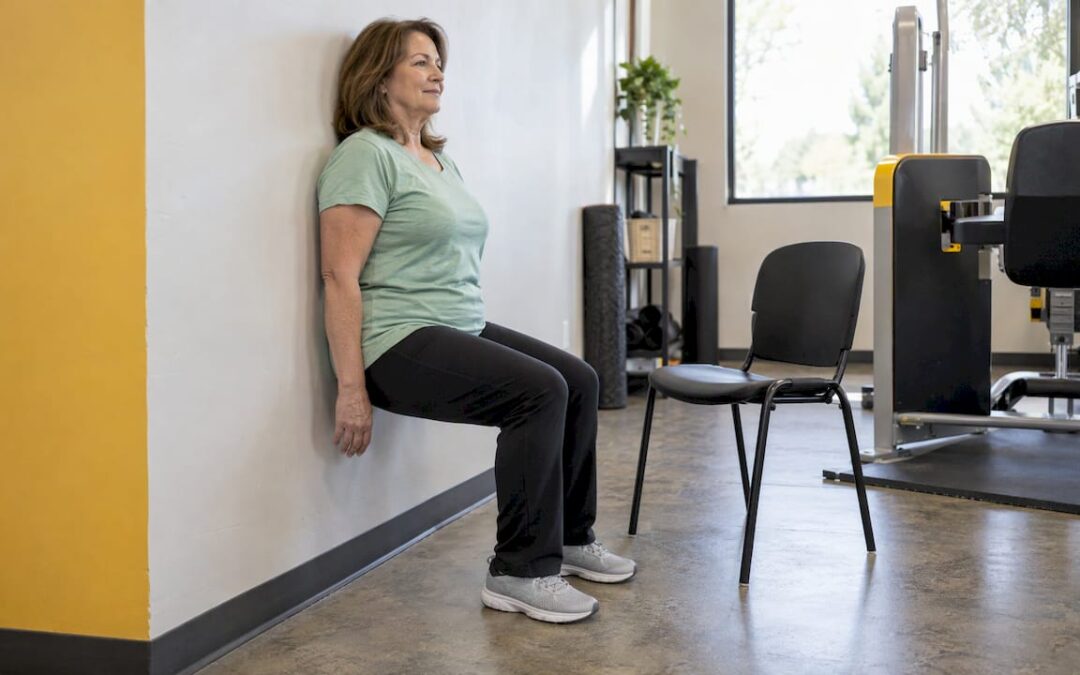
In most exercise, a muscle shortens and lengthens as a joint moves: a squat, a biceps curl, a step-up. In an isometric exercise the muscle contracts but the joint stays put. Pressing your palms together in front of your chest is isometric. So is pushing your back against a wall and holding a partial squat.
That matters with osteoporosis for three reasons:
- No bouncing or twisting. The movements most likely to stress a weakened spine are forward bending and rotation. A hold takes both out of the picture.
- Easy to scale. You choose how hard to push, so you can start very light and add effort over weeks.
- Joint-friendly. A review by Skelton and Mavroeidi recommends isometric work in the early stages of strength training to keep tension on the joints low.
The Mayo Clinic names strength training, weight-bearing aerobic activity, flexibility, and stability and balance work as the activities often recommended for people with osteoporosis. Isometrics sit in the first of those groups.
What the research says about isometrics, strength and bone
Be clear on what you are buying with your time. Isometrics have a documented effect on strength. Their effect on bone density is much less established.
The best-known trial is a 2000 study by Swezey and colleagues. Postmenopausal women with osteopenia or osteoporosis did about 10 minutes a day of progressive isometric exercise for eight weeks: 5-second maximum contractions against an inflatable ball held with straps. They got significantly stronger in the neck extensors, hand grip, elbow flexors, thighs and trunk extensors. A blood marker of bone formation (bone alkaline phosphatase) rose, while a marker of bone breakdown did not change. That is encouraging biology, but it is a marker, not a scan result.
A 2026 German-language-region fracture prevention guideline, summarized in Exercise for fracture prevention, takes a careful position. It recommends that exercise meant to improve bone strength be dynamic, and that when isometric work is used, short but intense stimuli be preferred. It also advises varying how hard and how fast you load, with high-intensity periods interrupted by lighter ones, and it found no evidence that you must train to muscle failure to benefit your bones.
The practical reading:
- Use isometrics to build muscle strength, steadiness and confidence.
- When you want to give bone a stronger signal, make the effort short and intense rather than long and mild.
- Do not rely on isometrics alone for bone density.
Why does load matter at all? The American Academy of Orthopaedic Surgeons explains that the force of gravity on bone activates bone cells to strengthen weaker areas, which is why regular weight-bearing exercise helps prevent further loss. Muscles pulling on bone provide a similar signal, which is the logic behind resistance work. MedlinePlus says the same: to build bone density, exercise must make muscles pull on bones.
Isometric exercises to try
These are simple holds. Move into each one slowly, keep breathing, and stop if anything hurts, especially in your back.
Wall slide hold (thighs and hips)
Stand with your back against a wall and slide down into a slight knee bend. The AAOS describes holding this for 10 seconds and repeating a few times, holding the back of a chair for support if needed. Keep the bend small. If 10 seconds is too much at first, start with a shorter hold and build up.
Palm press (chest and arms)
Sit or stand tall and press your palms together at chest height. Push gently, hold, release. Increase the effort over several weeks rather than all at once.
Towel or ball squeeze (inner thighs)
Sitting upright in a chair, squeeze a small ball or rolled towel between your knees. Hold, relax, repeat. The Swezey trial used an inflatable ball for several of its contractions, so the idea is well tested, though the trial participants were guided through it.
Back extension hold (posture muscles)
The UK consensus statement Strong, steady and straight recommends back-muscle exercises held for 3 to 5 seconds, repeated 3 to 5 times, at least twice a week, to support the spine and posture. Lying face down on a mat with a small pillow under your hips, or standing with your hands behind your head and gently lifting your chest, are common ways to do it. Lift only slightly. If you have had a vertebral fracture, ask your doctor or physical therapist which version is appropriate before you try it. Our daily posture plan covers short posture sessions in more detail.

Hand grip
Squeeze a soft ball or a rolled washcloth as hard as is comfortable for a few seconds. It is a light, low-risk way to practice the contract-and-hold pattern.
How long, how hard, how often
Hold time is where people go wrong. Long, maximal holds can push blood pressure up sharply. Skelton and Mavroeidi note that when isometric work is used for strength gains, a moderate workload with each contraction limited to 3 to 4 seconds avoids rapid rises in systolic and diastolic blood pressure associated with prolonged high-intensity holds. If you have high blood pressure or heart disease, talk with your doctor before adding isometrics.
A sensible starting pattern, built from the sources above:
| Variable | Starting point | Source basis |
|---|---|---|
| Hold length | 3 to 5 seconds for most holds; up to 10 seconds for the wall slide | Skelton and Mavroeidi; AAOS; UK consensus |
| Effort | Light to moderate, rising over weeks | IOF evidence table: start light, progress with capability |
| Repetitions | A few per exercise, adding one at a time | Harvard Health: add one repetition a week toward 8 to 12 |
| Frequency | At least twice a week for strength work | Harvard Health; UK consensus |
| Breathing | Continuous, never held | General safe practice |
Harvard Health’s guide to osteoporosis exercise advises starting slowly with light resistance and few repetitions. The International Osteoporosis Foundation gives a Grade A recommendation that progressive resistance training is safe for people with osteoporosis when you start light to moderate and progress with your capability.
Safety: what to avoid
Isometrics are gentle, but the position you hold them in still matters.
- Avoid forward bending and twisting at the waist. The Mayo Clinic lists toe touches, sit-ups and forceful golf, tennis, bowling or yoga movements as raising spinal fracture risk.
- Avoid high-impact moves such as jumping or running if you have osteoporosis, and choose slow, controlled movements instead. Fitter people may tolerate somewhat more than frail ones.
- After a spinal fracture, Harvard Health advises avoiding bending forward, reaching down, twisting and lifting heavy weights, and asking your doctor about limits based on your bone strength and general health.
- With a vertebral fracture or several low-trauma fractures, the UK consensus usually limits exercise to an impact equivalent to brisk walking.
- Spinal extension is safe; flexion is not. The IOF evidence table gives a Grade A recommendation to avoid trunk flexion exercise in people at high fracture risk, while trunk extension and abdominal stabilization are safe.
The NIH notes that a physical therapist can recommend safe exercises and build a tailored program, and Mayo Clinic Press advises designing a resistance program with a doctor, physiatrist, registered physical therapist or certified athletic trainer suited to your degree of bone loss. If you have advanced bone loss, a recent fracture or pain, that conversation comes before your first hold.
The reassuring side: the UK consensus statement found little evidence that physical activity causes significant harm and concluded that benefits generally outweigh risks. The goal is confidence with good technique, not avoiding movement.
For a longer list of moves to skip, see our guide to exercises to avoid with osteoporosis.
Where isometrics fit in a complete routine
No single exercise type covers everything. NIAMS says a combination of weight-bearing exercise, resistance training and balance training is best for building and maintaining healthy bones and preventing falls and fractures. Harvard Health adds flexibility: gentle stretching for 5 to 10 minutes after workouts, holding each stretch 10 to 30 seconds.
| Component | What it does for you | Examples |
|---|---|---|
| Weight-bearing | Loads bones through gravity; MedlinePlus suggests 3 or more days a week, over 90 minutes in total | Brisk walking, stair climbing, dancing |
| Resistance (including isometrics) | Builds the muscle that pulls on bone | Wall slide hold, bands, light weights |
| Balance | Lowers fall risk | Weight shifting, step-ups, tai chi |
| Posture and back extension | Supports the spine | Short back extension holds |
| Flexibility | Keeps you comfortable and mobile | Gentle, slow stretches after warming up |
Two details to remember. Mayo Clinic notes that swimming and cycling have many benefits but do not give bones the weight-bearing load they need, so add weight-bearing activity as you are able. And MedlinePlus points out that yoga and tai chi do not help bone density much but improve balance and lower fall risk, which is valuable on its own. Our pages on balance training, resistance bands and fall prevention go deeper on each.
A simple week to start
- Two days: 10 to 15 minutes of isometric holds (wall slide, palm press, knee squeeze, back extension), then gentle stretches.
- Three or more days: brisk walking or another weight-bearing activity you tolerate.
- Daily, a few minutes: weight shifting from foot to foot beside a counter for balance.
- Weekly: one supervised session aimed at bone (below).
A weekly session built for bone
Isometrics at home build the strength that supports you. If your goal is bone density, a supervised, brief session built around loading the skeleton is a natural next step, and it saves you from designing and monitoring the intense effort the guideline describes yourself.
Our osteogenic loading protocol is a non-pharmaceutical approach that asks for one brief, supervised session per week, with measurable results in bone density tracked using advanced equipment. We offer it at our centers in Rancho Cordova, El Dorado Hills and Granite Bay. To see how a session works, start with osteogenic loading at OsteoStrong, or read how it compares with loading at home.
If you are exploring the evidence first, our pages on osteogenic loading for osteoporosis and osteogenic loading results lay it out. Bring your doctor’s guidance on any fracture history, so the exercises you do at home and in the center fit together.
Our perspective
Most people with osteoporosis or osteopenia come to us afraid of moving the wrong way. That fear is reasonable, and it is also the first thing to work on, because strength and confidence are what keep you active for years.
Isometric holds are a fine place to begin. They are quiet, controlled and easy to adjust. We would simply encourage you not to stop there. Bone responds to short, strong signals, and a weekly supervised session is designed to deliver that signal in a controlled way, in one brief visit, without asking you to jump, twist or lift something heavy.
Our approach pairs that weekly session with what you do between visits: walking, balance practice and gentle posture work. Together they cover strength, bone and falls, which is the full picture.
Aaron
FAQ
Are isometric exercises safe for osteoporosis?
Generally yes, when done in a safe posture. Mayo Clinic Press lists isometrics as a gentler form of resistance training when heavy lifting is unsafe. Keep holds short, breathe normally, avoid bending forward or twisting, and check with your doctor or physical therapist if you have had a spinal fracture or have advanced bone loss.
Can isometric exercises increase bone density?
The best-known trial in women with low bone mass showed gains in muscle strength and a bone-formation marker over eight weeks, but it did not report bone density. For bone, guidelines favor short, intense loading that varies over time. Treat isometrics as one part of a program, alongside weight-bearing activity and, if you wish, supervised loading.
How long should I hold each isometric exercise?
Three to 5 seconds suits most holds, and the AAOS wall exercise uses 10 seconds. Longer, maximal holds can raise blood pressure quickly. Start with a light effort, repeat a few times, and add one repetition per week.
What exercises should I avoid with osteoporosis?
Avoid high-impact moves such as jumping and running, and avoid forward bending and twisting at the waist, such as toe touches, sit-ups and forceful golf swings. Back extension and posture exercises are generally considered safe, but confirm the versions with your clinician if you have a vertebral fracture.
Sources
- Exercising with osteoporosis: Stay active the safe way, Mayo Clinic
- Exercising when you have osteoporosis, Mayo Clinic Press
- Isometric progressive resistive exercise for osteoporosis, PubMed
- Exercise for fracture prevention, PMC
- Which strength and balance activities are safe and efficacious, PMC
- Osteoporosis Prevention and Treatment, AAOS OrthoInfo
- Exercise, lifestyle, and your bones, MedlinePlus
- Strong, steady and straight: UK consensus statement
- Effective exercises for osteoporosis, Harvard Health
- Exercise for individuals with osteoporosis, International Osteoporosis Foundation
- Osteoporosis, NIH Health
- Exercise for Your Bone Health, NIAMS