

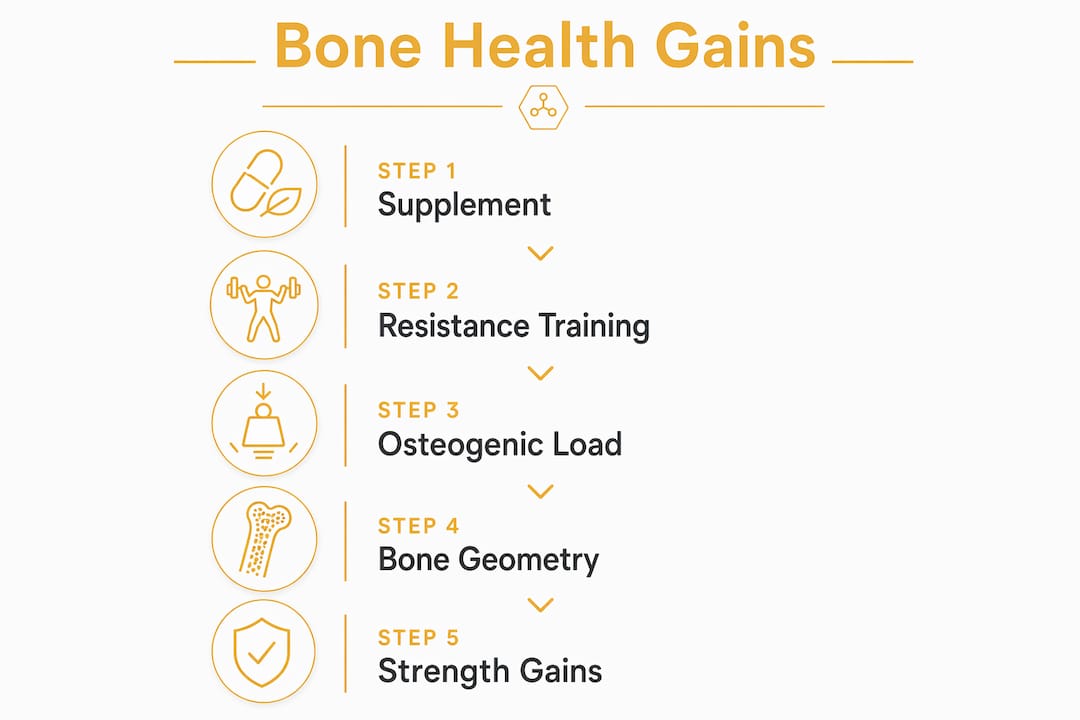
Creatine monohydrate is worth adding to your bone health routine, but only when paired with resistance or osteogenic loading. On its own, it does not improve BMD. What it does do is build the muscle quality and mechanical force that make every loading session more effective.
Here is what the evidence actually shows and what to do about it today:
- Check with your clinician first. Creatine is safe for most older adults, but kidney function and current medications matter before you start.
- Choose creatine monohydrate with third-party testing (NSF Certified for Sport or Informed-Sport). Mayo Clinic recommends this form as the most researched and cost-effective option.
- Book your osteogenic loading sessions at OsteoStrong Rancho Cordova East. Creatine amplifies the mechanical stimulus your bones need. Without the loading, the supplement has little to work with.
The key caveat: a two-year randomized controlled trial found creatine plus training preserved femoral neck geometry (section modulus and buckling ratio) without changing DXA bone mineral density. Geometry improvements matter for fracture risk, but they take time. Expect functional gains first.
A meta-analysis of postmenopausal women confirmed that creatine combined with resistance training produced measurable gains in leg-press strength and lean mass. Trials with low creatine doses without exercise showed no measurable effect. Dose and training context are everything.
One year of creatine plus resistance training also increased or maintained total bone area in the distal tibia compared to placebo, with men showing gains in both trabecular and cortical bone areas. These are geometry changes, not DXA numbers, but they reflect real structural adaptation. Reviews focused on older adults consistently show creatine reduces markers of bone resorption when combined with supervised training, suggesting a genuine effect on bone turnover.
Where to buy creatine in Rancho Cordova:
| Retailer | What they carry | Staff guidance | Best for |
|---|---|---|---|
| GNC | Monohydrate, blends, capsules | Supplement specialists on staff | Older adults wanting product advice |
| Whole Foods Market | Unflavored monohydrate, clean-label brands | General wellness staff | Purity-focused buyers |
| Walmart Supercenter | Budget monohydrate powders, capsules | General retail staff | Price-conscious shoppers |
| Max Nutrition Bend | Sport-focused monohydrate and blends | Knowledgeable fitness staff | Athletes and biohackers |
| CVS Pharmacy | Basic capsule formats | Pharmacy staff for safety questions | Convenience and medication checks |
GNC and Max Nutrition Bend are your best bets if you want staff who can actually discuss dosing. CVS is worth a stop if you want a pharmacist to review interactions before you buy.
Table of Contents
How Osteostrong Rancho Cordova East pairs with creatine
Creatine’s real clinical value at Osteostrong is straightforward: it lets you generate more force during your osteogenic loading session. More force means greater mechanical strain on bone, which is exactly the stimulus that drives bone geometry adaptation. You get that benefit from one weekly session, without adding more visits.
Suggested routine for Osteostrong clients:
- Dosing: 3–5 g creatine monohydrate daily. A brief loading phase (around 20 g/day split into four doses for five to seven days) saturates muscle faster if you want quicker results, but the standard maintenance dose gets you there within three to four weeks.
- Timing: Take creatine close to your session, either before or after. Consistency matters more than the exact window.
- On-site biohacks that complement creatine: Red light therapy supports muscle recovery and may reduce inflammation post-session. PEMF mats and the vibration plate add mechanical stimulus between loading cycles. The PureWave VEMI lounge and hydromassage lounges help with recovery so you show up to each session ready to load hard.
- Safety checkpoint: Get a basic metabolic panel before starting, especially if you take NSAIDs, diuretics, or have any kidney history. Creatine transiently raises serum creatinine, which looks like a kidney flag but reflects normal metabolism, not impairment.
Expect strength and functional gains within eight to twelve weeks. Bone geometry improvements, like the section modulus changes seen in the two-year RCT, take at least a year of consistent loading and supplementation combined.
Book your first session at OsteoStrong Rancho Cordova East and bring your creatine questions. The team can help you build a routine that actually moves the needle.

This article is general wellness information, not medical advice. Confirm supplement choices and dosing with your physician or a qualified clinician for your specific situation.
Key Takeaways
Creatine monohydrate at 5 g/day or more, combined with osteogenic loading, builds the muscle force and bone geometry that DXA scans alone cannot capture.
| Point | Details |
|---|---|
| Creatine needs exercise | Creatine combined with resistance training produced measurable gains in leg-press strength and lean mass. |
| Geometry, not just BMD | Two-year RCT showed preserved femoral neck section modulus and buckling ratio without DXA BMD changes. |
| Dose and form matter | Use creatine monohydrate with NSF or Informed-Sport certification; 3 g/day without exercise shows no effect. |
| Timeline is long | Functional strength gains appear within 8–12 weeks; bone geometry improvements require at least one year. |
| Osteostrong Rancho Cordova East | Weekly osteogenic loading sessions, red light therapy, PEMF, and vibration plates amplify creatine’s bone-support effects. |