
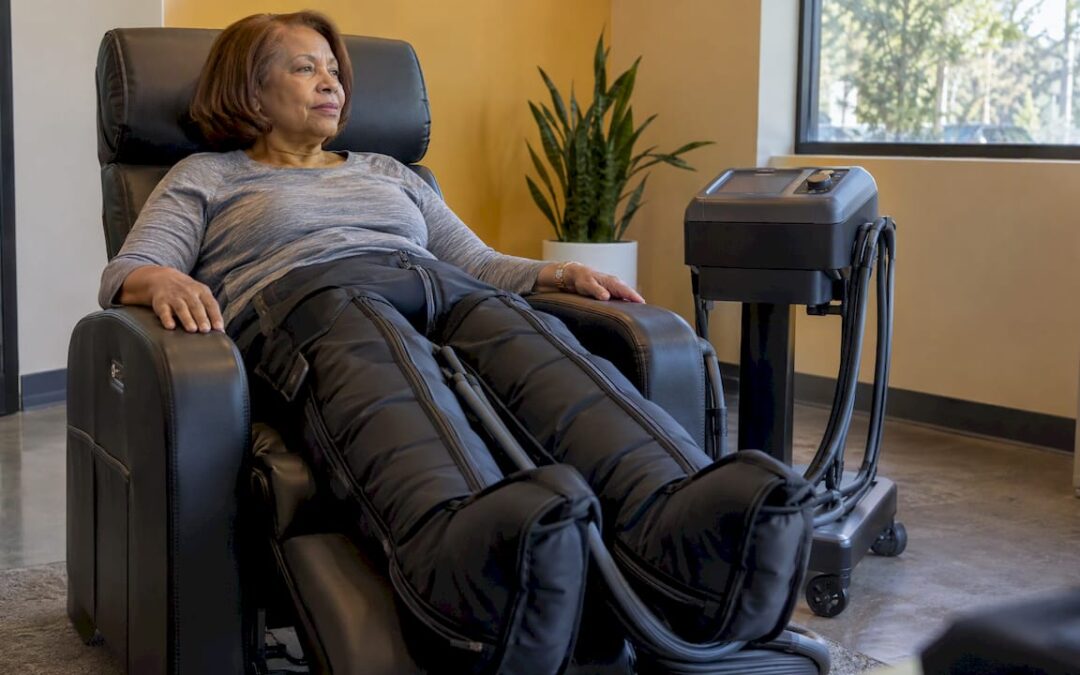
A compression therapy session is usually 20 to 30 minutes in a pair of inflatable leg sleeves that squeeze and release in a steady rhythm. You sit or recline and the machine does the work. If you have osteoporosis or osteopenia, the session is easy to add to a bone-health routine, as long as you clear it with your doctor first and the settings match your body. At OsteoStrong, we offer compression therapy alongside our weekly osteogenic loading, so you can do both in one place.
TL;DR
- A session uses sleeves that inflate and deflate in cycles to move blood and fluid toward the heart. Most protocols in research run 20 to 30 minutes.
- It feels like a firm, rhythmic squeeze, similar to a massage. It should never be painful.
- If you have osteoporosis or osteopenia, ask your doctor first. Recent fractures, blood clots, serious heart failure and arterial disease are reasons not to use compression devices.
- Compression is a comfort and circulation session. Osteogenic loading is the part of our program aimed at bone.
- Frequency is set with your physician, and it varies by purpose.
Table of Contents
- What a compression therapy session is
- What happens during a session
- What compression is known to help
- Compression and your bones: where each therapy fits
- Safety for people with osteoporosis or osteopenia
- How often should you have a session?
- What a session costs
- Our perspective
- Add compression to your bone-health routine
- FAQ
- Sources
What a compression therapy session is
Compression therapy applies controlled outside pressure to a limb, most often the legs. The “boots” version is called intermittent pneumatic compression (IPC). The Cleveland Clinic describes sleeves worn on the calves and attached to a machine that inflate every 20 to 60 seconds and then deflate. The squeeze helps move blood toward the heart, and when the sleeve relaxes, fresh blood flows back into the leg arteries.
There are two broad kinds of compression:
- Static compression, such as stockings or wraps, which hold constant pressure.
- Dynamic compression, the boots you sit in during a session, where chambers inflate and release in sequence.
When people search for a compression boots session, they mean the second kind. It is also the kind used in recovery studios and wellness centers.
What happens during a session
Here is a typical flow:
- Settle in. You sit or recline with your legs supported. Loose clothing or thin leggings work best, because the sleeve should sit smoothly over the skin or a thin layer.
- Fit the sleeves. The sleeves wrap around the legs, sometimes from the foot to the thigh. They should be snug but not tight.
- Set the pressure. Pressure is measured in millimeters of mercury (mmHg), the same unit as blood pressure. You choose or are given a level you can fully relax into.
- Run the cycle. The chambers inflate, hold for a few seconds, and release, over and over.
- Finish and stand up slowly. Your legs may feel lighter or a bit warm.
How long a session lasts
A 2024 systematic review and meta-analysis found that the most common recovery protocols for the lower limbs last 20 to 30 minutes at about 80 mmHg. Protocols in the included studies ranged from 15 to 60 minutes. A single 20 to 30 minute bout was suggested as enough for immediate and mid-term benefits.
A 2026 study in Japan used a sleeve from toes to thigh with four chambers inflating together for 20 to 30 seconds at 90 mmHg, repeated over 30 minutes. The authors found that tissue oxygen levels leveled off after about 10 minutes, while a measure of tissue fluid kept falling through 30 minutes. In their 59 healthy adults, tissue oxygen saturation rose from 75.7% to 81.2%. That is one reason a full half hour is a common choice.

What it feels like
Expect a firm hug that moves up the leg and then lets go. Many people compare it to a deep-tissue massage without the hands. A little pressure is normal. Sharp pain, numbness, tingling or a pins-and-needles feeling is not, and you should ask for the pressure to be lowered or the session stopped.
What compression is known to help
The strongest evidence for compression therapy sits in medical conditions. A 2023 review found robust support in advanced venous insufficiency, deep vein thrombosis and lymphedema. In venous disease, compression is the oldest and most widely used treatment and has been shown to improve healing of venous leg ulcers and lower the chance they return.
For lymphedema, a 2025 study of adults with stage II and III leg lymphedema used an 8-chamber device at 80 mmHg for 60-minute sessions three times a week. After six months, average limb volume fell 28.7% and pain fell 54.8%. That was a single-group study, and it describes a medical protocol. Your own plan should come from your physician.
If you want the medical uses in more depth, our guides on compression therapy medical uses and lymphatic compression therapy walk through them.
For most people in a wellness setting, the realistic goals are simple: legs that feel lighter, a sense of relaxation, and help with everyday swelling and heaviness after a long day on your feet. Interest in recovery methods runs wide, from boots to approaches such as reiki and sports recovery, and it helps to know which goal you are after before you book.

Compression and your bones: where each therapy fits
If you have osteoporosis or osteopenia, the first thing to understand is that compression boots and bone loading do different jobs.
- Compression sessions act on circulation and fluid in the soft tissues of the legs.
- Osteogenic loading is a brief, supervised session in which you press against resistance at high force, to signal the skeleton to build. It is the bone-focused part of our program, and our members come once a week.
A 2005 pilot study in the journal Bone looked at intermittent compression in sedentary postmenopausal women with low bone mass. It reported an exploratory signal in the femoral neck, the upper thigh bone. It was a small early study. We treat compression as a supportive session that complements weekly loading, and we keep bone-building work where it belongs. You can read more about that in our guide to weekly osteogenic loading for osteoporosis.
Safety for people with osteoporosis or osteopenia
Compression devices are used widely, and adverse events are rare when the device is used correctly. A German guideline on IPC says it is a safe and effective method when the indication and application are correct. Your job is to make sure the session suits you. Here is how to do that.
Talk to your doctor first
With osteoporosis or osteopenia, ask your doctor or bone specialist before starting. Bring up your fracture history, your medications, and any heart, circulation or kidney conditions. Pressure, fill pattern and which part of the limb is treated can all be adjusted, so tell the person running your session what your doctor says.
Who should not use compression devices
The following come from official lists. A U.S. Department of Veterans Affairs clinical document lists these exclusions for pneumatic compression devices:
- serious arterial insufficiency (poor blood supply in the leg arteries)
- deep vein thrombosis (a clot in a deep vein)
- uncontrolled congestive heart failure
- acute renal failure
- acute cellulitis or an active skin or limb infection
- a recent skin graft
- acute radiation dermatitis
An FDA clearance summary for sequential compression devices adds pulmonary embolism, acute venous thrombosis, inflammatory phlebitis, pulmonary edema and erysipelas to the list of reasons the device should not be used.
A recent fracture is another point to raise with your doctor before any compression session, since the injured area is not one to squeeze without medical direction. Our page on who should not use compression boots covers the full list, and the guide to compression for fracture swelling explains what is usually involved after a break.
Skin, nerves and older adults
An international consensus statement reviewed 62 publications and found the most frequent problems were skin irritation, discomfort and pain. Serious events such as nerve injury or clots are very rare and occur in predisposed people or with improper use. For people with polyneuropathy (nerve damage that dulls feeling) and older adults with thin, fragile skin, the statement recommends padding, careful fit, low pressure and close monitoring early on.
That applies to many of our members. In practice:
- Start at a low pressure and increase only if it feels comfortable.
- Wear a thin layer between the sleeve and your skin if your skin is delicate.
- Check your skin afterward for redness that does not fade, bruising or blisters.
- Report any new calf pain, swelling on one side, or shortness of breath to a doctor immediately. Those can signal a clot and need urgent care.
How often should you have a session?
There is no single schedule. One device maker’s manual states that a physician determines the duration and frequency of each treatment session. Medical protocols can be intensive, such as the three-times-weekly lymphedema study above, while a wellness routine is lighter.
A sensible approach for bone-health clients is to anchor your week around loading and add compression on the same visit or on a day when your legs feel heavy. Pair it with the plan your doctor has approved. If your goal is lymphatic or swelling support, your physician sets the frequency.
What a session costs
Pricing depends on whether you pay per session or as a member, and on what else you use. Our site has no published price for compression sessions in the information we use here, so please ask the center for current options. For a general view of when owning a unit or joining a membership pays off, see U.S. compression therapy cost.
Our perspective
We built our centers around one idea: low bone density deserves a plan that is measurable, supervised and brief enough to keep up. Osteogenic loading once a week is that plan’s core. It is non-pharmaceutical, and we track results in bone density.
Around it, we offer therapies that make the rest of the week feel better: compression therapy, red light, PEMF mats, vibration plates, hydromassage lounges and more. Compression is a good example. It is a quiet half hour where your legs get a steady rhythmic squeeze, and you can fit it right into a loading visit.
What we ask of every member is the same: tell us about your fractures, your medications and your doctor’s guidance, and we will set up your session around them. Your doctor’s instructions come first, and we work inside them.
Aaron
Add compression to your bone-health routine
OsteoStrong offers compression therapy alongside osteogenic loading, with centers in Rancho Cordova, El Dorado Hills and Granite Bay. Members come once a week for supervised loading, and compression and our other recovery therapies are available as part of the wellness side of what we do.
To see how a visit fits your plan, start with osteogenic loading at OsteoStrong. If you also want to learn about other sessions, our guide to a vibration plate session is a good next read.
FAQ
Is a compression therapy session safe with osteoporosis?
For many people with osteoporosis or osteopenia, a session at a comfortable pressure is appropriate, but you should ask your doctor first. Reasons not to use compression include a recent fracture, a blood clot, serious arterial disease and uncontrolled heart failure. Tell the person running your session about your diagnosis so pressure can be set low.
How long is a compression boots session?
Most research protocols for the legs run 20 to 30 minutes, with a range of 15 to 60 minutes across studies. A 2024 meta-analysis found about 80 mmHg to be the most common pressure. Your physician or session provider should set the length and pressure for you.
Does compression therapy hurt?
It should not. You should feel firm, rhythmic pressure, similar to a massage. If you feel sharp pain, numbness or tingling, ask to lower the pressure or stop. Older adults with thin skin may do best with low pressure and padding, as the consensus statement recommends.
How often should I do compression therapy?
There is no single answer. Medical uses such as lymphedema are scheduled by a physician, and wellness use is lighter. Ask your doctor what suits your health and then plan around your weekly loading visit.
Sources
- Intermittent Pneumatic Compression Devices, Cleveland Clinic
- Effects of lower-limb intermittent pneumatic compression, 2024 meta-analysis
- Effects of an intermittent pneumatic compression device on tissue oxygenation and fluid, 2026
- Black holes in compression therapy: A quest for data, 2023
- Compression for Primary Prevention, Treatment, and Prevention of Recurrence of Venous Leg Ulcers, 2016
- Therapeutic influence of intermittent pneumatic compression in lymphedema, 2025
- Effect of intermittent compression therapy on bone mineral density, 2005
- S1 guideline on intermittent pneumatic compression
- Pneumatic Compression Devices for Lymphedema, VA Clinical Document
- FDA 510(k) Summary K122640
- Risks and contraindications of medical compression therapy, 2020
- Movement and Compressions System user manual, 2025
- Reiki y recuperación deportiva