

Moderate caffeine intake does not meaningfully harm bone density in adults who get enough calcium. The relationship gets complicated fast once you push past that threshold, factor in genetics, or belong to a higher-risk group like postmenopausal women. Here is what the research actually shows:
- Consuming under 400 mg of caffeine daily poses no significant fracture or bone loss risk when calcium intake is adequate
- Chronic intake around 800 mg per day can raise urinary calcium excretion and disrupt the balance between bone-building and bone-resorbing cells
- Postmenopausal women and older adults face greater vulnerability than younger adults
- Genetics, specifically variants of the vitamin D receptor (VDR) gene, can amplify or reduce caffeine’s effect on bone metabolism
- Coffee’s polyphenols may partially offset caffeine’s negative effects, which is why the beverage itself does not always behave the way isolated caffeine does in lab studies
The bottom line: caffeine and bone density have a dose-dependent, context-dependent relationship. Dose matters. Diet matters. Your DNA matters too.
What does the science say about caffeine’s effect on bone health?
The research on caffeine’s impact on bones is genuinely mixed, and that is not a cop-out. It reflects real biological complexity.
Observational studies report positive, negative, and neutral associations between caffeine consumption and bone mineral density, depending on the population studied and how caffeine intake was measured. A large cross-sectional study using National Health and Nutrition Examination Survey (NHANES) data found that higher caffeine intake was associated with a decreased risk of osteoporosis in some analyses, with Mendelian randomization supporting a potential causal link. That finding runs counter to the conventional warning, and it deserves attention.
At the cellular level, the picture is clearer. Research published in Frontiers in Pharmacology found that moderate caffeine doses inhibit osteoclast differentiation (the cells that break down bone) and promote osteogenesis through the AKT, NF-κB, and MAPK signaling pathways. High doses flip that script: they activate NFATc1 and suppress Runx2 and Osterix, two proteins critical for bone formation, ultimately tipping the balance toward net bone loss.
Key finding: In animal models, moderate caffeine intake preserved bone mass in estrogen-deficient mice, while long-term high-dose intake caused measurable trabecular bone loss.
Age and sex modify this relationship in ways that matter clinically. Postmenopausal women with inadequate calcium intake who consumed high amounts of caffeine daily showed significantly greater bone loss at the spine and total body compared to lower-caffeine consumers. Women with adequate calcium intake showed no such difference. That single finding reframes the entire debate: caffeine’s effect on bones is largely conditional on whether you are getting enough calcium.
Tea presents an interesting case. It contains caffeine but also high levels of polyphenols and flavonoids, which appear to benefit bone mineral density independently. Research from Cambridge concluded that caffeine’s negative role in bone health has likely been overstated, partly because caffeinated beverages often contain bioactive compounds that work in the opposite direction.
How genetics shapes your personal caffeine and bone density risk
Not everyone metabolizes caffeine the same way, and not everyone’s bones respond to it identically. Genetic variation in the vitamin D receptor (VDR) gene is one of the most studied factors here. People carrying the ‘tt’ genotype of the VDR gene show accelerated bone loss with high caffeine intake compared to those with other variants. Since vitamin D is central to calcium absorption, a VDR variant that reduces receptor efficiency compounds the problem when caffeine is also suppressing calcium uptake.

Caffeine’s effect on bone cells is also biphasic, meaning the dose determines whether the outcome is protective or harmful. At lower concentrations, caffeine inhibits osteoclastogenesis and supports bone formation. At higher concentrations, it does the opposite. This dose-dependent pattern means that two people drinking the same amount of coffee can have meaningfully different skeletal outcomes depending on their genetics, baseline calcium status, and overall diet.
Pro Tip: If you have a family history of osteoporosis or have been told you carry a VDR gene variant, consider asking your doctor about a DEXA scan to establish a baseline before making assumptions about your caffeine tolerance.
Caffeine’s effect on bones is rarely a standalone story. It interacts with vitamin D status, calcium intake, estrogen levels, and physical activity. Treating it as an isolated variable misses most of what is actually happening in the body.
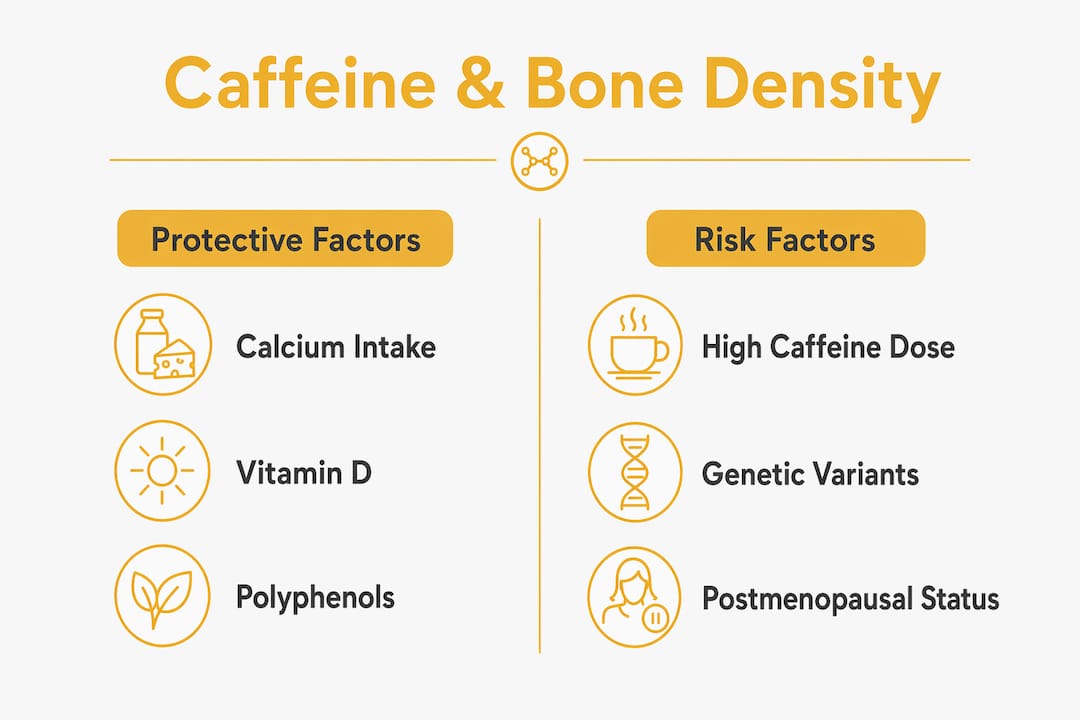
How much caffeine is safe for your bones?
The threshold that consistently appears in clinical research is 400 mg of caffeine per day. Below that level, no significant bone loss occurs in adults with adequate calcium intake. Above 800 mg per day, the risk profile changes substantially: urinary calcium excretion rises sharply, and the cellular balance between bone formation and resorption shifts toward net loss.
Groups at elevated risk include:
- Postmenopausal women with low calcium intake (below 800 mg per day)
- Adults over 65, who have reduced capacity to compensate for caffeine-induced calcium loss
- People with low vitamin D levels, since vitamin D deficiency already impairs calcium absorption
- Individuals with VDR gene variants linked to reduced vitamin D receptor function
- Smokers and heavy alcohol consumers, whose bone health is already compromised by other factors
For context, a standard 8-oz brewed coffee contains roughly 80–100 mg of caffeine. Staying under the safe caffeine intake threshold means roughly a few cups of coffee per day for most people, though energy drinks and espresso-based beverages can push that number up quickly.
Pro Tip: Space your coffee away from calcium-rich meals or supplements by at least 30–60 minutes. Caffeine temporarily reduces calcium absorption efficiency, so timing matters if you are trying to maximize what you get from dairy, fortified foods, or supplements.
Lifestyle strategies that protect your bones while you enjoy caffeine
Caffeine’s effect on bone health is modifiable. The primary protective factors are well established, and most of them are within your direct control.
- Calcium intake: Aim for at least 1,000 mg per day (1,200 mg for women over 50 and men over 70). This is the single most important buffer against caffeine-related calcium loss.
- Vitamin D: Without adequate vitamin D, calcium absorption suffers regardless of how much you consume. Most adults need 600–800 IU daily, and many need more.
- Weight-bearing exercise: Activities that load the skeleton, from walking to resistance training, stimulate osteoblast activity and help maintain bone mineral density.
- Quit smoking: Smoking accelerates bone loss through multiple pathways and compounds caffeine’s effects.
- Limit alcohol: Heavy alcohol use disrupts bone remodeling and reduces calcium absorption.
- Monitor your total dietary pattern: Caffeine consumed alongside a diet rich in polyphenols, calcium, and vitamin D behaves very differently than caffeine consumed with a nutrient-poor diet.
Osteogenic loading is one of the most direct ways to stimulate bone growth. Osteostrong’s weekly sessions use controlled, high-magnitude skeletal loading to trigger the same bone-building response that heavy resistance training produces, without the joint stress. For anyone managing caffeine intake alongside a bone health concern, osteogenic loading sessions provide a measurable, evidence-backed stimulus that diet alone cannot replicate. Osteostrong also offers red light therapy, PEMF mats, vibration plates, and compression therapy, all of which support the body’s recovery and bone remodeling processes between sessions.

If you are in the Granite Bay area and want to take a more active approach to your bone health, Osteostrong’s programs are designed for exactly this kind of proactive, science-informed client. One session per week. Real, measurable results over time.
Key Takeaways
Caffeine’s impact on bone density depends far more on dose, calcium intake, and genetics than on caffeine alone.
| Point | Details |
|---|---|
| Safe daily threshold | Under 400 mg per day poses no significant bone loss risk when calcium intake is adequate. |
| High-dose risk | Around 800 mg per day raises urinary calcium excretion and disrupts bone cell balance. |
| Calcium is the key buffer | Postmenopausal women consuming high caffeine intakes daily with low calcium showed significantly more bone loss. |
| Genetics amplify risk | VDR ‘tt’ genotype carriers face accelerated bone loss with high caffeine intake. |
| Lifestyle offsets risk | Adequate calcium, vitamin D, and weight-bearing exercise are the primary protective factors against caffeine-related bone loss. |