
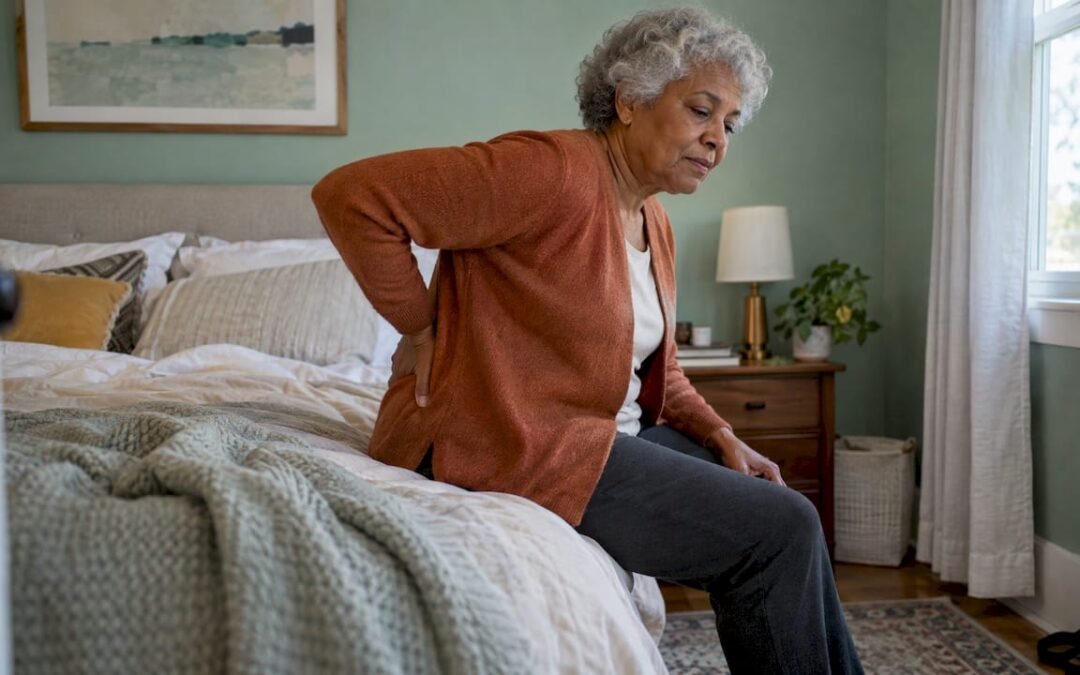
The most effective relief starts with finding out where the pain comes from. Osteoporosis itself usually doesn’t hurt. Pain most often comes from a small or large fracture, or from another condition such as arthritis. Heat and cold, supported movement, appropriate medicine and, for fractures, medical care can all help. Strengthening the skeleton over the long run is what lowers the chance of the next painful break.
This guide covers what causes the pain, what you can do at home, which medical options doctors use, how to stay active safely, and the signs that mean you should not wait.
TL;DR
- Osteoporosis alone doesn’t usually cause pain. Pain usually points to a fracture or to a separate problem such as arthritis or a herniated disc.
- Heat, cold, a supportive brace for a short time, and gentle guided movement are the first home steps. Over-the-counter pain medicine has risks, so ask your doctor what suits you.
- Back pain after a fall, with fever, or with new bowel or bladder trouble needs immediate care.
- Long-term relief comes from lowering fracture risk: medication your doctor prescribes, safe strength work, balance and posture habits.
Table of Contents
- Why osteoporosis hurts
- Warning signs: when not to wait
- Home measures that ease the pain
- Medical options for painful fractures
- Moving safely when it hurts
- The longer game: fewer fractures, fewer painful episodes
- Our perspective
- Where OsteoStrong fits
- FAQ
- Sources
Why osteoporosis hurts
Early bone loss is quiet. Mayo Clinic notes that there are often no symptoms in the early stages. Once bones are weak enough to break, signs include back pain from a broken or collapsed spinal bone, loss of height, a stooped posture, and a bone that breaks more easily than expected.
Researchers describe two broad kinds of osteoporotic pain. One is traumatic pain from a fragility fracture. The other is pain without an obvious fracture, which may come from tiny microfractures or structural changes such as muscle fatigue in people with a rounded upper back (kyphosis). The osteoporotic state itself has also been linked to heightened pain sensitivity.
There is a third source that is easy to miss. University of Utah Health points out that some people with osteoporosis also have arthritis or a herniated disc that causes the pain. That matters because the right fix for a disc problem is not the right fix for a spinal fracture.

What a spinal compression fracture feels like
Vertebral compression fracture is a common complication of osteoporosis. The American Academy of Family Physicians says it is often triggered by ordinary actions like turning in bed, coughing or sneezing, and that the back pain tends to worsen with posture changes.
The American Academy of Orthopaedic Surgeons describes the typical pattern: pain at the spot of the break, most often near the waistline, worse when you move or change positions and often easier when you rest or lie down. A serious fracture can press on nerves and cause pain or other symptoms in the legs.
If that description sounds familiar and you haven’t had it checked, get it checked. Imaging is how a fracture is confirmed.
Warning signs: when not to wait
Home care is for pain a professional has already looked at. Mayo Clinic advises seeking immediate care when back pain causes new bowel or bladder problems, comes with a fever, or follows a fall, a blow to the back or another injury.
The same source says to contact a healthcare professional for:
- back pain lasting longer than a few weeks
- severe pain that doesn’t improve with rest
- pain that spreads down a leg
- leg weakness, numbness or tingling
- unexplained weight loss
UF Health adds that you should reach out if you think you may have a compression fracture, if symptoms are getting worse, or if you have trouble controlling your bladder or bowels. Your primary care doctor, an orthopedist or an endocrinologist are the people to call. For a deeper look at risk and urgent signs, see our guide to osteoporosis risk factors and urgent signs.
Home measures that ease the pain
Heat and cold
WebMD describes warm showers or hot packs for stiff, tight muscles, and cold packs to numb aching areas and reduce swelling. Kaiser Permanente gives the practical rules:
- Use heat or cold for 10 to 20 minutes at a time, several times a day.
- Put a thin cloth between the pack and your skin.
- Don’t use either on broken skin, while sleeping, or on an area with poor blood flow or numbness.
The numbness rule matters for older adults with circulation or nerve problems. If that is you, ask your doctor first.
Over-the-counter medicine
WebMD lists acetaminophen, aspirin, ibuprofen and naproxen as options that may help, and also notes that long-term use can bring stomach irritation, bleeding or liver problems. The Merck Manual says acetaminophen can relieve pain from spinal compression fractures and that doctors occasionally prescribe opioids when pain is severe. Which one is right depends on your kidneys, stomach, liver and other medicines, so confirm the choice and dose with your doctor or pharmacist.
Braces, massage and other supports
A back brace can relieve pain after a spinal fracture. WebMD cautions that relying on one for too long can weaken the muscles. The same page also lists physical therapy, acupuncture, acupressure and massage as ways people ease pain. The AAFP is more reserved about bracing and nerve root blocks, saying they have very limited evidence of short-term benefit. So treat a brace as a short-term helper, with your clinician setting the timeline.
Medical options for painful fractures
When a fracture is behind the pain, doctors have more tools than rest and over-the-counter pills.
| Option | What the sources say |
|---|---|
| Pain medicine and rest | UF Health says pain medicine and bed rest may be used for compression fractures. |
| NSAIDs and acetaminophen | The AAFP lists both within conservative treatment, along with physical rehabilitation. |
| Osteoporosis drugs | The AAFP says several anti-osteoporotic medications can improve pain after a fracture and that clinicians should consider bisphosphonates, calcitonin and teriparatide for acute fractures. |
| Minimally invasive procedures | Vertebroplasty or kyphoplasty should be considered for symptomatic fractures that haven’t responded to conservative care after 4 to 10 weeks, per the AAFP. |
| Surgery | UF Health says surgery may be done if severe, disabling pain lasts more than 2 months without improvement from other treatments. |
A 2024 network meta-analysis in JAMA Network Open pooled 20 trials with 2,102 patients. It found that calcitonin and NSAIDs eased short-term pain during activity better than placebo in acute osteoporotic vertebral fractures. The authors suggested NSAIDs and teriparatide may be preferred options, since calcitonin’s safety profile limits wide use. They also noted that most results were of low or very low certainty.
Teriparatide is prescription-only. According to its FDA label on DailyMed, it is indicated for postmenopausal women with osteoporosis at high risk for fracture, or patients who have failed or can’t tolerate other therapies. The usual dose is a daily injection under the skin, and use beyond 2 years in a lifetime should only be considered if high fracture risk remains. Common side effects include joint pain, pain and nausea. Your prescriber decides whether any of this applies to you.
Moving safely when it hurts
Staying still too long works against you. The Merck Manual encourages people with compression fractures to sit up, walk for short periods and resume normal activities as soon as possible to prevent loss of muscle tone and further bone loss. The MSD Manual adds that treatment of vertebral fractures focuses on pain relief and early mobilization, and that physical therapists can teach correct lifting and prescribe exercises for the back muscles, though therapy may need to wait until pain is controlled.
The Bone Health and Osteoporosis Foundation’s Safe Movement brochure points to controlled dance, back-safe yoga, Tai Chi, swimming, balance and posture exercises as better choices for fragile bones. It advises avoiding sit-ups, abdominal crunches, running, jumping rope, golf, tennis, bowling, and yoga or Pilates postures that twist at the waist or bend forward. Harvard Health likewise advises avoiding bending or twisting the spine and talking with your doctor before starting a new program.
Three practical steps:
- Get clearance. Ask your doctor which movements are safe for your scan results and fracture history.
- Start small. Short walks spread across the day beat one long effort that flares the pain.
- Work on posture. Our daily posture plan takes 5 to 10 minutes. Our osteoporosis exercise guidelines and the list of exercises to avoid can help you sort safe from risky.
Balance work protects you from the falls that cause painful breaks. Our guide to reducing fall and fracture risk walks through the steps, and Tai Chi is one gentle option.
The longer game: fewer fractures, fewer painful episodes
The AAFP stresses that preventing low bone density is critical for avoiding vertebral compression fractures, and that pharmacotherapy and rehabilitation are the primary conservative approaches. The American College of Physicians guideline recommends bisphosphonates as initial treatment to reduce fracture risk in postmenopausal women with primary osteoporosis. It suggests denosumab as a second-line choice when bisphosphonates are not tolerated, and romosozumab or teriparatide, followed by a bisphosphonate, only for those at very high risk.
Medication is one part. Resistance and weight-bearing activity, nutrition and fall prevention are the others. The National Osteoporosis Foundation’s Boning Up brochure recommends weight-bearing exercise for 30 total minutes on most days and resistance work 2 to 3 days a week, within your doctor’s limits. The Academy of Geriatric Physical Therapy guideline (2022) recommends long-duration programs of static weight-bearing exercise and progressive-resistance training for postmenopausal women.
Our perspective
We meet many people who arrive with a scan result and a lot of worry about the next break. Pain is often what brings them in, and we start by saying what we can and can’t do. We are not a replacement for your physician, and fracture pain needs a medical evaluation first.
What we focus on is the question that comes after: how do you build a stronger skeleton so you have fewer reasons to hurt? Our approach is osteogenic loading, a brief, supervised session once a week on specialized equipment that is designed to stimulate bone growth. Members tell us they like the structure and the measurable tracking, and the sessions are short enough to fit around medical care.
We pair that with recovery-oriented services such as red light therapy, PEMF mats, compression therapy and hydromassage lounges, which many members use for comfort and relaxation. Our protocol is non-pharmaceutical, and it is meant to sit alongside the plan your doctor sets, not to compete with it.
Aaron
Where OsteoStrong fits
If your doctor has cleared you for exercise and you want a supervised, once-a-week way to work on bone strength, our centers in Rancho Cordova, El Dorado Hills and Granite Bay offer osteogenic loading. You can also read how the approach works for osteoporosis in our weekly osteogenic loading guide, or see what to expect from fracture risk reduction with weekly clinic loading. Pricing isn’t published, so contact the center nearest you for current membership details.
Our wellness lounges, including red light therapy, hydromassage and compression therapy, are available to members as well. Share your diagnosis and any fracture history with our team and your physician before starting.
FAQ
Does osteoporosis hurt every day?
Not usually. Osteoporosis doesn’t cause pain unless it causes a painful fracture, according to University of Utah Health. Ongoing daily pain more often points to a healed or healing fracture, muscle strain from posture changes, or another condition such as arthritis, so have it evaluated.
What is the safest way to relieve osteoporosis back pain at home?
Heat or cold for 10 to 20 minutes with a cloth barrier, short walks and gentle posture work are common first steps. Over-the-counter medicines can irritate the stomach or affect the liver with long-term use. Confirm any medicine with your doctor, and get new or severe back pain checked first.
How long does a compression fracture hurt?
The sources here don’t give a single timeline. The AAFP considers procedures like vertebroplasty or kyphoplasty when pain hasn’t responded to conservative care after 4 to 10 weeks. Mayo Clinic says back pain lasting longer than a few weeks warrants a call to a professional.
Can exercise make osteoporosis pain worse?
The wrong kind can. Forward bending, twisting and high-impact activities are on the foundation’s avoid list for fragile bones. Guided, appropriate movement is encouraged, so ask your doctor or a physical therapist to approve a plan.
Can treating osteoporosis reduce pain?
Indirectly, yes. The AAFP notes that several osteoporosis medications can improve pain after a fracture, and treatment aims to prevent new fractures, which are the main source of osteoporotic pain.
Sources
- Osteoporosis: Symptoms & Treatment, University of Utah Health
- Osteoporosis, Symptoms and causes, Mayo Clinic
- Pathomechanisms and management of osteoporotic pain, PMC
- Vertebral Compression Fractures, American Family Physician
- Osteoporosis and Spinal Fractures, OrthoInfo (AAOS)
- Back pain, Symptoms and causes, Mayo Clinic
- Compression Fractures of the Back, UF Health
- Treating Osteoporosis Pain, WebMD
- Using Cold and Heat Therapies, Kaiser Permanente
- Compression Fractures of the Spine, Merck Manual
- Vertebral Compression Fractures, MSD Manual
- Conservative Treatments for Acute Painful Osteoporotic Vertebral Compression Fractures, JAMA Network Open
- Teriparatide injection, DailyMed
- Safe Movement brochure, Bone Health and Osteoporosis Foundation
- Pharmacologic Treatment of Primary Osteoporosis or Low Bone Mass, ACP guideline