
Yes, posture can be safely improved with osteoporosis, but with real limits. Targeted posture work, spine-sparing movement, and balance and strength training can reduce fall and fracture risk and ease symptoms, according to guidance from the Bone Health & Osteoporosis Foundation, and consensus exercise statements, while clinic options like osteogenic loading can complement that work. Structural kyphosis from past fractures usually will not fully reverse. The priorities: avoid end-range spinal bending and forceful twisting, start a daily extension and posture routine, and get a physical therapy evaluation if anything feels uncertain.
TL;DR:
- Strengthening back extensor muscles through daily posture and spine-sparing exercises can help reduce fracture risk but cannot fully reverse established kyphosis.
- Avoid forward-bending and rapid twisting movements, as they increase the risk of vertebral fractures in osteoporosis, and modify Pilates or yoga practices accordingly.
- Balance exercises like single-leg stands and tandem walking improve fall prevention, which is critical since most hip fractures result from falls.
- Osteogenic loading clinic sessions, combined with support therapies, serve as an adjunct to medical treatment for bone stimulation but are not substitutes for medication or prescribed therapies.
- Maintaining a healthy lifestyle with adequate calcium, vitamin D, protein intake, and avoiding smoking and heavy alcohol supports bone health alongside targeted exercise.
Table of Contents
- Posture and Safe Body Mechanics: Neutral Spine and Daily Movement
- Exercises That Build Posture and Back-Extensor Endurance
- Movements to Avoid or Modify
- Balance and Fall-Prevention Exercises That Protect Your Spine
- When to See a Physical Therapist or Clinician
- How Osteogenic Loading and Clinic Therapies Fit In
- How Osteoporosis Changes Posture Over Time
- Nutrition and Lifestyle Habits That Support Bone and Posture
- Where Medication Fits Alongside Posture Work
- Living With Postural Changes: Long-Term Outlook
- What I’d Do This Week
- A Supervised Path to Support Your Bone Density Goals
- FAQ
- Sources
Posture and Safe Body Mechanics: Neutral Spine and Daily Movement
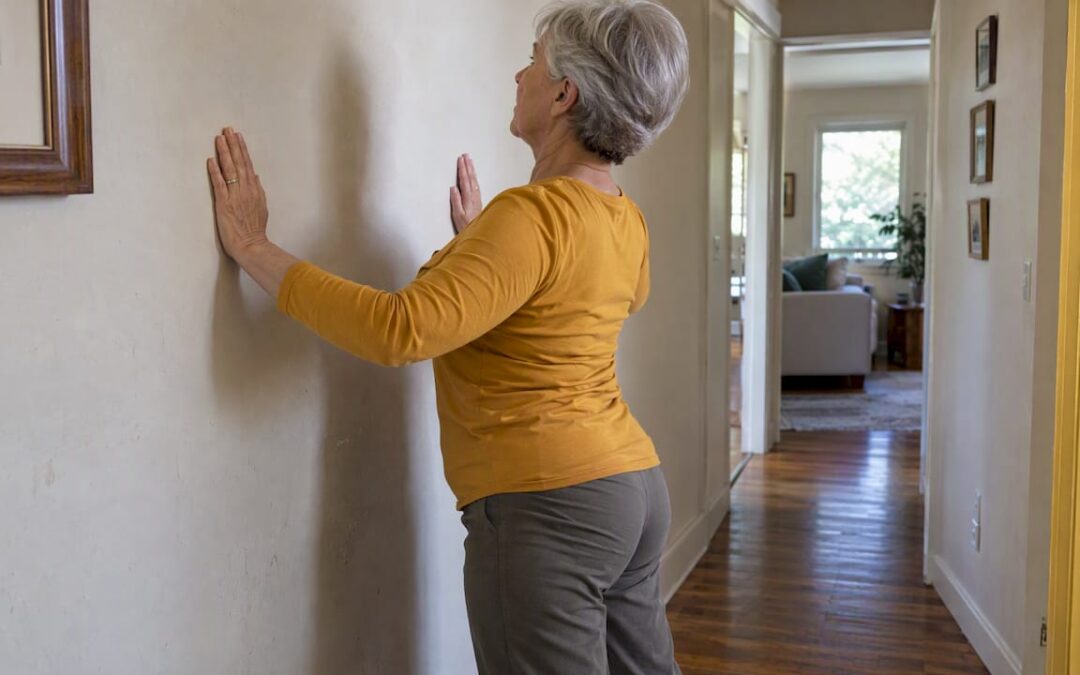
Neutral spine means your head sits over your shoulders, your chin is gently tucked rather than jutting forward, and your shoulder blades are relaxed down and back instead of rounded. A quick check: stand with your back against a wall. Your head, shoulder blades, and buttocks should touch it without straining.
That alignment matters most during ordinary tasks, where bad habits do the real damage over time.
- When sitting, use a chair with lumbar support and keep knees level with hips.
- When tying shoes, sit and bring the foot up rather than bending forward from the waist.
- When lifting, bend at the hips and knees with the object close to your body, not at the spine.
- When using stairs, keep your trunk upright and use the handrail.
- When coughing or sneezing, brace your abdomen instead of curling forward.
- When getting out of bed, roll to your side first, then push up with your arms.
Two patterns protect the spine in almost every situation: the hip hinge, which lets your hips and knees do the bending while your back stays straight, and the step-to-turn, which replaces trunk twisting with a pivot of the feet. Both come directly from spine-sparing guidance for people with fragile vertebrae.
Pro Tip: Practice the hip hinge holding a light object, like a book, until it becomes automatic before you use it for real lifting.
Exercises That Build Posture and Back-Extensor Endurance
Your back extensors, the muscles running along your spine, are postural muscles that need endurance rather than brute strength. When they tire, you slump, and slumping increases the kind of forward load that stresses the front of the vertebrae. Spinal extension exercises help improve posture and strengthen these muscles, and research reviewing osteoporosis exercise finds they lower the risk of further vertebral fractures, even though they do not reliably reverse kyphosis that has already developed.
A sensible progression moves from the floor to standing as strength improves:
- Head presses: lying on your back, gently press the back of your head into a pillow and hold.
- Supine bridges: lift your hips off the floor while lying on your back, keeping your spine neutral.
- Prone or supported back raises: lying face down, lift your chest slightly using your back muscles, or use resistance bands for seated rows instead.
- Wall angels: standing with your back against a wall, slide your arms up and down while keeping contact.
- Scapular squeezes: pull your shoulder blades together and hold, done seated or standing.
- Modified plank holds: build core support from your knees before progressing to a full plank.
Positions like supine and prone place the least load on the spine, which is why they come first. Standing exercises load the spine more and should wait until the easier versions feel controlled.
For frequency, aim for short posture practice daily, around five to ten minutes, with resistance work roughly twice a week. Hold extension positions for a few seconds, build toward longer holds over weeks, and use a simple effort scale: work at a pace that feels moderately challenging, not maximal. Sharp pain, numbness, or pain that lingers after a session is the signal to stop and scale back.
Pro Tip: Keep a small pillow under your head during supine exercises if you already have some rounding in your upper back, since it keeps your neck comfortable without forcing overextension.
Movements to Avoid or Modify
Bending forward at the waist, the motion behind sit-ups and toe touches, compresses the front of the vertebral body. In a spine already weakened by low bone density, that compression raises the risk of a vertebral fracture, a mechanism Bone Health & Osteoporosis Foundation guidance specifically warns against. Rapid or loaded twisting carries a similar risk.
- Avoid: toe touches, traditional sit-ups or crunches, heavy forward lifts, and fast trunk twisting.
- Instead: use the hip hinge for bending, a half-kneel position for lifting from the floor, and supine core work that keeps the spine supported.
- Modify: in Pilates or yoga classes, skip deep forward folds and twists, and ask the instructor for a flexion-free alternative.
Mayo Clinic’s patient guidance echoes this, recommending upper-back strength, weight-bearing aerobic activity, flexibility, and balance training while steering people with osteoporosis away from forward-bending moves. As a general rule, avoid repeated, weighted, or rapid flexion and twisting, and check with a clinician before starting any high-impact activity like jumping or running.
Balance and Fall-Prevention Exercises That Protect Your Spine
Most hip fractures happen because of a fall, not because bone simply gives way, which is why balance training belongs next to posture work rather than after it. Clinical trials cited in exercise guidelines for osteoporosis show that improved postural balance from training lowers fracture risk by improving stability and cutting fall rates, with combined resistance and balance programs performing particularly well.
- Single-leg stands, holding a counter or chair back for support, build ankle and hip stability.
- Tandem walking, placing one foot directly in front of the other, trains the same balance pathways used in everyday walking.
- Tai Chi-style slow stepping patterns improve control through smooth weight shifts.
- Step-ups onto a low step build leg strength alongside balance.
- Heel-to-toe walking along a straight line rounds out a short daily routine.
Start with supported versions and progress to brief unsupported holds only once you feel steady. Pair this work with home-safety basics: supportive footwear, good lighting on stairs and hallways, clear walkways, and an assistive device if your clinician recommends one. These same habits support independence more broadly, a theme covered well in resources on staying active while aging.
When to See a Physical Therapist or Clinician
Some signs mean it is time for a professional look rather than more home troubleshooting.
- Height loss of half an inch or more within twelve months, a red flag tracked by bone health specialists for possible vertebral compression fractures.
- New or worsening back pain, especially if it started suddenly.
- Suspected fracture after a fall or even a minor strain.
- Repeated falls or a growing fear of falling.
A physical therapist will typically assess your posture and balance, test your back-extensor and core strength, and build a progression tailored to your bone density and fall history, including hands-on instruction in the hip hinge and step-to-turn. When booking, bring a list of your fractures or falls, your current medications, and your most recent bone density results, and ask directly what exercises to avoid given your specific spine imaging.
How Osteogenic Loading and Clinic Therapies Fit In
Osteogenic loading is a clinic-based mechanical loading protocol, where a brief weekly supervised session applies controlled force intended to stimulate bone-building response. It is best understood as a complement to exercise and medical management, not a replacement for either.
- Osteogenic loading sessions are supervised and typically run once a week.
- Red light therapy, PEMF mats, vibration plates, and hydromassage lounges are offered as adjunctive wellness supports alongside the core loading sessions.
- These additions are not a substitute for prescribed medication, physical therapy, or the posture and balance work described above.
Anyone considering these options should loop in their treating clinician or physical therapist first, so clinic-based work stays coordinated with the rest of their care plan rather than running in parallel to it.
How Osteoporosis Changes Posture Over Time
Osteoporosis rarely announces itself through posture alone, but repeated vertebral compression fractures, often silent ones, gradually wedge the front of vertebral bodies, pulling the upper spine forward. The visible result is a forward-curving upper back known as kyphosis, sometimes called a dowager’s hump in its more advanced form.

This is a structural change, not a muscular one, and it matters because a few wedged vertebrae can shift how weight travels through the rest of the spine. The curve can push the head forward, shorten the torso, and compress the rib cage against the abdomen, which sometimes affects breathing capacity and digestion in more advanced cases. It can also shift your center of gravity forward, which is part of why balance training matters so much once kyphosis has set in.
The honest news, backed by the exercise literature, is that posture and extension exercises help the muscles supporting the spine and protect against further fractures, but they do not reliably undo a curve that has already formed from vertebral compression. The goal shifts from reversal to prevention: stopping additional wedge fractures, keeping the surrounding muscles strong enough to support the altered curve, and maintaining the balance and mobility needed to avoid falls that could cause new fractures. That reframing, protection rather than correction, tends to be more motivating in practice than chasing a straighter spine that may not be achievable.
Nutrition and Lifestyle Habits That Support Bone and Posture
Posture exercises work on the muscles around the spine, but the bone itself responds to different inputs, and the two need to move together. Adequate calcium and vitamin D remain foundational for bone maintenance, alongside enough protein to support the muscle mass that holds posture in place. Weight-bearing activity, walking, stair climbing, and the resistance work described earlier all send the mechanical signals bone needs to maintain density.
A few lifestyle factors work against both bone and posture at once. Smoking is linked to lower bone density, and heavy alcohol use interferes with the balance and coordination that prevent falls, compounding risk in two directions simultaneously. Prolonged sitting, especially in a slumped position, trains the back extensors to weaken exactly when they need to be holding you upright.
Sedentary behavior is often more dangerous for people with osteoporosis than carefully chosen activity, a point emphasized in the exercise and osteoporosis literature, which pushes back on the instinct to avoid movement altogether out of fear of fracture. The practical takeaway is that nutrition and exercise are not separate tracks. Someone eating well but sitting still all day, or exercising diligently while skipping protein and calcium, is only solving half the problem.
Where Medication Fits Alongside Posture Work
Posture exercises and spine-sparing habits protect against the day-to-day forces that can trigger a fracture, but they do not change the underlying bone density that makes fractures possible in the first place. That is the job medications are designed for, working alongside, not instead of, the exercise and movement strategies covered here.
Prescription options for osteoporosis generally fall into two categories: those that slow bone breakdown and those that stimulate new bone formation, with the specific choice depending on fracture history, bone density scores, and other health factors a prescribing clinician weighs individually. None of that decision happens outside clinical care. The exercise and posture guidance in this piece is meant to run alongside whatever medical management a clinician has prescribed, not as an alternative to it.
Coordination matters most around the exercises to avoid. If a clinician has flagged specific vertebral levels as especially fragile based on imaging, that changes which exercises are safe and which modifications a physical therapist should build into the plan. The same applies to clinic-based options like osteogenic loading, which should be discussed with the treating clinician before adding them to an existing medication regimen, so that bone-building approaches do not work at cross purposes with a prescribed treatment timeline.
Living With Postural Changes: Long-Term Outlook
The long-term picture for posture and osteoporosis is less about reversal and more about steady management, and that distinction shapes realistic expectations from the start. Once a vertebral compression fracture has altered the shape of the spine, exercise will not restore the original curve, but it consistently helps with the things that matter most day to day: pain levels, mobility, fall risk, and the odds of another fracture.
Consensus guidance from the Too Fit To Fracture program recommends individualized programs built around strength, balance, and posture, with daily spinal extensor endurance work and spine-sparing technique training as permanent fixtures rather than a short-term fix. That framing, ongoing management instead of a finish line, tends to hold up well over years.
Programs combining resistance training, balance work, and postural endurance exercises are associated with modest improvements in bone density at the spine and hip, along with meaningful reductions in fracture risk, though the size of the benefit varies by individual and program design, according to the same exercise guidelines. For most people, the realistic long-term plan looks like this: continue daily posture and extension work, keep resistance and balance training in the weekly rotation, get height and posture rechecked periodically, and adjust the program as strength and balance change rather than treating any single routine as permanent.

What I’d Do This Week
Start small and consistent. Pick a five to ten minute posture practice you can do daily, like wall angels and scapular squeezes, and add two fifteen to twenty minute sessions this week focused on low-load balance and strength work, such as supported single-leg stands and supine bridges.
Track your progress with a yearly height check, a short pain diary, and honest notes on balance confidence. If anything feels uncertain, a physical therapist can tailor the progression to your spine and your history far better than a generic routine can.
— Aaron
A Supervised Path to Support Your Bone Density Goals
Home posture work and balance training build a real foundation, but some people want a supervised, measurable intervention alongside it. Osteogenic loading sessions take about one brief visit per week, supervised throughout, and are positioned as a non-pharmaceutical complement to the exercise and medical management described in this guide rather than a replacement for either.
Alongside the loading sessions, some centers offer red light therapy, PEMF mats, a BioCharger, the PureWave VEMI lounge, compression therapy, vibration plates, and hydromassage lounges as adjunctive wellness support. This combination tends to appeal to people who want a structured, clinic-managed addition to their bone health routine.
- Weekly supervised sessions mean no daily commitment beyond your existing home exercise routine.
- Complementary therapies are available on-site for recovery and general wellness support.
- The approach is designed to work alongside, not instead of, your physical therapist and prescribing clinician.
If this sounds like a fit, talk to your doctor or physical therapist about adding supervised loading to your current plan, then learn more about osteogenic loading at OsteoStrong’s Rancho Cordova East location to see what a first visit involves.
FAQ
How can you increase bone density after 60?
Weight-bearing exercise, resistance training, and adequate calcium, vitamin D, and protein intake all support bone density at any age, and combined resistance and balance programs are linked to modest gains in spine and hip density according to exercise guidelines for osteoporosis. Prescription medication may also be appropriate depending on your bone density scores and fracture history, which a clinician can assess directly.
Can kyphosis from osteoporosis be reversed?
Kyphosis caused by vertebral compression fractures is a structural change that exercise does not reliably reverse, according to research on exercise and osteoporosis. Posture and extension exercises still help by strengthening the back extensors, easing pain, and reducing the risk of further fractures that would worsen the curve.
Can osteoporosis be treated without medication?
Exercise, nutrition, and lifestyle changes support bone health and can modestly affect bone density, but whether medication is also needed depends on individual fracture risk and bone density results that only a clinician can evaluate. Many treatment plans combine both approaches rather than choosing one over the other.
What lifestyle changes help prevent osteoporosis?
Weight-bearing and resistance exercise, adequate calcium and vitamin D, sufficient protein intake, and avoiding smoking and heavy alcohol use all support bone health over time. Limiting prolonged sitting and incorporating balance training also help protect against the falls that most often cause fractures.
Sources
- Moving safely (Bone Health & Osteoporosis Foundation)
- Exercise and osteoporosis review (PMC9304091)
- Mayo Clinic — osteoporosis exercise guidance