
Habitual short sleep (under 7 hours) and long sleep (over 8 hours) are both linked to meaningfully higher osteoporosis risk, and circadian disruption from shift work or sleep apnea appears to compound that risk further. A UK Biobank analysis of 402,533 people found hazard ratios around 1.20 to 1.24 for both sleep extremes over 13 years of follow-up. The practical takeaway: chronic sleep problems deserve a place in bone-health screening, not just fatigue management.
TL;DR:
- Both short and long sleep durations increase osteoporosis risk by about 20 to 24 percent over long follow-ups, especially when combined with circadian disruption.
- Research shows a consistent U-shaped pattern linking sleep extremes to lower bone density and higher fracture risk across multiple large cohort studies.
- Disrupted sleep affects bone remodeling by impairing activity of bone-building cells and increasing inflammation through conditions like sleep apnea.
- Addressing sleep issues in at-risk populations is recommended, with focus on maintaining 7 to 8 hours of quality sleep and managing sleep disorders like OSA.
- Combining sleep improvements with mechanical bone-loading exercises offers the best approach to preserving or improving bone density.
Table of Contents
- Sleep and Bone Density: How Strong Is the Evidence?
- Why Would Sleep Affect Your Bones? The Biological Mechanisms
- Key Studies on Sleep Duration and Bone Strength
- When Should You Bring Sleep Into a Bone-Health Conversation?
- Practical Steps to Protect Bone Density Through Better Sleep
- Does Sleep Quality Matter More Than How Long You Sleep?
- Does Age or Sex Change How Sleep Affects Your Bones?
- How Sleep Problems Compound Other Bone Health Risk Factors
- Can Sleep Medications Affect Your Bone Density?
- What Happens to Bone Density When Sleep Patterns Change Over Time?
- An Editor’s Take on Where Sleep Fits in Bone Care
- How Osteostrong Fits Into a Sleep-Informed Bone Health Plan
- Sources for Further Reading
- Sources
- FAQ
Sleep and Bone Density: How Strong Is the Evidence?
The evidence isn’t a single dramatic study. It’s a pile of large, mostly consistent cohort data that keeps pointing the same direction, even when the researchers, populations, and countries change.
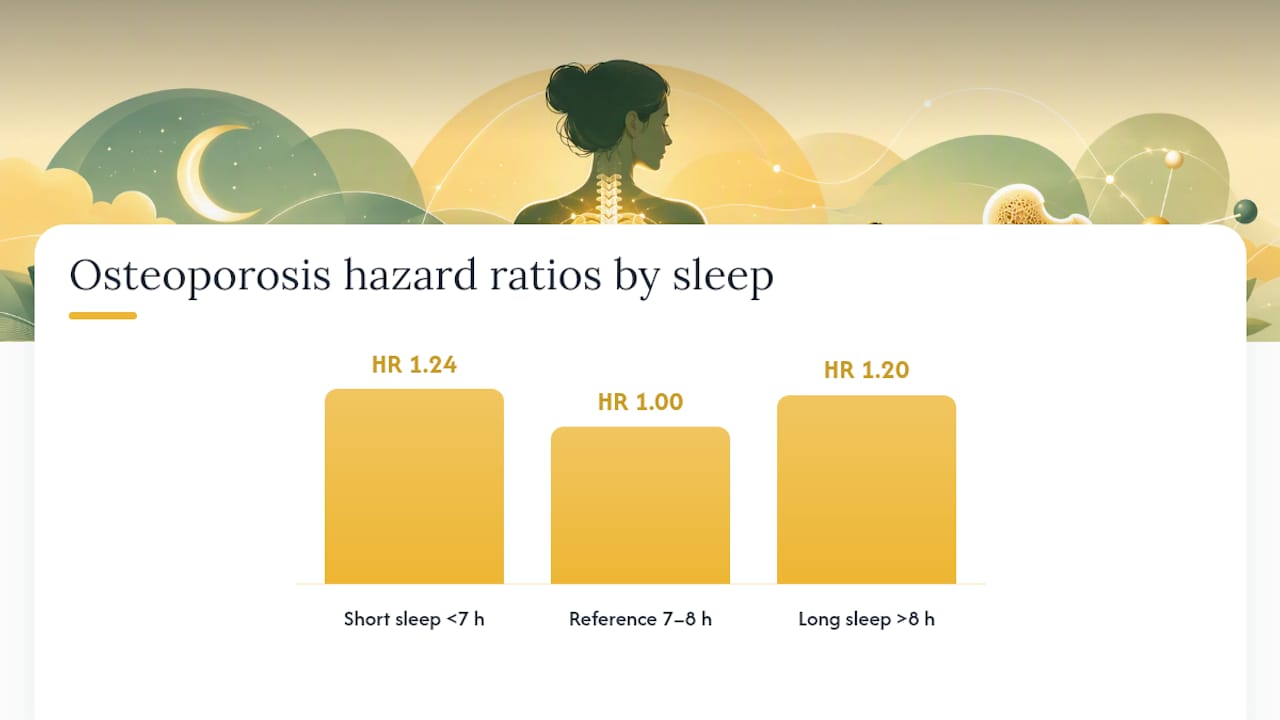
The clearest signal comes from the UK Biobank cohort, where both short sleepers (fewer than 7 hours) and long sleepers (more than 8 hours) carried elevated osteoporosis risk compared to people sleeping in the 7 to 8 hour range. Short sleep carried a hazard ratio of 1.24, long sleep 1.20, both statistically significant across a median follow-up of 13.1 years. That’s a U-shaped risk curve, not a straight line, which matters because it rules out the simple story that “more sleep is always better for bones.”
Older data backs this up from a different angle. The Women’s Health Initiative found postmenopausal women sleeping 5 hours or less per night had higher odds of low bone mineral density at both the hip and lumbar spine, and the Nurses’ Health Study cohort work reported a similar pattern tied to fracture risk. These aren’t fringe findings. They come from some of the longest-running women’s health cohorts in existence.
A few caveats keep this from being an open-and-shut case:
- Most large studies rely on self-reported sleep duration, which is a blunt instrument compared to actigraphy or polysomnography.
- Confounding is a real problem. People who sleep poorly also tend to have higher inflammation, less physical activity, and more chronic disease. Untangling cause from correlation is hard.
- Mendelian randomization work on the UK Biobank data found mixed evidence for direct causality, suggesting some of the association reflects shared risk factors rather than sleep directly damaging bone.
Even with those caveats, the pattern was consistent enough that a 2026 expert consensus published in Bone Research now recommends folding sleep-disorder screening into osteoporosis prevention protocols. That’s a notable shift. Sleep has moved from a footnote in bone-health literature to something clinicians are told to actively ask about.
By the numbers: short sleepers face a 24% higher relative risk of osteoporosis, long sleepers 20% higher, compared to people sleeping 7 to 8 hours a night, based on the UK Biobank’s 13-year follow-up of over 400,000 adults.
Why Would Sleep Affect Your Bones? The Biological Mechanisms
Bone doesn’t just sit there. It’s constantly being broken down and rebuilt in a cycle called remodeling, and that cycle runs on a daily clock, not a random schedule.
Osteoblasts (the cells that build bone) and osteoclasts (the cells that break it down) both carry circadian clock genes that regulate when they’re most active. Bone formation, tracked through a marker called P1NP, tends to peak overnight and dip during the day. Bone resorption markers like CTX and TRAP5b follow their own rhythm too. When sleep is fragmented, short, or badly timed relative to your internal clock, that rhythm gets disrupted. Intervention studies tracking these markers under sleep restriction found the pattern skews unfavorably: formation markers suppressed, resorption markers elevated. Over months and years, that imbalance tips toward net bone loss rather than net bone gain.
Obstructive sleep apnea (OSA) adds a second mechanism on top of simple sleep loss. The repeated drops in blood oxygen that come with untreated OSA trigger low-grade inflammation, raising levels of inflammatory signals like IL-6 and TNF-alpha. Chronic inflammation is one of the more reliable drivers of increased bone resorption. Some clinical studies also link OSA to altered bone microstructure and higher vertebral fracture risk, particularly in cases with more severe hypoxemia and daytime sleepiness. There’s a fall-risk angle here too: OSA patients who are chronically sleep-deprived and hypoxic are simply less steady on their feet, which matters enormously once bone density is already compromised.
A few factors seem to modify how much any of this affects an individual:
- Vitamin D status interacts with both sleep and bone metabolism, and deficiency can amplify resorption independent of sleep quality.
- Age matters because bone turnover is already accelerating during and after menopause, so a sleep-driven nudge toward resorption lands on a system with less buff.
- Sex hormones, especially the drop in estrogen after menopause, appear to interact with circadian bone signaling in ways that are still being mapped out.
- Weight change, particularly rapid loss, can independently affect bone density and muddy the picture in observational studies.
Pro Tip: If you already track resistance training or osteogenic loading sessions, note your sleep duration alongside them for a few months. Poor sleep the night before a loading session may blunt how well your body responds to the mechanical stimulus, even though no controlled study has measured that specific interaction directly.
Key Studies on Sleep Duration and Bone Strength
A handful of studies carry most of the weight in this field. Here’s what each one actually found, and where its limits are.
-
UK Biobank (2025 analysis, 402,533 participants). This is the largest dataset in the field by a wide margin. Researchers tracked self-reported sleep patterns against incident osteoporosis diagnoses over a median of 13.1 years. The U-shaped risk curve, hazard ratio 1.24 for short sleep and 1.20 for long sleep, held up even after adjusting for age, sex, BMI, and lifestyle factors. Its Mendelian randomization component is what makes it stand out. That genetic-instrument analysis found the causal picture was murkier than the observational one, which is an honest and useful finding, not a weakness.
-
Women’s Health Initiative. Focused on postmenopausal women, this cohort found those sleeping 5 hours or fewer per night had roughly 63% higher odds of low bone density at the total hip and 28% higher odds at the lumbar spine, compared to women sleeping longer. This study can’t speak to men or younger women, but for its target population, the signal is strong and specific.
-
Nurses’ Health Study and related cohorts. These added fracture outcomes to the picture, not just bone density scores, linking short sleep to a higher incidence of fractures over follow-up. Fractures are the outcome that actually matters to patients, so this data carries real clinical weight even though it can’t isolate sleep as the sole driver.
-
Actigraphy-based cohorts. A smaller number of studies used wrist-worn actigraphy instead of self-report, giving objective sleep duration and fragmentation data. Results here are more mixed. Some confirm the short-sleep association, others show weaker or null effects, which likely reflects smaller sample sizes rather than a real contradiction of the larger self-report cohorts.
Here’s the part worth sitting with: a hazard ratio of 1.20 to 1.24 sounds modest next to something like a tenfold cancer risk. But osteoporosis affects tens of millions of adults over 50, so a 20% relative increase in risk translates into a meaningful number of additional fractures at the population level. Small relative risks matter when the baseline condition is common. That’s exactly the case with osteoporosis and sleep.
When Should You Bring Sleep Into a Bone-Health Conversation?
If you already have osteoporosis risk factors, a low DXA score, or a prior fragility fracture, a sleep history belongs in that conversation right alongside calcium intake and family history. Most bone-health visits don’t ask about sleep at all, which is exactly the gap the 2026 expert consensus is trying to close.
A few practical screening heuristics follow from the evidence:
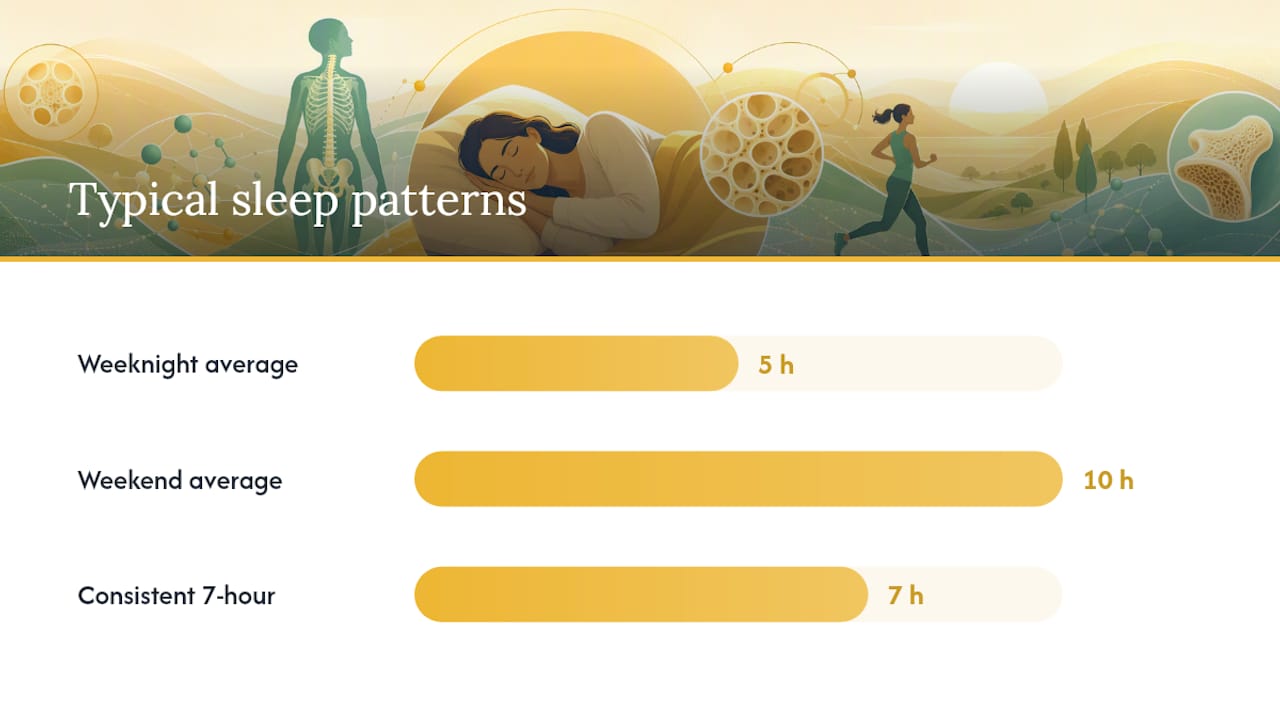
- Ask about typical sleep duration and consistency, not just “do you sleep okay.” Someone averaging 5 hours on weeknights and 10 on weekends is a different risk profile than a consistent 7.
- Flag loud snoring, witnessed breathing pauses, or persistent daytime sleepiness as reasons to consider a sleep study. Undiagnosed OSA is common and frequently missed in older adults, especially women.
- If sleep disorders and other risk factors (low BMI, early menopause, glucocorticoid use, prior fracture) show up together, that’s a reasonable trigger for a DXA scan or a bone microarchitecture assessment rather than waiting on age-based screening alone.
- For confirmed OSA, CPAP treatment has shown improvement in some bone-resorption markers in small clinical studies, which gives clinicians a concrete reason to treat the sleep disorder as part of bone care, not a separate issue.
Pro Tip: Bring a two-week sleep log to your next bone-density appointment, even a rough one jotted on your phone. It gives your provider actual data instead of a vague impression, and it takes five minutes a night to keep.
None of this means sleep alone causes osteoporosis, and no clinician should treat it that way. The honest position is that sleep is one modifiable piece among several, alongside calcium, vitamin D, weight-bearing activity, and hormonal status. Treating a sleep disorder is a reasonable, low-risk intervention that plausibly helps bone health, even in cases where perfect causal proof is still years away.
Practical Steps to Protect Bone Density Through Better Sleep
Here’s what to actually do with all of this, ranked roughly by impact and ease of implementation.
-
Target 7 to 8 hours of consistent sleep, not just total hours. Sleep researchers commonly point to 7 to 8 hours as the range associated with the best health outcomes across multiple systems, not just bone. If you’re chronically under 7 or consistently over 8 without an obvious lifestyle reason, that’s worth mentioning at your next physical rather than shrugging off.
-
Fix your circadian anchors before anything else. A consistent wake time, even on weekends, does more for sleep quality than most supplements or gadgets. Get bright light exposure within an hour of waking, and dim household lighting and screens for the last hour before bed. If you work night shifts, this is harder but not impossible: consistent light exposure timed to your actual schedule, and blackout conditions during your sleep window, both help offset the circadian mismatch that shift work creates.
-
Take snoring and daytime exhaustion seriously. If a partner has mentioned loud snoring, gasping, or breathing pauses, or if you’re falling asleep during the day despite adequate time in bed, ask your doctor about a sleep study. Untreated OSA is one of the more fixable contributors to poor bone turnover on this list, and CPAP therapy has a real, if still developing, evidence base for improving bone markers.
-
Pair sleep improvements with mechanical loading on bone. Sleep optimization addresses the hormonal and inflammatory side of bone health. It doesn’t replace the mechanical stimulus bone needs to actually build density. Weight-bearing exercise, resistance training, or supervised osteogenic loading sessions remain the more direct lever for stimulating new bone formation, and combining that with better sleep gives your body both the mechanical signal and the metabolic environment to use it well.
-
Don’t neglect the basics that interact with sleep. Adequate protein intake, calcium from food or supplements as advised by your doctor, and vitamin D status all interact with bone metabolism, and deficiencies in any of them can blunt the benefit of better sleep. Fall-prevention measures, like clearing tripping hazards and addressing balance issues, matter more once density is already reduced, since a fracture is usually the real event you’re trying to prevent.
-
Know when to escalate. If sleep problems persist despite consistent effort, if you suspect OSA, or if a DXA scan shows rapid bone loss between scans, that’s the point to bring in a sleep specialist or an endocrinologist rather than continuing to self-manage.
Pro Tip: If you’re already getting DXA scans every one to two years, ask your provider to note your average sleep duration in the same chart. Watching the two trends side by side over several years is one of the more practical ways to see whether sleep changes are tracking with density changes for you personally.
Does Sleep Quality Matter More Than How Long You Sleep?
Duration gets most of the research attention because it’s easy to measure and report, but quality may carry just as much weight, and possibly more, for bone turnover specifically. Someone who spends 8 hours in bed but wakes up repeatedly, or never reaches deep sleep, isn’t getting the same hormonal and metabolic benefit as someone with 7 hours of consolidated, restful sleep.
This matters because bone formation markers like P1NP show their strongest activity during specific sleep stages, not just during “time asleep” in general. Fragmented sleep, the kind common in OSA, chronic pain, or frequent nighttime waking, disrupts that pattern even when total hours look acceptable on paper. That’s part of why OSA shows up as an independent risk factor in the research rather than just overlapping with short sleep duration.
The practical implication: if you’re logging 7 to 8 hours nightly but still waking up exhausted, duration isn’t the problem you need to solve. Quality is. That distinction should shape what you bring up with a doctor. “I sleep 7 hours” and “I sleep 7 fragmented, restless hours” are different clinical pictures, even though a sleep tracker might report them identically.
Does Age or Sex Change How Sleep Affects Your Bones?
Postmenopausal women appear to carry the highest documented risk in this research, which lines up with what’s already known about accelerated bone loss after estrogen decline. The Women’s Health Initiative data, focused specifically on this group, found some of the strongest associations between short sleep and low bone density anywhere in the literature.
That doesn’t mean men or younger adults are exempt. The UK Biobank cohort included both sexes and still found the U-shaped risk pattern, suggesting the sleep-bone link isn’t purely a menopause phenomenon. What’s less clear is whether the mechanism is identical across sexes. Sex hormones interact with circadian bone signaling in ways researchers are still mapping, so a man in his 50s and a postmenopausal woman may be experiencing overlapping but not identical biological pathways toward the same outcome.
Age compounds the effect independent of sex. Bone remodeling naturally shifts toward more resorption and less formation as people get older, so a sleep-related nudge toward resorption lands on a system with less capacity to compensate. A 30-year-old with a rough month of sleep is unlikely to see measurable bone impact. A 65-year-old with chronic short sleep over several years is operating with much less margin. Age doesn’t just add risk on its own. It appears to amplify how much sleep disruption matters.
How Sleep Problems Compound Other Bone Health Risk Factors
Sleep disruption rarely operates alone, and that’s part of why isolating its exact contribution is so difficult. It tends to travel with, and worsen, other established osteoporosis risk factors.
Vitamin D deficiency is a common example. Poor sleep and low vitamin D frequently coexist, partly because both are linked to reduced outdoor time and lower physical activity. When both are present, resorption markers tend to run higher than either factor alone would predict, though the exact combined effect hasn’t been precisely quantified in large trials.
Low calcium intake works similarly. Sleep-related shifts toward bone resorption give your body less formation activity to offset inadequate calcium, so a marginal diet that might be tolerable with good sleep becomes a bigger problem when sleep is chronically poor.
Physical inactivity is perhaps the most important interaction. Weight-bearing and resistance exercise are among the most reliable ways to stimulate bone formation directly, and they also happen to improve sleep quality for many people. That creates a two-way relationship: better activity supports better sleep, and better sleep supports the hormonal environment that makes exercise-driven bone gains more effective. Someone who is sedentary, sleep-deprived, and low in vitamin D isn’t dealing with three separate small risks. They’re dealing with one compounded risk that’s larger than any single factor would suggest.
Can Sleep Medications Affect Your Bone Density?
This is an area with far less direct data than sleep duration itself, and it’s worth being honest about that gap rather than overstating what’s known. Chronic use of certain sedative medications has drawn research interest because some sleep aids affect the same hormonal systems, including cortisol and melatonin regulation, that also touch bone metabolism.
Benzodiazepines and some older sedative-hypnotics have been associated with increased fall risk in older adults, which matters enormously for fracture outcomes even independent of any direct effect on bone density itself. A fall in someone with low bone density is far more likely to end in a fracture than the same fall in someone with normal density, so a medication that increases grogginess or unsteadiness carries fracture risk through that pathway alone.
Melatonin itself has been studied somewhat more directly, with some smaller studies exploring its role in bone metabolism given that melatonin receptors exist in bone cells. The evidence here is preliminary and shouldn’t be read as either a warning or an endorsement. The more actionable point for most readers: if a sleep aid, prescription or over the counter, is part of your routine, it’s worth mentioning to whoever manages your bone health, particularly if you’re older or already have reduced density. The fall-risk angle alone justifies that conversation.
What Happens to Bone Density When Sleep Patterns Change Over Time?
Most of the compelling data here is cross-sectional or based on a single sleep-duration snapshot compared to bone density measured once. True longitudinal data, tracking the same people’s sleep patterns and bone density over multiple points in time, is thinner, but what exists tends to reinforce the broader pattern rather than contradict it.
The UK Biobank’s 13.1-year median follow-up is the closest thing to a long-arc dataset in this field, and it captured incident osteoporosis diagnoses over that period rather than a single time-point comparison. That design strengthens confidence that the association isn’t just a snapshot artifact. Bone remodeling operates on a slow biological timeline. It’s a process built from years of accumulated formation and resorption cycles, not something that shifts dramatically after a few rough weeks of sleep. That’s consistent with what’s understood about circadian clock genes in bone cells: chronic misalignment, sustained over years, is what’s thought to gradually uncouple the formation and resorption balance, not an occasional bad night.
The practical upside of that slow timeline is real. It means sleep optimization is a long-term prevention strategy, not something you can expect to reverse existing bone loss quickly. Someone who improves their sleep habits at 55 isn’t likely to see a dramatic DXA change within months, but the trajectory over the following decade may look meaningfully different than if the poor sleep pattern had continued unaddressed.
An Editor’s Take on Where Sleep Fits in Bone Care
Sleep gets treated as a wellness afterthought in most bone-health conversations, and the evidence doesn’t support that ranking anymore. It belongs in the same category as calcium intake and weight-bearing exercise: a modifiable factor worth asking about at every visit, not a lifestyle nicety mentioned in passing.
What the research actually supports is more measured than headlines suggest. Sleep alone isn’t going to reverse osteoporosis, and no legitimate reading of the UK Biobank data claims otherwise. But treating chronic sleep problems as a genuine part of skeletal health, alongside mechanical loading approaches like the osteogenic loading sessions programs built around, reflects where the evidence is actually pointing: multiple modifiable inputs working together, not one silver-bullet fix.
— Aaron
How Osteostrong Fits Into a Sleep-Informed Bone Health Plan
Better sleep supports the hormonal and metabolic environment your bones need. It doesn’t deliver the mechanical loading signal that actually triggers new bone formation. That signal comes from brief, high-intensity osteogenic loading, the approach Osteostrong centers built its sessions around.

A typical visit takes about 15 minutes, once a week, using equipment designed to apply controlled force through your skeleton well beyond what everyday activity provides. Members often pair that weekly session with other in-clinic modalities, including red light therapy, PEMF mats, vibration plates, and the PureWave VEMI lounge, as supportive additions rather than replacements for the core loading work. None of these tools are marketed as a cure for osteoporosis, and no legitimate program should claim otherwise. They’re one evidence-informed piece of a broader plan that should also include the sleep habits and screening covered above.
If you’re already tracking sleep and other risk factors and want to see how supervised osteogenic loading fits alongside them, the Rancho Cordova East center offers consultations to walk through what a personalized assessment looks like.
Sources for Further Reading
- Self-reported sleep disturbances are associated with osteoporosis: multivariable-adjusted and Mendelian randomization analyses in UK Biobank
- Expert consensus on osteoporosis risk management in patients with sleep disorders | Bone Research
- Sleep Disruptions and Bone Health: What Do We Know So Far?
- Sleep disruption and bone health (review)
- The importance of the circadian system & sleep for bone health
- Relationship between sleep and bone (review/meta)
This article is general information, not a substitute for advice from a qualified doctor. Consult a qualified healthcare professional about your own circumstances before acting on anything here.
Sources
Dairy products, leafy greens like kale and collard greens, fortified plant milks, canned fish with bones such as sardines, and almonds all provide meaningful calcium, though individual needs and supplementation should be discussed with a doctor.
- Self-reported sleep disturbances are associated with osteoporosis: multivariable-adjusted and Mendelian randomization analyses in UK Biobank
- Expert consensus on osteoporosis risk management in patients with sleep disorders | Bone Research
- Sleep Disruptions and Bone Health: What Do We Know So Far?
- Sleep disruption and bone health (review)
FAQ
What are 5 symptoms of osteoporosis?
Osteoporosis is often symptomless until a fracture occurs, but warning signs can include loss of height over time, a stooped posture, back pain from a compressed or fractured vertebra, a bone that breaks more easily than expected, and brittle or weakening fingernails in some cases.
Can bone density be increased after age 70?
Bone density gains become harder to achieve in older adults than in younger ones, but studies on resistance training and mechanical loading approaches, including supervised osteogenic loading, show measurable improvements are still possible with consistent effort and adequate nutrition support.
What types of exercise are best for building bone density?
Weight-bearing and resistance exercises that load the skeleton directly, such as strength training, brisk walking, and stair climbing, are the most consistently effective, while low-impact activities like swimming provide cardiovascular benefits without the same bone-building stimulus.
Does poor sleep alone cause osteoporosis?
No single factor causes osteoporosis on its own. Chronic short or long sleep is associated with higher risk in large cohort studies, but it interacts with age, hormones, nutrition, and activity level rather than acting as an isolated cause.