
The most effective path to healthy aging and bones combines three things: weight-bearing and resistance exercise most weeks, adequate protein and calcium with vitamin D as needed, and a fall-prevention plan backed by proper screening. Supervised osteogenic loading at a clinic like Osteostrong can serve as a useful adjunct for people who want a measurable, once-a-week stimulus on top of that foundation.
TL;DR:
- Regular weight-bearing and resistance exercise for 2 to 3 hours weekly can produce meaningful bone density benefits and slow age-related loss.
- Adequate dietary calcium, combined with vitamin D and sufficient protein intake, supports bone health but cannot prevent fractures alone.
- DXA scans should be spaced about five years apart for most without new risk factors, but earlier testing is necessary after fractures or significant health changes.
- Supervised osteogenic loading sessions once a week can supplement traditional exercise by providing a measurable, targeted bone stimulus.
- Fall prevention through balance training and home safety measures is equally important as improving bone density, especially for those at higher fall risk.
Table of Contents
- What Kind of Exercise Actually Protects Aging Bones?
- How Much Calcium, Vitamin D, and Protein Do You Need?
- When Should You Get a DXA Scan?
- Why Falls Matter as Much as Bone Density
- When Do You Need Medication for Bone Loss?
- How Osteogenic Loading and Clinic Adjuncts Fit a Healthy-Aging Plan
- How Bisphosphonates and Hormone Therapy Affect Older Adults
- Does Bone Strategy Change With Age or Gender?
- How Do Osteoporosis and Arthritis Interact With Aging Bones?
- Can Mental Health and Social Connection Affect Fracture Risk?
- Do Smoking and Alcohol Really Affect Bone Density?
- A Simple Way to Start This Week
- Ready to Add Supervised Osteogenic Loading?
- Sources
- FAQ
What Kind of Exercise Actually Protects Aging Bones?
Bone responds to mechanical stress the same way muscle responds to training. Load it consistently and it adapts. Ignore it and it thins, especially after age 50.
A 2026 meta-analysis published in BMJ found that brisk walking, jogging, or combined aerobic-resistance training produced clinically meaningful bone mineral density benefits when done for 2 to 3 hours per week. That is roughly 25 to 45 minutes most days, nothing exotic. The same research identified two periods of accelerated bone loss: women during menopause, typically in their early 50s, and men starting after age 65.
Resistance training is the other half of the equation. Multiple sessions per week using weights, bands, or body weight moves build bone through mechanotransduction. Muscle pulling on bone during a squat or a row sends a signal to bone cells to lay down more density. A Nature review on bone aging describes this as one of the few interventions with a genuine dose-response relationship, though the same review cautions that “more is not always better.” Overtraining a fragile skeleton can backfire.
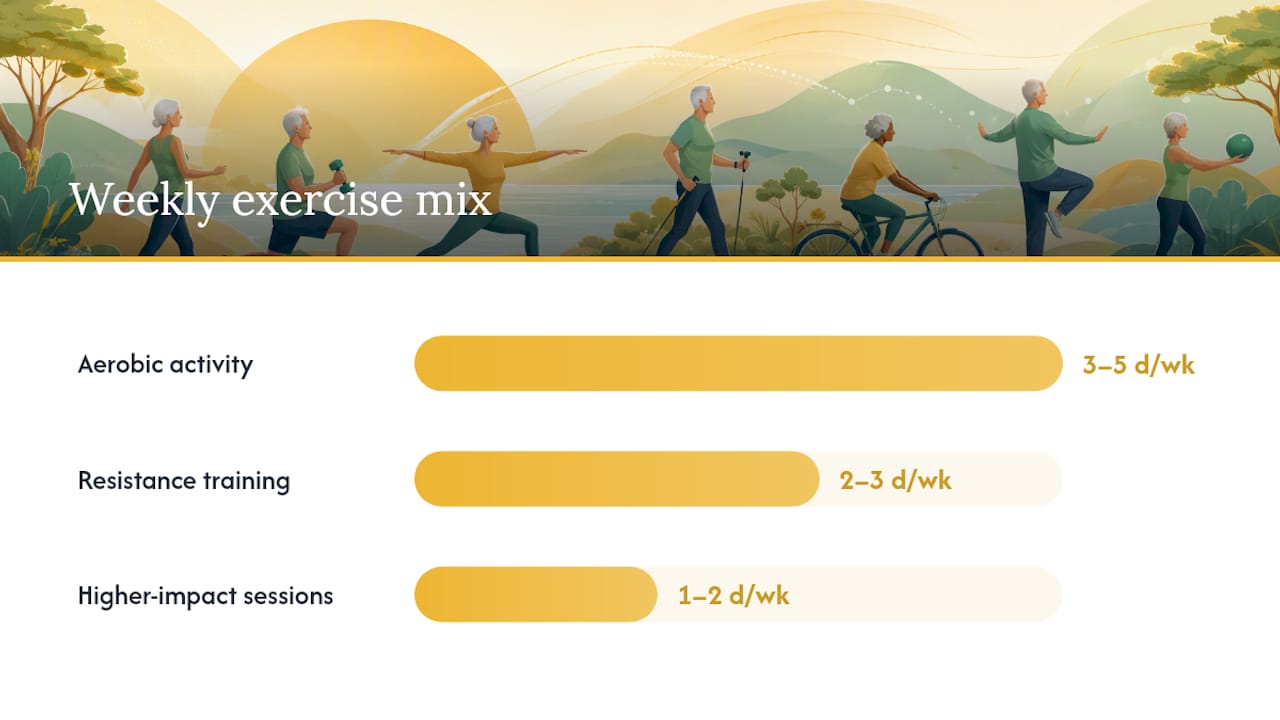
For most people, a sensible weekly mix looks like this:
- Three to five days of brisk walking, hiking, or dancing.
- Two to three days of resistance training targeting hips, spine, and wrists.
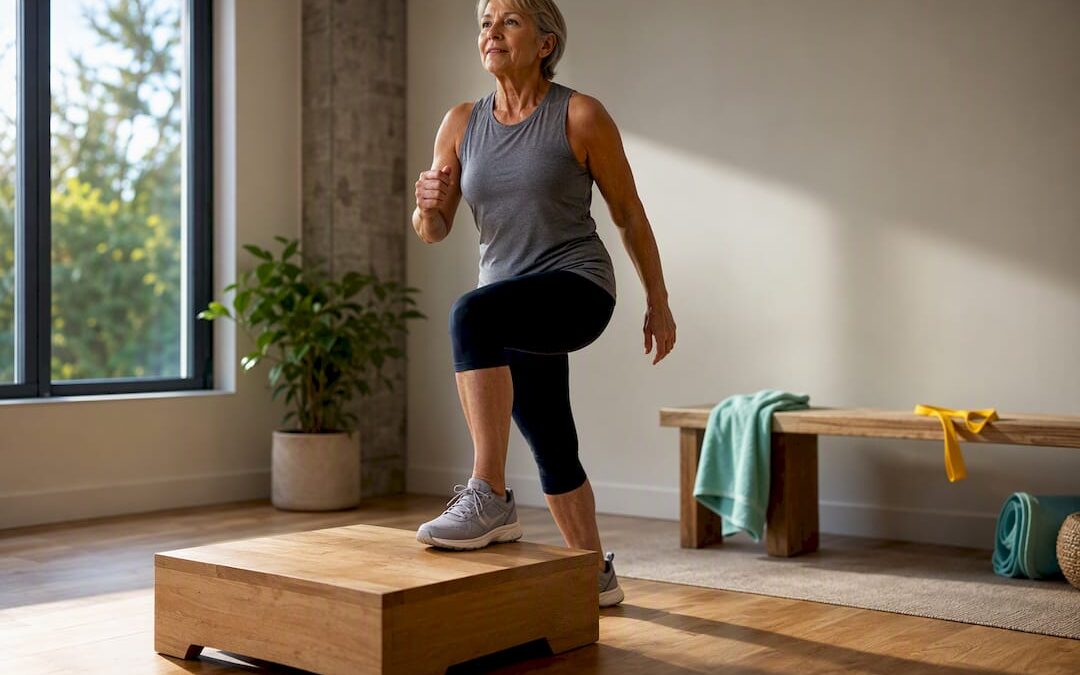
- One or two sessions that include a supervised, higher-impact element, like light jump training or step-ups, if a clinician has cleared it.
Anyone with a prior fragility fracture, severe osteoporosis, or balance problems should skip sudden high-impact moves and progress under professional supervision instead.
Pro Tip: Start resistance sessions with the movements you find hardest, like squats or step-ups, while your energy is fresh. Bone responds best to load performed with full effort, not to a tired afterthought at the end of a workout.
How Much Calcium, Vitamin D, and Protein Do You Need?
Food should supply most of your calcium. Adults over 50 generally need a moderate amount of calcium daily, and dairy, leafy greens, canned fish with bones, and fortified foods usually help most people meet dietary needs.
Vitamin D is a different story. Skin becomes less efficient at making it with age, and many older adults fall short even with decent sun exposure. A daily target of moderate vitamin D intake is common guidance, and the BMJ’s 2024 review on osteoporosis management notes that combined calcium and vitamin D supplementation is still widely recommended, even though recent trials show mixed results for fracture prevention. Vitamin D’s clearer benefit shows up in muscle function and fall risk, not bone density alone.
Protein deserves attention as a key nutrient. Guidelines commonly recommend higher intakes for older adults than the standard minimum to help counter muscle loss and support bone health. That range helps counter sarcopenia, the age-related muscle loss tied directly to fall risk and fracture risk.
A few more notes worth knowing:
- Vitamin K (found in leafy greens) and magnesium (nuts, seeds, whole grains) support bone metabolism, though evidence for supplementing beyond food sources is thinner.
- Megadosing any single nutrient, especially calcium, without medical guidance can cause its own problems and hasn’t shown reliable fracture-prevention benefit.
One figure worth sitting with: an osteoporotic fracture happens somewhere in the world every three seconds. Nutrition alone will not close that gap, but it removes one of the easiest risk factors to control.
When Should You Get a DXA Scan?
A DXA scan (dual-energy X-ray absorptiometry) measures bone mineral density, the standard yardstick for diagnosing osteoporosis and osteopenia. It’s a fast, low-radiation scan, but it has a real limitation: it measures density, not bone quality. Microstructural damage, like cortical porosity or tiny microcracks, can raise fracture risk even in someone whose DXA numbers look only mildly low.
Guidance summarized in an NCBI clinical reference on fragility in elderly patients suggests many people without new risk factors can safely wait around five years between scans, rather than repeating them annually. That is longer than most people assume.
A full workup usually includes more than the scan itself:
- Spinal imaging to catch vertebral fractures that cause no symptoms but signal serious bone loss.
- Lab tests to rule out secondary causes, such as thyroid disease or vitamin D deficiency, that mimic or worsen osteoporosis.
- Risk calculators like FRAX, which combine BMD with age, prior fractures, and other factors to estimate 10-year fracture risk and guide referral to an endocrinologist or rheumatologist.
Why Falls Matter as Much as Bone Density
A hip doesn’t need to be especially fragile to break. It needs a fall hard enough to overwhelm whatever strength is left, and sarcopenia is what removes the muscle that normally catches a stumble before it becomes a fracture. Combined resistance and balance training addresses both problems at once, and multicomponent programs have been shown to improve lumbar spine and femoral neck density by roughly 1 to 1.1 percent over a year, alongside muscle strength gains of 10 to 13 percent, according to the BMJ’s osteoporosis management review.
A practical starting sequence:
- Add two balance sessions a week: tai chi, single-leg stands, or heel-to-toe walking.
- Walk through your home and clear loose rugs, poor lighting, and cluttered stairwells.
- Ask your doctor or pharmacist to review medications that cause dizziness or drowsiness.
- Get an annual vision check, since uncorrected vision loss is a quiet but major fall risk.
- Consider a supervised balance or strength class rather than going it alone if you’ve had a previous fall.
Pro Tip: If you’ve fallen once in the past year, treat it as data, not bad luck. One fall roughly doubles the odds of another within twelve months, so it’s worth a conversation with your doctor before it happens again.
When Do You Need Medication for Bone Loss?
Lifestyle measures come first, but they aren’t always enough. Doctors typically consider drug therapy after a fragility fracture, when DXA shows very low bone density, or when a FRAX score puts someone at high 10-year fracture risk.
Two drug categories work differently. Antiresorptives, like bisphosphonates, slow the cells that break down bone, giving bone-building cells more time to catch up. Anabolic agents actively stimulate new bone formation and tend to work faster. Current thinking, discussed in ongoing osteoporosis research, favors starting with anabolic therapy in patients at very high risk, then transitioning to an antiresorptive to lock in the gains, rather than the older approach of saving stronger drugs for later.
None of this works if people stop taking their medication, and adherence is a persistent problem in osteoporosis care. Side effects, dosing schedules, and simply forgetting why the pill matters all play a role. The most successful care plans pair medication with:
- Regular follow-up visits to catch side effects early and reinforce why treatment matters.
- Fall-prevention coaching alongside drug therapy, not instead of it.
- Realistic goal-setting, since bone density gains from medication show up gradually, not overnight.
Researchers are also exploring senolytic drugs, which target aging cells linked to bone deterioration, as a future direction. That work is still experimental and not yet part of standard care.
How Osteogenic Loading and Clinic Adjuncts Fit a Healthy-Aging Plan
Osteogenic loading is a supervised technique that applies controlled mechanical force to the skeleton, delivered in a brief weekly session designed to stimulate the same bone-building response that resistance exercise triggers, but in a more concentrated dose. This approach is often structured around a once-a-week supervised session format.
Centers also offer several adjunct therapies that support recovery and general wellness alongside the loading sessions:
- Red light therapy
- PEMF mats
- BioCharger sessions
- PureWave VEMI lounge
- Compression therapy
- Vibration plates
- Hydromassage lounges
This approach tends to suit two kinds of people best: those who want a supervised, measurable weekly stimulus rather than a self-directed gym routine, and those with low bone density or joint issues that make standard high-impact exercise hard to tolerate. None of this replaces medical care. Anyone with osteoporosis or a fracture history should talk to their doctor before starting, since clinic-based loading works best as a complement to a broader treatment plan, not a substitute for it.
How Bisphosphonates and Hormone Therapy Affect Older Adults
Bisphosphonates remain the most commonly prescribed osteoporosis medication, and for good reason: they slow bone breakdown effectively and have decades of safety data behind them. They come with tradeoffs worth knowing about upfront. Oral versions can irritate the esophagus, so patients take them on an empty stomach and stay upright for 30 to 60 minutes afterward. Rare but serious risks, like osteonecrosis of the jaw or atypical femur fractures, tend to show up after long-term use, which is why many doctors recommend a “drug holiday” after several years to reassess.
Hormone therapy works through a different mechanism. Estrogen loss during menopause accelerates bone breakdown, so restoring estrogen can slow that process for postmenopausal women. It’s rarely prescribed for bone health alone anymore. Doctors weigh it against risks like blood clots and certain cancers, which vary depending on a woman’s age, health history, and how soon after menopause she starts treatment.
Both drug categories require conversations, not assumptions. A bisphosphonate that’s a great fit for a 68-year-old with normal kidney function might be wrong for someone with reduced kidney function or a swallowing disorder. Hormone therapy that makes sense for a woman five years into menopause might carry different risks a decade later. This is exactly why individualized care, guided by a doctor who knows the patient’s full history, matters more than following a generic protocol. Side effects should be reviewed at every follow-up, not just at the start of treatment.
Does Bone Strategy Change With Age or Gender?
Bone strategy isn’t one-size-fits-all, and the biggest dividing line is menopause. Postmenopausal women lose bone density fastest in the years immediately surrounding that transition, often losing more density in a five-year window than they lost in the previous two decades combined. This is why the BMJ meta-analysis on exercise and bone density specifically flags ages 50 to 54 as a critical intervention window for women, when consistent weight-bearing exercise can meaningfully blunt that loss.
Men face a slower decline overall but see their own acceleration point around age 65, particularly in hip density. That later onset sometimes leads men to underestimate their risk, since osteoporosis carries a reputation as a “woman’s disease” that doesn’t hold up in the data.
Younger adults, especially those under 30, are still building toward peak bone mass, which is typically reached between ages 16 and 25. For this group, the priority is different: maximizing that peak through weight-bearing activity and adequate nutrition sets the baseline that everything later in life draws down from. Someone who reaches age 30 with strong bone density has more room to lose before hitting fracture risk than someone who never built much reserve to begin with.
Practical takeaway by group: women approaching or in menopause benefit most from front-loading resistance training now, men over 60 should treat hip-focused strength work as a priority rather than an afterthought, and younger adults should think of bone-building exercise as an investment with decades of payoff.
How Do Osteoporosis and Arthritis Interact With Aging Bones?
Osteoporosis and arthritis get lumped together because they both affect the skeleton, but they work in almost opposite ways. Osteoporosis is a loss of bone density and structural strength. Arthritis, particularly osteoarthritis, is joint degeneration involving cartilage breakdown and inflammation. The overlap matters because someone managing both conditions faces a harder balancing act: joint pain from arthritis can discourage the very weight-bearing exercise that osteoporosis management requires.
This is where exercise selection gets more nuanced. Low-impact weight-bearing options, walking on softer surfaces, water-based resistance work, or stationary cycling combined with upper-body strength training, let someone load bone without hammering an inflamed joint. Anti-inflammatory management of arthritis, whether through medication, weight management, or physical therapy, often becomes a prerequisite for staying consistent with the bone-focused exercise that matters most.
Chronic conditions rarely travel alone in older adults, either. Diabetes, kidney disease, and thyroid disorders all influence bone metabolism and complicate medication choices. A patient on long-term corticosteroids for an autoimmune condition, for instance, faces elevated fracture risk independent of age, which is why secondary-cause screening during a bone workup matters as much as the DXA scan itself. Managing bone health in the context of other chronic disease isn’t a separate task from managing the disease itself. It’s usually the same conversation, happening with the same doctor, informed by the same labs.
Can Mental Health and Social Connection Affect Fracture Risk?
Bone density and mood seem like unrelated topics until you look at what actually predicts falls. Depression and social isolation are consistently linked to reduced physical activity, and reduced physical activity is one of the strongest predictors of both bone loss and fall risk. The pathway isn’t mysterious: someone who feels isolated or low is less likely to take the daily walk, attend the balance class, or stay consistent with a resistance routine that protects bone over years, not weeks.
There’s a second, more direct connection. Depression and certain psychiatric medications have been associated with lower bone density in some populations, and chronic stress affects the hormonal environment that governs bone remodeling. Sleep quality plays a role too, since poor sleep is tied to both mood disturbance and slower recovery from physical activity.
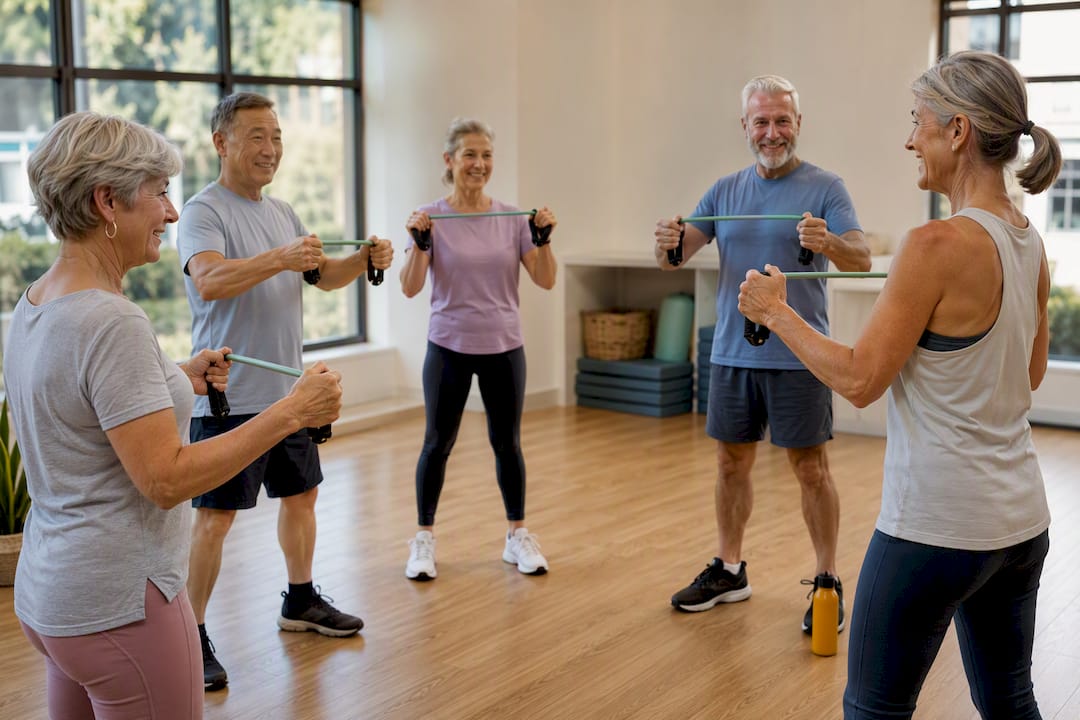
Social engagement offers a practical countermeasure that has nothing to do with supplements or medication. Group exercise classes, walking clubs, or community fitness programs deliver the physical benefit of movement alongside a social structure that makes people more likely to actually show up. For an older adult managing bone health alone, the honest challenge often isn’t knowing what to do. It’s staying motivated to do it week after week, and a class or a walking partner solves that problem better than a printed handout ever will.
Do Smoking and Alcohol Really Affect Bone Density?
Smoking damages bone through more than one pathway. It reduces blood flow to bone tissue, interferes with calcium absorption, and appears to lower estrogen levels in women, accelerating the very process that already speeds up after menopause. Quitting doesn’t reverse existing damage instantly, but it stops the ongoing loss, and bone density benefits from cessation tend to accumulate over the following years.
Alcohol’s relationship with bone is dose-dependent. Moderate intake hasn’t shown the same clear harm as heavy use, but regular heavy drinking interferes with calcium and vitamin D metabolism, disrupts the hormones involved in bone remodeling, and raises fall risk directly through impaired balance and coordination. It’s a double hit: worse bone quality paired with a higher chance of the fall that breaks it.
Neither factor gets the attention that exercise and calcium get in most bone health conversations, but both are entirely within a person’s control, and both compound with age rather than staying flat. Someone who smoked for twenty years and quit at 55 is in a meaningfully different position than someone who never stopped. The same logic applies to drinking habits that shift from occasional to daily over the course of a stressful decade. These aren’t dramatic interventions. They’re subtractions, and subtracting a known risk factor is sometimes more powerful than adding another supplement.
A Simple Way to Start This Week
Walk most days, add two short strength sessions, hit your protein target, and fix one fall hazard at home. At three months, check exercise consistency, review supplements, schedule a DXA if you’re due, and talk to a clinician if progress feels stalled. Expect functional gains, like better balance, before you see measurable density change.
Ready to Add Supervised Osteogenic Loading?
If you’ve read this far, you already know exercise and nutrition only work if you actually stick with them, and that’s exactly where a once-a-week, supervised session solves a problem home workouts can’t. The model focuses on osteogenic loading: a brief, clinic-based session that applies measured mechanical force to stimulate bone, done once a week rather than requiring daily gym visits.
Some centers offer adjunct therapies, including red light therapy, PEMF mats, BioCharger sessions, the PureWave VEMI lounge, compression therapy, vibration plates, and hydromassage lounges, for those seeking additional recovery and wellness support alongside their weekly loading session. None of this replaces a physician’s guidance. Talk to your doctor about your bone density and fracture risk, and treat a clinic visit as a complement to that care, not a substitute for it. If a supervised, measurable weekly session sounds like the missing piece in your routine, you can find osteogenic loading session details and see what a first visit involves at a center near you.
Sources
- BMJ 2026 meta-analysis on exercise and BMD
- Bone aging: a paradigm of multiscale degeneration and targeted rejuvenation (Nature, 2026)
- Osteoporosis and fragility in elderly patients – NCBI Bookshelf
FAQ
What Is the Best Exercise for Aging Bones?
A mix of weight-bearing aerobic activity, like brisk walking, and resistance training two to three times a week works best. Research shows 2 to 3 hours of brisk walking or jogging weekly produces clinically meaningful bone density benefits.
How Much Calcium and Vitamin D Do Older Adults Need?
Most guidelines recommend 800 to 1,000 milligrams of calcium daily, ideally from food, plus 800 to 1,000 IU of vitamin D. Combined supplementation is common, though the BMJ notes mixed evidence for actual fracture prevention from supplements alone.
How Often Should You Get a DXA Scan?
Many people without new risk factors can safely wait around five years between DXA scans rather than repeating annually. Anyone with a new fracture, medication change, or major health shift should ask their doctor about earlier retesting.
What Is Osteogenic Loading and How Does It Help Bones?
Osteogenic loading is a supervised technique that applies controlled mechanical force to the skeleton to stimulate a bone-building response. Osteostrong offers this as a once-weekly clinic session, alongside adjunct therapies, as a complement to standard medical care and lifestyle measures.
Can Bone Loss Be Reversed Naturally?
Lifestyle measures like resistance training, adequate protein, and calcium and vitamin D intake can slow bone loss and modestly improve density in some cases, but they rarely reverse significant osteoporosis on their own. Multicomponent exercise programs have shown about 1 to 1.1 percent density gains over a year, alongside meaningful strength improvements.