
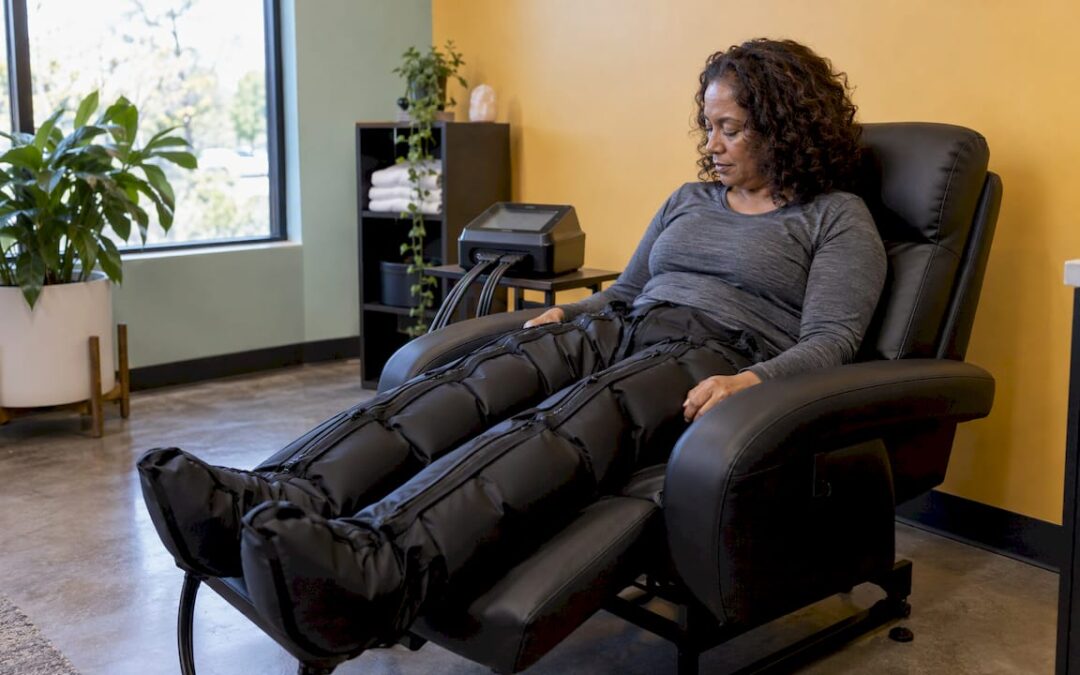
Compression therapy helps most with how sore and heavy your muscles feel after effort, and it does so by applying steady, measured pressure to the limbs. For adults with osteopenia or osteoporosis, it fits well beside a bone-focused routine, because it is a low-impact, seated way to support recovery between sessions. This guide covers how it works, what the studies found, the pressures and session lengths researchers used, and the health checks to do first.
TL;DR
- Compression therapy applies controlled pressure to the limbs to move blood and fluid back toward the heart, which is why it is used after exercise.
- A pooled analysis of 27 studies found a small, statistically significant drop in soreness and pain after pneumatic compression.
- Studied protocols most often ran about 20 to 30 minutes at about 80 mmHg, and garment research points to gentle pressures of roughly 14 to 24 mm Hg on the thigh and calf.
- Certain conditions, such as suspected blood clots or heart failure, rule compression out, so check with your doctor first.
- At our centers in Rancho Cordova, El Dorado Hills and Granite Bay, compression therapy sits alongside our weekly osteogenic loading sessions.
Table of Contents
- What compression therapy is and how it helps you recover
- What the research says about soreness
- Pressure, time and frequency: what studies used
- Safety first: who should check with a doctor
- Compression for adults with osteopenia or osteoporosis
- Getting the most from a session
- How we offer compression therapy
- Our perspective
- FAQ
- Sources
What compression therapy is and how it helps you recover
Compression therapy squeezes the limbs, usually the legs, so that veins can return blood to the heart more efficiently. Cleveland Clinic describes it as a common treatment to improve blood flow in the lower legs, ankles and feet, helping prevent blood from pooling and fluid from building up.
There are two broad forms you will see in recovery settings:
- Garments: compression socks, sleeves, tights or wraps that hold constant pressure while you wear them.
- Pneumatic devices: boots or sleeves connected to a pump. They inflate and deflate in cycles, working from the foot or hand upward, much like a gentle wave of pressure. Researchers call this intermittent pneumatic compression.
The idea behind both is simple. Hard effort, or a long day on your feet, leaves fluid and metabolic by-products in the tissues. Moving that fluid along is meant to leave the muscles feeling lighter and less stiff. UPMC lists the range of options in medical use, from stockings worn through the day to boots and sequential compression devices, which shows how established the basic approach is.
What the research says about soreness
Most recovery studies measure how sore people feel after exercise, along with blood markers of muscle damage. The findings on soreness are encouraging.
Pneumatic compression. A meta-analysis of 27 studies with 554 healthy adults found small, statistically significant effects of intermittent pneumatic compression on soreness and pain (effect size of -0.45) and on creatine kinase, a blood marker released when muscle fibers are stressed. A separate 2024 review of 17 studies and 319 participants found a trivial-to-moderate effect on pain and soreness from lower-limb pneumatic compression.
Compression garments. The garment evidence is broader:
- A 2021 scoping review of 50 studies on muscle soreness found 29 reporting a positive effect of compression garments, and none reporting a negative effect on soreness or perceived exertion.
- A 2022 systematic review found that 20 of 26 studies reported lower perceived soreness. Benefits were expected from as little as 60 minutes after exercise and possibly continued up to 96 hours.
- A 2018 meta-analysis found a small-to-large decrease in delayed-onset muscle soreness, the stiffness that peaks a day or two after unfamiliar exercise, with effects still significant 96 hours later.
- A 2021 American College of Sports Medicine review found no evidence that compression garments are harmful, and found they improved athletes’ perception of muscle damage.
The pattern across these papers is consistent: the clearest benefit is in how recovered you feel. If you are asking whether compression helps with muscle soreness, the answer from the research is yes, mainly by easing soreness and the sensation of heavy, tight muscles.
Researchers also track whether compression changes strength, performance or creatine kinase. If you want to see how those markers are measured in practice, a sports performance and recovery assessment shows what that testing looks like.
Pressure, time and frequency: what studies used
More pressure is not better. A 2022 ACSM review reports that the best pressures for recovery from exercise-induced muscle damage lie around 14 to 19 mm Hg at the thigh and 19 to 24 mm Hg at the calf. It also notes that pressure needs to be high enough to influence local blood flow, and that results are compromised when pressure sits below or above the optimal range. The unit, mm Hg, is millimeters of mercury, the same unit used for blood pressure.

For pump-driven boots, the 2024 pneumatic compression review found the most-used recovery protocol was about 20 to 30 minutes at about 80 mmHg. Garments follow a different logic: the 2021 ACSM review found lower-body garments produced their main effects at 20 to 30 mm Hg.
A practical way to read this:
| Approach | What studies used | What to take from it |
|---|---|---|
| Pneumatic boots or sleeves | About 20 to 30 minutes at about 80 mmHg | One seated session of roughly half an hour is the typical protocol |
| Compression garments | Roughly 20 to 30 mm Hg on the lower body, within a 14 to 24 mm Hg optimal band at the thigh and calf | Comfortable, graduated pressure rather than a tight squeeze |
| Timing | Benefits from about 60 minutes after exercise, possibly up to 96 hours | Use it after your effort, not only on the day itself |
The 2022 ACSM review also advises athletes to be wary of wearing garments for prolonged periods through heavy training blocks, since the effect on long-term muscle adaptation is not known. For most adults with low bone density, a session after activity, kept to the length the device or your care team recommends, matches how the studies were run.
Safety first: who should check with a doctor
Compression is gentle for most people, but it is a pressure treatment, so screening matters. A 2020 international consensus statement on medical compression says every patient should be screened for conditions that raise the risk of complications, and every device checked for appropriate fit. It lists skin irritation and itching as the common complications, and much rarer events that are why screening exists.
An FDA 510(k) summary for a sequential compression device lists these contraindications, meaning situations in which it should not be used:
- Suspected or confirmed deep vein thrombosis (a blood clot in a deep vein) or pulmonary embolism
- Acute venous thrombosis or inflammatory phlebitis
- Congestive heart failure or decompensated cardiac insufficiency, and pulmonary edema
- Arterial or venous occlusive disease, and arterial dysregulation
- Erysipelas, acute inflammatory skin disease or infection
- Carcinoma in the affected limb
If any of these could apply to you, or if you have swelling in one leg that is new, painful or warm, talk to your doctor before using compression. UPMC likewise advises checking with a doctor before buying or using compression stockings. Our own overview of who should not use compression boots walks through the same questions in plain language.
If you have osteoporosis or osteopenia, include your bone diagnosis and any medicines in that conversation. Your physician knows your history and can tell you whether compression suits you.
Compression for adults with osteopenia or osteoporosis
A recovery tool is only useful if you can use it comfortably and regularly. Compression boots are used seated or reclined, so the session does not add load or impact. That makes them a natural companion for people building bone strength, who want soreness and fatigue to settle between sessions.
What bone health calls for is resistance. Bone responds to forces that challenge it, which is the principle behind osteogenic loading, and recovery therapies support the routine around it rather than replacing it. If you want the background on how that works, see our guide to weekly osteogenic loading for osteoporosis.
For a closer look at the compression side, two of our guides are written for people with low bone density: what a compression therapy session is like and how compression therapy costs compare. If your swelling is lymphatic rather than muscular, our lymphatic compression guide covers that.

Getting the most from a session
A few habits make compression more comfortable and more useful:
- Start with a clear health check. Go through the contraindication list above, and ask your doctor if anything applies.
- Keep the pressure comfortable. The research points to moderate pressure. You should feel firm, even squeezing, never pain, numbness or tingling. Stop and tell someone if you do.
- Time it after activity. Studies measured benefits from about an hour after exercise and out to four days, so a session once you have finished your effort fits the evidence.
- Keep sessions to a standard length. About 20 to 30 minutes is what most pneumatic protocols used.
- Check your skin. Skin irritation is the commonest complication in the consensus statement, so look at your legs afterward and mention any redness or itching.
- Pair it with the basics. Hydration, sleep and your regular movement routine do the heavy lifting. Compression adds comfort on top.
How we offer compression therapy
At our centers in Rancho Cordova, El Dorado Hills and Granite Bay, compression therapy is one of the recovery therapies we offer next to our core service, osteogenic loading. Our members come in once a week for a brief, supervised session designed to stimulate bone growth, and our protocol is non-pharmaceutical and built around measurable results in bone density. Compression, red light therapy, PEMF mats, vibration plates and hydromassage lounges round out the wellness side of a visit.
If you have osteopenia or osteoporosis and want a recovery routine that sits around your bone-building plan, start with our osteogenic loading program.
See how osteogenic loading works at OsteoStrong
Our perspective
Most people come to us asking one question: how do I get stronger bones without taking on more risk? Recovery is part of the answer, and it is often the part that gets skipped.
We built our approach on one brief, supervised session per week, because consistency beats intensity. Compression therapy fits that thinking. It is seated, gentle and easy to repeat, and the research on soreness is encouraging: pooled studies show lower soreness after compression, with no harm reported in the garment literature we reviewed.
That is why we offer compression alongside osteogenic loading, red light therapy, PEMF mats and the rest of our wellness equipment. Each one supports a body that is working to get stronger, and each is easier to stick with when it is part of one visit.
We also take screening seriously. Before any compression session, talk with your doctor about clots, heart conditions and skin or circulation problems. A good recovery plan starts from what is safe for you.
Aaron
FAQ
Does compression therapy help muscle soreness?
Yes, the studies point that way. A pooled analysis of 27 trials found a small, significant reduction in soreness and pain after pneumatic compression. Garment research reports lower perceived soreness in most of the studies reviewed.
How long should a compression session last?
The most common protocol in the research was about 20 to 30 minutes at about 80 mmHg using pneumatic boots, according to the 2024 review. Follow the guidance of your device or provider, and check with your doctor if you plan to use it every day.
Can you overdo compression boots?
Stay within the recommended pressure and time, and stop if you feel pain, numbness or unusual skin changes. The consensus statement on compression risks recommends screening and a proper fit for every patient. People with suspected clots, heart failure or skin infection in the limb should not use compression without medical advice.
Is compression therapy okay with osteoporosis or osteopenia?
Compression is applied seated and does not load your bones, but your health history decides whether it suits you. Ask your doctor, mention your bone diagnosis and medicines, and go through the contraindications above. Our guide to compression boot contraindications can help you prepare.
Sources
- Compression Therapy: Types and Benefits, Cleveland Clinic
- Compression Therapy, UPMC
- From Fads to Facts: A Systematic Review and Meta-Analysis
- Effects of lower-limb intermittent pneumatic compression, 2024
- Putting the Squeeze on Compression Garments, 2021
- Tight Margins: Compression Garment Use during Exercise and Recovery, 2022
- An Evidence-Based Approach for Choosing Post-exercise Recovery Techniques, 2018
- Passive Recovery Strategies after Exercise, ACSM, 2021
- Compression Garments for Recovery from Muscle Damage, ACSM, 2022
- Risks and contraindications of medical compression treatment, 2020
- FDA 510(k) Summary K122640