
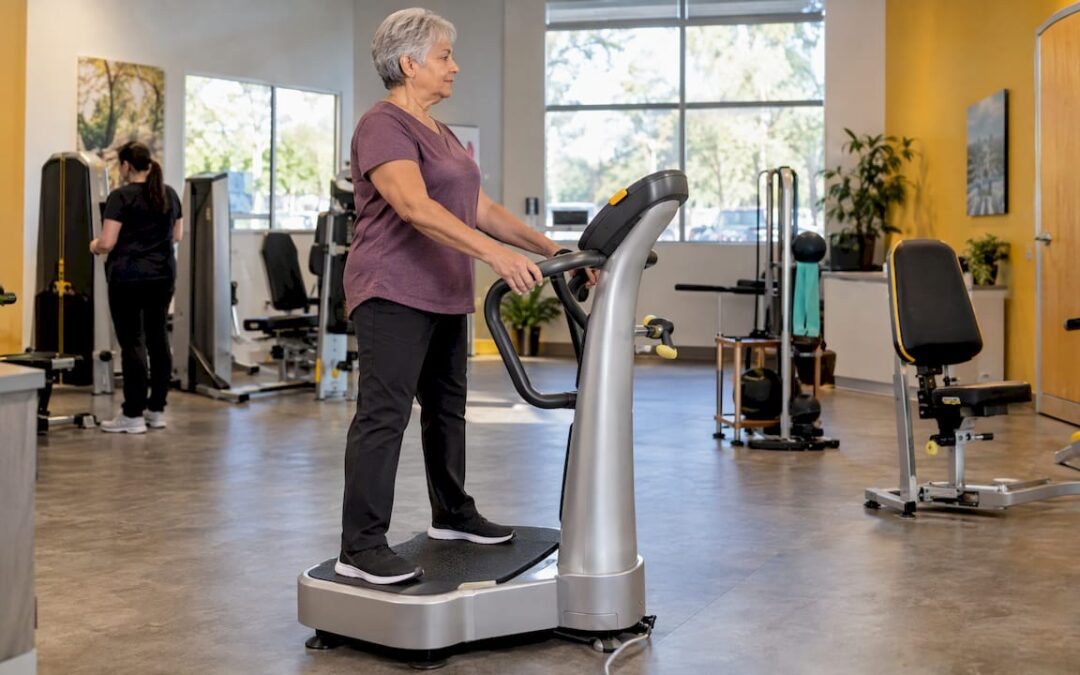
A vibration plate protocol for bone health has five parts: the right platform type, a frequency and amplitude in the studied range, a stable posture, short sessions two to three times a week, and a plan that runs for months. Intensity is the part that matters most for fragile bones, because a plate built for a workout and a plate built for bone therapy deliver very different forces. This guide lays out the settings researchers have used, how a session is structured, and who should get medical clearance first. We also show how it fits with the weekly osteogenic loading session at our centers.
TL;DR
- Studies in postmenopausal women used frequencies of roughly 12 to 40 Hz, amplitudes of 0.7 to 5 mm, and sessions from seconds to 30 minutes, two to three days a week.
- Side-alternating platforms, where one side rises as the other drops, performed best in a 2022 meta-analysis of 30 studies.
- Force matters more than any other number. Workout-grade plates often exceed 4 g, which researchers consider unsuitable for frail people. Low-intensity vibration stays under 1 g.
- Hold a stable, slightly bent-knee stance, keep a handrail within reach, and run any new routine past your physician first.
- Vibration pairs well with a weekly, supervised osteogenic loading session for people who want a structured bone-health plan.
Table of Contents
- What a vibration plate does for bone
- Step 1: Choose the right kind of platform
- Step 2: Understand frequency, amplitude and g-force
- Step 3: Pick settings from the studied range
- Step 4: Set your posture
- Step 5: Build the weekly schedule
- Safety: who should get clearance first
- How vibration fits with a weekly bone-loading plan
- Come in for a supervised session
- Our perspective
- FAQ
- Sources
What a vibration plate does for bone
A whole-body vibration (WBV) plate is a platform that oscillates while you stand on it. The oscillation sends small, rapid mechanical signals up through your legs and into the hips and spine. The idea is that bone responds to mechanical load, and vibration delivers a load without the impact of jumping.
The research is real but varied, and the details of the protocol decide a lot. A 2022 meta-analysis of 30 studies found a small overall improvement in bone density (Hedges’ g = 0.11), including in postmenopausal women (g = 0.09). The authors concluded that WBV may be useful as a non-drug adjunct for lowering osteoporosis risk in healthy postmenopausal women. Side-alternating platforms were the most effective type in that analysis (g = 0.21).
For you, that means the protocol is not “stand on any plate for any length of time.” The platform type, frequency, amplitude, posture and schedule all count. For more background on the benefits for bone and muscle, see our guide to whole body vibration benefits.
Step 1: Choose the right kind of platform
There are two main designs.
- Side-alternating (oscillating): the platform tilts like a seesaw, so one foot rises while the other drops. It also mimics the pelvic motion of walking.
- Synchronous (vertical): the whole platform moves straight up and down.
In the 2022 meta-analysis above, side-alternating platforms produced the largest effect. A 2016 meta-analysis of nine studies covering 527 postmenopausal women reached the same conclusion: side-alternating platforms were more effective than synchronous ones for hip and spine density.
The second distinction is between intensity classes. A federal technical brief from the Agency for Healthcare Research and Quality (AHRQ) points out that consumers often cannot tell a low-intensity platform intended for osteoporosis from a high-intensity exercise platform. The label on the box will rarely tell you which you have. The settings, and the force they produce, will.
Step 2: Understand frequency, amplitude and g-force
Three numbers define a vibration dose:
- Frequency (Hz): how many cycles per second.
- Amplitude (mm): how far the platform travels.
- Acceleration (g): the resulting force, measured against gravity.
The third number comes from the first two, and it climbs quickly. A review of bone vibration therapy by Thompson, Yen and Rubin explains that 1 mm of displacement at 10 Hz produces about 0.4 g, while the same 1 mm at 50 Hz produces about 10 g. The authors note that most workout-oriented devices deliver more than 4 g and are not appropriate for elderly or frail patients. They recommend devices that clearly report their vibration parameters and deliver low-intensity vibration, under 1 g, at high frequencies of 30 to 100 Hz.
This is why the AHRQ brief notes that ISO 2631-1, the international standard for whole-body vibration exposure, treats vibration above 1 g as hazardous regardless of frequency. It also notes that above 1 g a person can briefly become airborne, which is a poor match for fragile bones, and that frequencies above 20 Hz can line up with the natural resonance of body parts and amplify the force that part feels.
Low-intensity vibration sits comfortably inside those limits. Chan, Uzer and Rubin report that 0.3 g at 30 Hz is well within ISO safety limits and would be considered safe for four to eight hours per day. For a deeper look at that range, read our page on 30 Hz and 0.2 to 0.3 g low-intensity vibration.

Step 3: Pick settings from the studied range
Researchers have tried many combinations. Across 12 studies reviewed by AHRQ, frequency ranged from 12 to 40 Hz and amplitude from 0.7 to 5 mm. Sessions lasted anywhere from 15 seconds to 30 minutes, and programs ran 8 to 72 weeks.
Here is how some of the published protocols compare.
| Source | Settings | Posture | Schedule |
|---|---|---|---|
| Lai et al. trial, as summarized in a 2023 review | 30 Hz, 3.2 g | Standing, 5 minutes | 3 times a week, 6 months |
| ACSM study of 108 postmenopausal women | 12.5 Hz/12 mm or 35 Hz/1.7 mm, about 8 g | Dynamic squats, bent joints, weight on forefoot, flat-soled shoes | Three 15-minute sessions a week, 12 months |
| Registered clinical trial | 30 to 40 Hz, 2 to 4 mm | Five static positions: squat, deep squat, wide-step squat, lunge, hands-front lunge | 20 to 60 minutes, 3 days a week, 24 weeks, with calcium and vitamin D |
| 2024 umbrella review (Petrigna et al.) | Below 20 Hz, below 1 g, amplitude around 4 mm | Side-alternating, barefoot, feet shoulder-width apart, handrail, supervision | 3 to 10 series of 60 seconds with 60 seconds rest, 2 to 3 times a week |
Some of these trials used forces well above 1 g, in supervised research settings. That does not make them a template for home use. The umbrella review’s suggestion is more conservative, and it adds that low intensity (under 1 g) and low amplitude (under 0.5 mm) seem safest for people at high fracture risk.
A 2025 meta-analysis of 28 randomized trials, searched through April 2024, found that frequencies of at least 20 Hz with amplitudes of at least 2 mm significantly increased bone density at the femoral neck, greater trochanter and lumbar spine. It also recommends static training for the lumbar spine and dynamic training for the hip.
If you want to see how a clinic reasons about frequency, our page on clinic-tested vibration frequency from 15 to 30 Hz goes through it.
Step 4: Set your posture
Posture changes how force travels through your body. In the 2016 meta-analysis, the full standing posture showed the largest gains, at 0.041 g/cm², while the hack squat also appeared among the studied positions.
A practical stance, drawn from the protocols above:
- Stand with feet about shoulder-width apart, or hip-width if that feels steadier.
- Keep your knees slightly bent, never locked, so your joints absorb the vibration instead of passing it straight to the spine.
- Shift your weight slightly toward the forefoot, as the ACSM study participants were advised.
- Wear flat-soled shoes, or go barefoot as in the umbrella review.
- Keep one hand near a handrail or sturdy support. AHRQ key informants noted that handrails are not confirmed on every platform used for osteoporosis, so check yours.
- Keep your head level and your core lightly braced.
Start with the static stance. Add shallow squats or a gentle lunge only once the static stance feels easy and your clinician agrees.
Step 5: Build the weekly schedule
More is not better here. The 2025 meta-analysis found that two to three sessions a week, adding up to 48 to 96 sessions, were associated with significant bone-density gains. At three sessions a week, that is roughly 16 to 32 weeks.
A sensible structure to bring to your doctor:
- Session length: short bouts. The umbrella review suggests series of 60 seconds with 60 seconds of rest, anywhere from 3 to 10 series.
- Frequency: two to three non-consecutive days a week.
- Duration: several months at minimum, since the studies ran from 8 weeks up to 72 weeks.
- Progression: lengthen time before changing intensity.
The umbrella review also cautions that prolonged WBV sessions can have negative health effects, while shorter times seem safe. Keep bouts brief.
One more practical point from AHRQ: home-based studies asked for use seven days a week, while facility-based studies asked for one to five days a week. Supervised, scheduled sessions are easier to keep up than a daily home habit. Our page on what a vibration plate session involves walks through a typical visit.
Safety: who should get clearance first
Because you are reading this with osteoporosis or osteopenia, safety comes before settings. Talk with your physician, endocrinologist or rheumatologist before starting, especially if you have had a fracture, take medication for bone loss, or have joint replacements, implants, heart rhythm problems, blood clots, or balance problems.
The research points to a few reliable guardrails:
- Keep force low. Under 1 g, and low amplitude, is the range the researchers describe as safest for people at high fracture risk.
- Know your device’s numbers. Choose equipment that reports its frequency, amplitude and acceleration.
- Avoid workout-grade settings. Forces above 4 g are not appropriate for frail people.
- Use support. A handrail, a stable stance and supervision reduce fall risk.
- Stay in range on frequency. The umbrella review notes frequencies below 20 Hz can cause chest, head and jaw discomfort, and frequencies above 100 Hz may stress blood vessels, nerves and muscle.
- Stop if something feels wrong. Dizziness, chest discomfort, sharp pain or numbness are reasons to step off and call your doctor.
A 2024 overview of 15 systematic reviews found that only five reported any adverse events and none reported severe ones. Still, long-term harms are not well defined, so a gradual start under guidance is the right call. Our page on vibration plate contraindications lists who should avoid them in more detail.
How vibration fits with a weekly bone-loading plan
Vibration is one tool among several. Our centers focus on osteogenic loading, a once-a-week, supervised session designed to stimulate bone growth. Our clients come in one time per week for it, and we also offer vibration plates alongside red light therapy, PEMF mats, the BioCharger, the PureWave VEMI lounge, compression therapy and hydromassage lounges.
If you are building a routine, that gives you one place to do the bone-focused work and the recovery work, with staff nearby. Our protocol requires only one brief, supervised session per week, which fits the common problem that daily home routines fade after a few weeks.
The pieces of a week might look like this:
- One supervised osteogenic loading session.
- Short, low-intensity vibration bouts on non-consecutive days, as cleared by your physician.
- Walking, resistance work and balance practice as your clinician advises.
- Calcium and vitamin D as your doctor recommends. The registered trial above supplied 1,000 mg of calcium and 880 IU of vitamin D daily to every participant.
To see how the loading side works, read our pages on weekly osteogenic loading for osteoporosis and osteogenic loading evidence.
Come in for a supervised session
If you would rather not guess at settings, we can help. Our centers in Rancho Cordova, El Dorado Hills and Granite Bay offer osteogenic loading sessions built for adults with osteoporosis or osteopenia, with vibration plates and other recovery therapies available in the same place.
Learn more about osteogenic loading at OsteoStrong and find the location nearest you. Pricing is not published on that page.
Our perspective
Most people who come to us with a low T-score have the same question: what can I do that is strong enough to matter but gentle enough to be safe? Vibration is part of the answer for many of them, and the details are what make it work.
We think about it in three layers. First, the force: low intensity, with known numbers, never a workout-grade setting. Second, the posture: stable, supervised, with support within reach. Third, the rhythm: short bouts, a few times a week, kept up for months instead of days.
That rhythm is why we built our approach around one brief, supervised session a week. Our protocol is evidence-based, non-pharmaceutical, and designed to give measurable results in bone density along with broader wellness benefits, using advanced equipment. Vibration plates sit alongside it as one of the therapies our clients can add.
If you are living with osteoporosis or osteopenia, you do not have to design your own protocol from a stack of studies. Bring your questions and your doctor’s guidance, and we will build the routine around you.
Aaron
FAQ
How many times a week should you use a vibration plate?
For bone health, studies point to two to three sessions a week. A 2025 meta-analysis linked 2 to 3 weekly sessions, totaling 48 to 96 sessions, with significant bone-density gains. Use non-consecutive days and keep each bout short.
How long should a vibration plate session last?
Published protocols range from 15 seconds to 30 minutes. A cautious structure suggested in a 2024 umbrella review is 3 to 10 series of 60 seconds, with 60 seconds of rest between them. Ask your clinician to confirm the right length for your bone density and health history.
Who should not go on a vibration plate?
Anyone with osteoporosis or osteopenia should get medical clearance first. Extra care applies if you have had a recent fracture, have implants or joint replacements, heart rhythm problems, blood clots or balance problems. Workout-grade plates that exceed 4 g are not appropriate for frail people.
What settings are used for osteoporosis?
Studies used 12 to 40 Hz and 0.7 to 5 mm. Researchers describe low intensity, under 1 g, and low amplitude as safest for people at high fracture risk. A common low-intensity example is 30 Hz at about 0.3 g, which sits within ISO safety limits.
Sources
- Systematic review and meta-analyses on whole-body vibration and bone density (2022)
- AHRQ technical brief: Whole-Body Vibration Therapy for Osteoporosis
- Vibration therapy: clinical applications in bone
- The Potential Benefits and Inherent Risks of Vibration as a Treatment for Osteoporosis
- Whole Body Vibration Treatments in Postmenopausal Women (PLOS One, 2016)
- Whole-Body Vibration Therapy as a Modality for Treatment of Osteoporosis (2023)
- Effects of Whole-Body Vibration Training on Different Devices (ACSM, 2011)
- Registered trial NCT03910348
- Intervention Hypothesis for Training with Whole-Body Vibration (2024)
- Effect of whole-body vibration training on bone mineral density (2025)
- Effects of whole-body vibration on bone mineral density in postmenopausal women (BMC Women’s Health, 2024)