
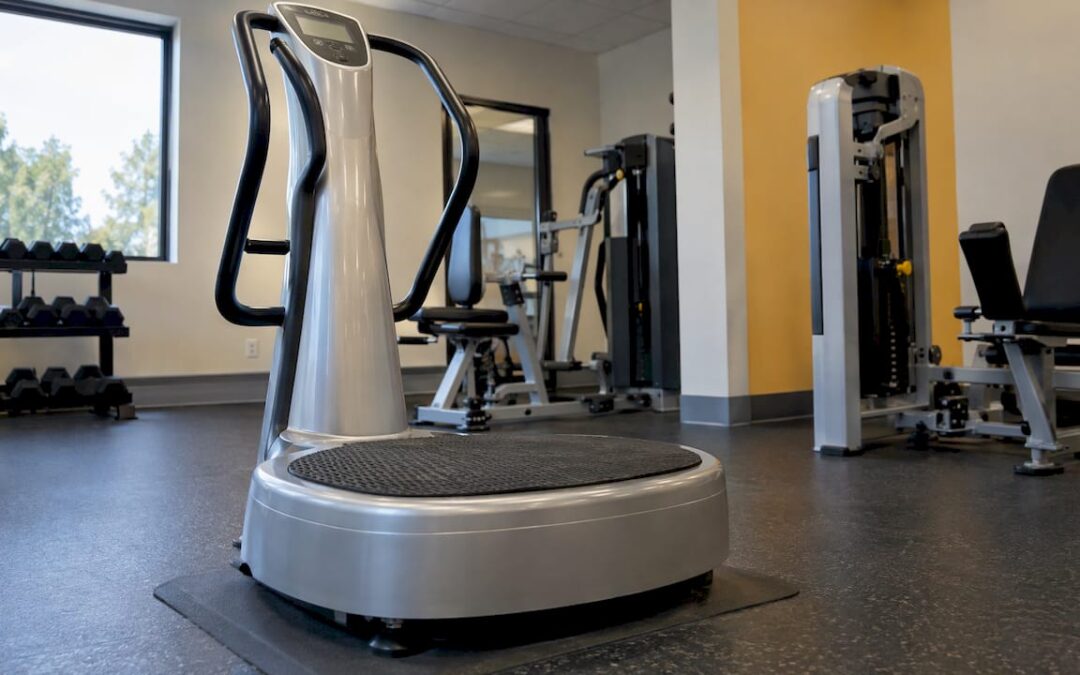
Most vibration plate side effects are mild and short-lived: dizziness, itchy legs, tingling, a headache or tired legs. With osteoporosis or osteopenia, what matters more is the intensity of the plate, your balance and your fracture risk. Check those three things first, ask your doctor if any of the conditions below apply to you, and start low and short. At OsteoStrong, we also offer vibration plates among our wellness therapies, and we build a member’s plan around the weekly osteogenic loading session, a brief, supervised, non-pharmaceutical protocol for bone density.
TL;DR
- Commonly reported effects include itchy legs, dizziness, headache, a sense of imbalance and sore feet. A 2026 systematic review, as reported by Consumer Reports, found side effects were generally mild.
- With fragile bones, the settings matter: high acceleration and very intense signals are the ones researchers say to avoid.
- Severe osteoporosis, recent surgery, implants, pregnancy, retinal detachment, balance problems and uncontrolled epilepsy call for a doctor’s clearance first.
- Stop if you feel nausea, pain, lightheadedness or unsteadiness, and bring any lasting symptom to your clinician.
- Our weekly supervised osteogenic loading session is the core of our bone-density approach. Other therapies, including vibration plates, sit around it.
Table of Contents
- What side effects can a vibration plate cause?
- Is a vibration plate safe with osteoporosis or osteopenia?
- Who should ask a doctor before using a vibration plate
- How to lower your chance of side effects
- How vibration plate effects compare with workplace vibration
- Where a plate fits in a bone-health plan
- Perspective: why we start with a plan, not a gadget
- Start safely with us
- FAQ
- Sources
What side effects can a vibration plate cause?
A whole-body vibration plate shakes the platform you stand on, and the vibration travels up through your feet, legs, spine and head. Side effects come from that vibration reaching tissues that are not used to it.
The U.S. Agency for Healthcare Research and Quality (AHRQ), a federal health research agency, asked clinical experts which harms they had seen or worried about. Their list, in the AHRQ technical brief on whole-body vibration for osteoporosis, includes:
- plantar fasciitis (heel and arch pain)
- itchy legs
- blurred vision
- tinnitus (ringing in the ears)
- white-finger disease, a circulation problem also called secondary Raynaud’s syndrome
- a drop in blood pressure on standing, called orthostatic hypotension in clinical terms
- aggravation of existing soft-tissue and joint injuries
The same brief notes that the studies it reviewed gave little information on harms. So this list is a set of things to watch for, not a statistic on how often each one happens.
A review of vibration therapy, published in 2024 in PMC, adds that vertical vibration has been linked to reduced visual acuity and reduced capacity for visual-motor monitoring. It also reports that 71 to 189 percent more vibration reaches the upper head and body than with rotational vibration, in healthy men and women. In plain terms: the head takes more of the shake than you might expect, which explains the dizziness, headache and blurred vision some people report.
A case report in the Journal of the American Academy of Dermatology is summarized in the research literature as documenting vibration plate purpura, small purple skin spots, as a rare skin reaction.
What the milder reactions look like
A few reactions are common enough that a first-time user should expect them:
- Tingling or itching in the legs and feet. The vibration stimulates skin nerves and blood flow. It usually fades within minutes.
- Lightheadedness when you step off. Your blood pressure adjusts after standing still on a moving platform.
- Tired or sore legs. The muscles work reflexively to steady you, so the effort is real even if you feel you are only standing.
- A mild headache or a feeling of imbalance. More likely with higher frequencies and with locked knees, because the vibration then travels straight up the skeleton.
Research trials offer reassurance on tolerability. A 12-month randomized trial in postmenopausal women found low-magnitude vibration at 30 Hz and 90 Hz was well tolerated. A 2023 trial in adults with moderate knee osteoarthritis reported no adverse events over 15 sessions of low-magnitude vibration. A 2025 trial in patients with aortic valve stenosis saw no serious adverse events in the vibration group, though it was small and from one center. These were all supervised, low-intensity protocols, which is the point: the setting is what you control.
Is a vibration plate safe with osteoporosis or osteopenia?
For many people, low-intensity vibration used correctly is tolerated well. For fragile bones, the details of intensity decide whether a session is gentle or risky, so they deserve your attention.
Acceleration: how hard the plate hits you
Acceleration is how forcefully the platform moves, measured in g (1 g is the pull of gravity). AHRQ’s brief warns that above 1 g a person can become briefly airborne, and the impact on landing may be harmful for someone with fragile bones. Researchers Chan, Uzer and Rubin, in a review of the benefits and inherent risks of vibration, say that very intense signals of 10 g and above should be avoided among osteoporotic patients already prone to fracture. They note that these levels far exceed international workplace exposure limits (ISO 2631) even for one minute a day.
Gym-style plates with large amplitude settings can reach high accelerations without telling you. Low-intensity protocols work in a very different range. Our own background reading on this topic covers 30 Hz and 0.2 to 0.3 g low-intensity vibration for osteoporosis, which is far gentler than a gym plate at full amplitude.

Frequency: why resonance matters
Every body segment has a natural frequency at which it vibrates most readily. The same review explains that vibration delivered near these natural frequencies, below 20 Hz, can amplify the intensity inside the body through resonance. That is one reason a plate’s frequency setting is not a cosmetic number. If you want to see how frequency ranges are usually discussed for bone and balance, we explain them in our guide to vibration plate frequency.
Balance and falls
For a person with low bone density, a fall is the real danger, because a fall is how most fractures happen. AHRQ lists loss of balance and falls during platform use as a concern. Harvard Health quotes Dr. Elizabeth Matzkin of Brigham and Women’s Hospital, who says that a vibration plate is harmless for most people but advises caution for those with balance problems, who may be at risk of falling. She also names stress incontinence, since vibration can cause unintended urine release.
If balance is your concern, hold a rail or stable support, keep your feet planted and start with the lowest setting. Our guide to using vibration plates for balance safely goes through the stance in more detail, and our article on balance training for seniors covers fall-prevention exercises.
Eyes after cataract surgery
There is one risk specific to this population that readers rarely hear. AHRQ notes that dislocation of an intraocular lens after cataract surgery may be a concern with whole-body vibration, particularly because people with osteoporosis are at greater risk of cataract. If you have had cataract surgery, ask your eye doctor before using a plate.
Who should ask a doctor before using a vibration plate
The University of Rochester Medical Center lists the following as safety risks for vibration plate use in its orthopaedic experts’ guidance:
- severe osteoporosis
- back problems or an acute injury
- cardiovascular conditions
- implanted medical devices
- balance problems or frailty
- pregnancy
- a history of retinal detachment
- uncontrolled epilepsy
Chan, Uzer and Rubin add fresh surgical wounds and recent joint implants, pacemakers or cochlear implants to the list of people who should avoid vibration therapy.
If any of these fits you, talk to your primary care doctor, endocrinologist or the specialist who manages that condition before a first session. Bring your most recent DXA scan (the bone density test) and your medication list. They can tell you whether to skip vibration or to use it at a particular intensity. If you are not sure whether your osteopenia or osteoporosis counts as severe, that same conversation settles it.
Our more detailed page on vibration plate contraindications covers who should avoid them, and the one on what the evidence shows for osteoporosis is the right next read if you want the research behind it.
How to lower your chance of side effects
The research gives clear levers. Here is how to use them, step by step.
- Get clearance if you are on the list above. This is the single most useful step, and it takes one appointment.
- Pick the lowest intensity first. Low amplitude and moderate frequency keep acceleration well under the levels researchers flag for fragile bones. If you cannot tell what a plate’s settings are, you cannot judge its intensity.
- Keep your knees slightly bent. Locked knees send vibration straight up the spine and into the head, which is where dizziness and headaches come from.
- Wear supportive shoes or stand barefoot on a non-slip surface. Foot pain such as plantar fasciitis is on the experts’ list, and cushioning or a stable stance keeps the feet comfortable.
- Keep sessions short. Starting with a few minutes and building up gives your body time to adapt. Our page on what to expect in a vibration plate session lays out a gentle start.
- Step off slowly. Stand still for a few seconds before walking, especially if you tend to feel lightheaded.
- Use a rail or have someone nearby if your balance is not steady.
One reason supervised sessions help: someone else watches your posture, the settings and how you look when you step off, so you are not judging all of that yourself.
When to stop and when to call a clinician
Stop the session right away if you feel nausea, pain, lightheadedness, chest discomfort, sudden changes in vision or unsteadiness. Pain in a joint, your back or a bone that does not settle after resting should go to your doctor, especially with osteoporosis, because a new, sharp back or hip pain can mean a fracture. Call emergency services for chest pain, fainting or trouble breathing. Mention ringing in the ears, blurred vision or numb, white fingers to your doctor if they linger after use.
How vibration plate effects compare with workplace vibration
People searching for “dangers” often run into scary results about workplace vibration, such as back pain in truck drivers or Raynaud’s syndrome in construction workers. Chan, Uzer and Rubin mention those cases to show that vibration can affect tissues when it is strong and prolonged. Those exposures run for hours a day over years, at intensities and frequencies that are not the same as a short, low-intensity session. The practical lesson is the one above: intensity, frequency and duration are the variables that decide the outcome, and you can manage them.
Consumer Reports, updating its guidance in September 2026, reports that a 2026 systematic review found side effects were generally mild. That fits the pattern: the effects people feel are mostly temporary and tied to settings and posture.
Where a plate fits in a bone-health plan
A vibration plate is one tool. What drives bone-health work at our centers is osteogenic loading, a brief, supervised session once a week in which you press against resistance to stimulate bone growth. It is a non-pharmaceutical protocol, and members can track measurable results in bone density. Our pages on osteogenic loading for osteoporosis and osteogenic loading results go through what we see in trials and clinic data. We also offer vibration plates, red light therapy, PEMF mats, BioCharger, the PureWave VEMI lounge, compression therapy and hydromassage lounges, so you can choose what fits you alongside the weekly session.
If you want a vibration option, its place is in a plan that starts with your bone density, your balance and your doctor’s input, not in guesswork at home.
Perspective: why we start with a plan, not a gadget
We meet many people with osteopenia or osteoporosis who bought a plate for the house because it looked like an easy answer, then felt dizzy, sore or unsure. The plate is not the issue. The missing piece is a plan that fits a person with fragile bones.
Our approach starts from one brief, supervised session a week of osteogenic loading, a non-pharmaceutical protocol designed to stimulate bone growth, with results you can measure. From there we add therapies that support how you feel and move, vibration among them, at settings chosen for you and with your doctor’s guidance in mind.
The research is clear on the variables: acceleration, frequency, duration and balance. Those are exactly what a supervised session lets someone watch for you. That is how people get the benefits of a wellness routine without taking on risks they did not know were there.
Aaron
Start safely with us
If you live near Rancho Cordova, El Dorado Hills or Granite Bay, you can come in for our weekly osteogenic loading session. It is brief, supervised and built around measurable bone-density results. Tell us about your diagnosis, your medications and any of the conditions listed above, and we will build your routine from there, including whether a vibration plate belongs in it. Start at our Osteogenic Loading page.
FAQ
Is a vibration plate safe if I have osteoporosis?
It can be tolerated well at low intensity, but severe osteoporosis is listed by the University of Rochester Medical Center as a safety risk. High-acceleration plates are the concern: AHRQ warns that above 1 g the impact on landing may harm fragile bones. Ask your doctor before starting, and bring your latest DXA result.
Do vibration plates cause dizziness or headaches?
Sometimes. Dizziness, headache and a sense of imbalance are among the effects reported with whole-body vibration, partly because the head receives a good share of the vibration. Slightly bent knees, a low setting and short sessions reduce the chance. Stop if the feeling does not pass quickly.
What are the most serious vibration plate dangers?
The most relevant for bone health are falls from loss of balance, and impact from high-acceleration plates. Others on expert lists include retinal detachment history, implanted devices, pregnancy, uncontrolled epilepsy and a lens implant after cataract surgery. Each of these is a reason to ask a clinician first, not a reason to guess.
How long should I use a vibration plate at first?
Start with a few minutes at the lowest setting and see how you feel for the rest of the day. Build up gradually only if you feel fine and your doctor agrees. Step off slowly and stop for nausea, pain or lightheadedness.
Sources
- AHRQ: Whole-Body Vibration Therapy for Osteoporosis, technical brief
- Chan, Uzer and Rubin: The Potential Benefits and Inherent Risks of Vibration
- Simon et al.: The Clinical Utility of Whole Body Vibration, 2024
- Slatkovska et al.: 12 months of whole-body vibration therapy, PubMed
- Pasterczyk-Szczurek et al.: low-magnitude vibration in knee osteoarthritis, 2023
- Klaus et al.: oscillatory whole-body vibration in aortic valve stenosis, 2025
- University of Rochester Medical Center: Do Vibration Plates Work?
- Harvard Health: Using a vibration plate
- Consumer Reports: What Do Experts Think of Vibration Plates?