
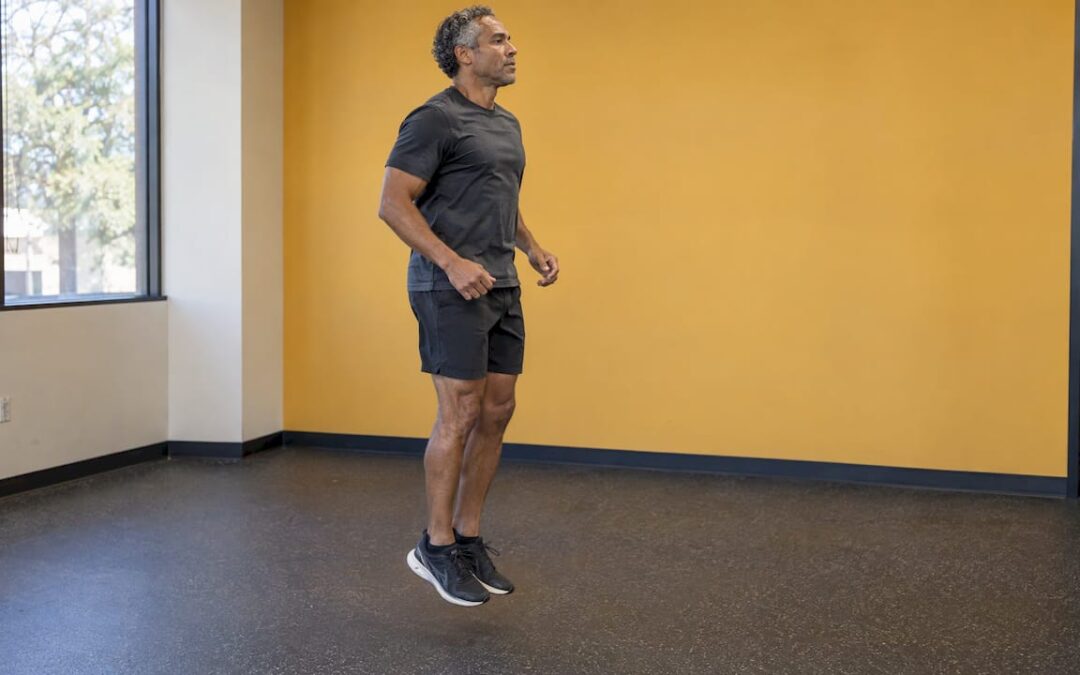
Impact loading, meaning brief, forceful ground contact such as jumping, hopping and heel drops, is one of the few kinds of exercise that professional guidelines say is most effective for increasing or maintaining bone density. The catch is that the dose, the landing and your fracture risk decide whether it helps or hurts. If you have osteoporosis or osteopenia, the safest way to get the bone-building signal is a supervised routine matched to your bone density. That is why many of our members come to us once a week for osteogenic loading instead of improvising jumps at home.
TL;DR
- Moderate- to high-impact activity (jumping, hopping, skipping) is among the best-supported exercise types for bone density, but results vary between studies and depend on dose and your starting point.
- Short, repeated bouts of about 50 impacts beat one long, gentle session, according to RACGP guidance.
- With severe osteoporosis, vertebral fractures, severe knee pain, arthritis or pelvic floor prolapse, jumping may not be advised. Talk with your doctor first.
- Our osteogenic loading protocol is non-pharmaceutical and takes one brief, supervised session per week at our Rancho Cordova, El Dorado Hills and Granite Bay centers.
Table of Contents
- What impact loading means for your bones
- Which exercises count as impact loading
- What the research shows about jumping and hopping
- How much impact is enough
- Who should be careful with jumping
- A cautious way to start at home
- Where a supervised weekly session fits
- Our perspective on impact loading
- Try a supervised session near Sacramento
- FAQ
- Sources
What impact loading means for your bones
Bone responds to force. When your skeleton takes a load that is larger or faster than what it is used to, bone remodeling is stimulated, and over months the bone can become denser. A 2024 analysis in PMC of impact exercise types describes the same idea: high-impact exercise generates mechanical loading that stimulates remodeling.
The Royal Osteoporosis Society explains that one jump counts as one impact, and that in many moderate-impact moves both feet leave the ground together. That counting method is useful because the dose of impact exercise is measured in impacts, not minutes. A 45-minute walk may deliver fewer meaningful impacts than two minutes of well-executed hops.
This also explains why walking and cycling, good for your heart, appear in guidelines as having minimal evidence of benefit for bone density. They simply do not load the skeleton hard enough.
Which exercises count as impact loading
Impact exercises sit on a spectrum. The International Osteoporosis Foundation sorts them by intensity:
| Impact level | Examples |
|---|---|
| Lower | Walking, marching, hiking, Nordic walking, stair climbing, gentle heel drops or stamping, low-impact dancing |
| Moderate | Jogging, low-level jumping, skipping and hopping, racket sports |
| High | Basketball, volleyball, track events, hockey, star or tuck jumps, high jumps, vigorous heel drops, dancing with jumps |
Healthy Bones Australia also lists jumping, hopping, bounding, skipping rope, drop jumps and bench stepping as beneficial impact-loading exercises. Vibration platforms appear in the same family of standing, high-force activities in the Academy of Geriatric Physical Therapy guideline.
Technique matters as much as the category. A physician-authored review in Medicine Today advises that jumps and heel drops land with hips and knees fully extended, so the force travels into bone rather than being absorbed by muscle. The same review notes such jumps produce ground-reaction forces of three to four times bodyweight. That is the point of the exercise, and also the reason it needs care.
What the research shows about jumping and hopping
The honest summary: impact exercise can raise bone density at certain sites, and the strongest results come from well-designed, progressive programs.
Men with osteopenia. In a 12-month randomized trial, physically active men with osteopenia did either resistance training or jump training. Whole-body and lumbar-spine bone density rose significantly by 6 months and stayed higher at 12 months. Total-hip density rose only in the resistance group. The jump program used squat jumps, forward hops, split-squat jumps, bounding and progressive depth jumps from 10 to 100 cm, with no more than 100 jumps a session.
Women after menopause. A 2023 Korean position statement reports that impact exercise, especially jumping, in women with osteopenia or osteoporosis improves bone density when done at least two to three times a week over 6 to 12 months. Six months of impact exercise alone was enough to change density, while combining it with resistance or aerobic exercise took longer than 8 months.
A 2022 Spanish study followed 39 postmenopausal women with osteopenia or osteoporosis for two years. The group that combined high-impact training with calcium and vitamin D had the largest T-score improvements, a baseline change above 20%, and the lowest share of fracture events. The groups doing high-impact training alone or intense walking with supplements held their density steady.
Intensity. A 2022 meta-analysis comparing high-intensity and moderate-intensity resistance and impact training in postmenopausal women with osteoporosis found that the high-intensity version improved lumbar-spine density significantly, and almost all included studies reported minimal adverse events.
Site-specific effects. A 2023 meta-analysis of 28 randomized trials with nearly 3,000 participants found that impact exercise improved density at the distal tibia and the proximal femur (the hip region) and cortical thickness at the radius. Effects at the lumbar spine were not seen across all studies. Bone adapts where the load lands, which is why program design matters.

Mixed results. Some trials found little. A review in PMC notes that 50 jumps six days a week did not change density in 124 postmenopausal women, and a 30-month trial of 160 women did not show a significant gain, although the control group lost bone at the femoral neck and trochanter. The same review reports a roughly 2% trochanter gain in a 12-month class of jumping, skipping, side-stepping and marching two to three times weekly, while the control group lost about 2%. The pattern: consistency, progression and the right loads separate the programs that work from the ones that do not. Preventing loss is itself a result worth having.
How much impact is enough
Different bodies give different doses, so use these as ranges to discuss with your clinician, not as a prescription.
- AAOS (United States): higher-impact moves such as stepping off an 8-inch step or a squat jump with a rebound add more load, and even 20 to 30 jumps a day can help bone density, especially at the hip.
- RACGP: 1 to 2 minute bouts with about 50 impacts, for example 5 sets of 10, are more beneficial than one longer, gentler session.
- Royal Osteoporosis Society: people without spinal fractures build up to 50 moderate-impact exercises on most days.
- Healthy Bones Australia: for people at high fracture risk, moderate-impact activity four to seven days a week, working up to 50 repetitions per session.
Notice the common thread: build up gradually. Starting at 50 jumps on day one is how people end up with sore knees, a tweaked back or worse.
Who should be careful with jumping
This is the part of impact loading most pages skip, and it is the most important. The AAOS says that in severe osteoporosis jumping may not be advised. It can also be painful with severe knee pain or arthritis, and may be limited with pelvic floor prolapse.
The International Osteoporosis Foundation adds that people with osteoporosis should generally avoid high-impact exercise, and that lower-impact options are recommended if you have spinal fractures. Healthy Bones Australia states that sudden jolts are not recommended with extremely low bone density because of the higher risk of fracture. For those with poor muscle strength or coordination, it advises practicing near a stable rail or bench to steady the landing. For extremely low density, stamping the feet may be a manageable alternative.

Before you start any jumping routine, ask your physician or endocrinologist where your DXA results, fracture history and joints place you. If you have had a vertebral fracture, make that the first thing you say.
A cautious way to start at home
If your doctor has cleared you for impact work, this is a sensible progression drawn from the guidance above:
- Begin with heel drops or stamping. Rise onto your toes and drop to your heels, holding a counter. Start with a few sets of 10.
- Add marching and low steps. Step off a low platform, landing softly but with extended knees, only if your knees and balance are comfortable.
- Progress to small jumps. Both feet leave the floor together. Count impacts and aim for sets of 10, with rests between sets, as in the RACGP pattern.
- Increase one thing at a time. Raise the height, the number of sets or the days per week, never all three in the same week.
- Pair it with resistance work. Healthy Bones Australia notes that weight-bearing exercise plus resistance training is the best combination for protecting bones. Our guide to resistance training for osteoporosis covers a safe start.
- Stop if something hurts. Sharp back, hip or knee pain is a reason to pause and call your clinician.
For a wider look at what we know about this category, see our high-impact exercise for osteoporosis guide and our osteoporosis exercise guidelines.
Where a supervised weekly session fits
The weak spot of any home jumping plan is not the science, it is adherence and execution. Doing 50 precisely landed impacts, progressing the load and keeping track of results is hard to sustain alone, and harder when you are worried about a fracture.
Our approach at Osteostrong is osteogenic loading: an evidence-based, non-pharmaceutical protocol that needs only one brief, supervised session per week, with measurable results in bone density. Members come once a week, so there is no jump counting, no daily routine to keep up and no guessing about progress. You can read more about weekly osteogenic loading for osteoporosis and what the evidence says.
It also fits next to the rest of a bone-friendly routine. The same one-visit-a-week rhythm leaves room for walking, resistance work and the balance-focused movement you already enjoy, a combination we describe in our drug-free osteoporosis guide.
Our perspective on impact loading
Impact loading is right in principle: bone strengthens when it is asked to handle force. Where people go wrong is in the delivery. Too little force and nothing changes. Too much, too soon, and a person with fragile bone is taking a risk.
That is why we built our work around one supervised session a week. Our protocol is designed to give your skeleton a meaningful loading stimulus in a controlled setting, with someone beside you and numbers you can follow over time. For people with osteoporosis or osteopenia, that structure is the difference between a good intention and a routine you keep.
We also want you to move the rest of the week. Walk, lift, balance, eat enough calcium and protein, and talk with your physician about your results. Osteogenic loading becomes the anchor of that plan, not a replacement for your doctor.
Aaron
Try a supervised session near Sacramento
If you want your weekly loading done in a supervised setting, we offer osteogenic loading at our Rancho Cordova, El Dorado Hills and Granite Bay centers. Membership and session packages are available, and the sessions are brief. Pricing is not published online, so ask the center nearest you.
If you want to see what the research behind weekly clinic loading looks like, start with our page on osteogenic loading results.
FAQ
Can jumping improve bone density if I have osteoporosis?
It can for some people, particularly with a progressive program. A 2023 position statement reports improved density in women with osteopenia or osteoporosis who did jumping exercises at least two to three times weekly for 6 to 12 months. Severe osteoporosis changes the picture, so check with your doctor first.
How many jumps a day do I need?
Guidance varies. The AAOS says 20 to 30 jumps a day can have a positive effect, especially at the hip. Other bodies suggest working up to 50 impacts per session. Build up slowly rather than starting at the top of the range.
Is hopping better than jumping?
Both are impact loading. In one trial, three weekly sessions of unilateral hops progressing to daily multidirectional single-leg hops raised femoral-neck density by 1.6% in healthy men, as summarized in PMC. Single-leg hopping demands more balance and joint tolerance, so it suits people who are already stable and cleared by a clinician.
What if I cannot jump because of knee pain or fractures?
The AAOS notes jumping can be painful with severe knee pain or arthritis, and the IOF recommends lower-impact options after spinal fractures. Ask your doctor which loading is right for you, and consider a supervised weekly session designed around your bone density.
Sources
- Exercise and Bone Health, OrthoInfo (AAOS)
- RACGP guideline: Exercise
- Impact exercise to help make your bones stronger, Royal Osteoporosis Society
- Exercise and Bone Density, Healthy Bones Australia
- Exercise brochure, International Osteoporosis Foundation
- Physical Therapist Management of Patients With Suspected or Confirmed Osteoporosis, Journal of Geriatric Physical Therapy
- Exercise and osteoporotic fracture prevention, Medicine Today
- Resistance training or jumping exercise in men with osteopenia, PMC
- Position Statement: Exercise Guidelines for Osteoporosis, Journal of Bone Metabolism
- Effects of three interventions combining impact or walking, PMC
- Comparison of exercise intensities for postmenopausal osteoporosis, PMC
- Prescribing Physical Activity for the Prevention and Treatment of Osteoporosis, PMC
- Effects of Moderate- to High-Impact Exercise Training, Journal of Bone and Mineral Research
- Association between different impact exercises and bone health, PMC