
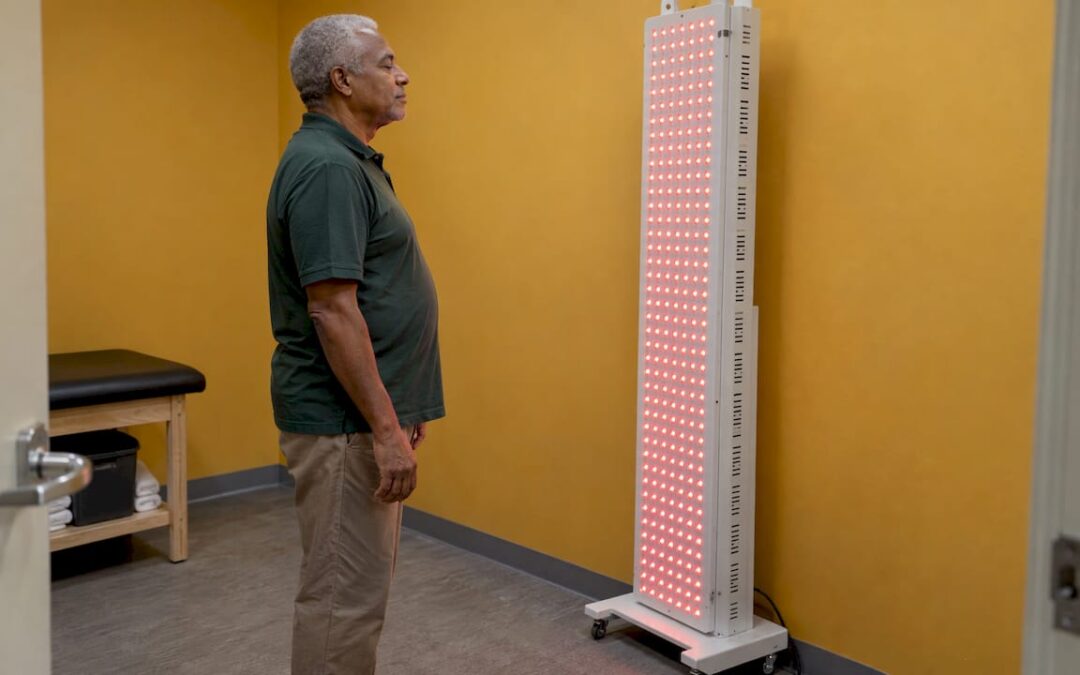
Use red light before a workout if you want to support performance and endurance. Use it after if your main goal is less soreness and faster recovery. The research leans toward pre-exercise use for performance and post-exercise use for soreness, and a 2018 guideline suggests that for endurance training you can use it on both sides of the session. If you can only fit one session, pick the one that matches your goal that day.
This guide walks through what studies show about each timing, how long a session should run, how it fits with strength training, and what adults with osteopenia or osteoporosis should know first.
TL;DR
- Before exercise: studies of photobiomodulation (the clinical term for red and near-infrared light therapy) point to small gains in muscle endurance and fewer markers of muscle damage.
- After exercise: a 2026 meta-analysis of 13 randomized trials links it to less delayed-onset muscle soreness within 72 hours.
- Not a warm-up: light may help you feel ready, but it does not replace moving your joints through their range before you lift.
- Bone health: red light is not a treatment for osteoporosis. Talk with your doctor before adding it, and wear eye protection.
- Consistency beats timing: most guidance lands on 3 to 5 sessions a week, 10 to 20 minutes each.
Table of Contents
- The short answer: match the timing to your goal
- What the research says about using red light before a workout
- What the research says about using red light after a workout
- What the guidelines say about timing and dose
- A simple way to decide: three sample routines
- If you have osteopenia or osteoporosis
- Eye protection and medication checks
- How to get the most from each session
- Make red light part of a bone-strength routine
- FAQ
- Sources
The short answer: match the timing to your goal
People searching this question usually want one rule. The honest version is that the two timings do slightly different jobs.
| Goal | Best timing | What the research suggests |
|---|---|---|
| Better endurance or more reps | Before | Small gains in time to exhaustion and repetitions |
| Less muscle damage after hard training | Before | Lower creatine kinase, a marker of muscle damage |
| Less soreness in the next 1 to 3 days | After | Lower delayed-onset muscle soreness (DOMS) |
| Regaining strength after a tough session | After | Strength improvements measured up to 96 hours later |
| Endurance training (cycling, running, rowing) | Both | Guideline suggests before and after each session |
None of these effects are dramatic. They are modest, and they depend on dose, device and the person using it. That is why the rest of this article spends time on how to use the light, not just when.
What the research says about using red light before a workout
The strongest case for pre-exercise use comes from meta-analyses, which pool many small trials.
A 2015 systematic review and meta-analysis by Leal and colleagues found that phototherapy applied before exercise increased time to exhaustion by about 4 seconds and added roughly 5 repetitions compared with placebo. The authors concluded that it improves muscular performance and speeds recovery mainly when applied before exercise.
A 2024 meta-analysis of 34 randomized controlled trials pointed the same way. Pre-exercise photobiomodulation significantly improved muscle endurance and helped recovery of muscle strength and creatine kinase levels. The same analysis did not find a significant benefit in physically active people, so results vary by who is using it.
A 2022 analysis of 37 studies with 586 participants found improved endurance in single-joint exercises and in time to exhaustion on a bike. It found no effect on maximal muscle strength, running or swimming performance.
One study is a useful reality check. In a 2023 trial, 20 minutes of whole-body light right before maximal cycling did not change power output or lactate. It did produce a slightly higher peak heart rate and better heart rate variability the next morning, which the authors read as a possible recovery benefit without a performance boost.
Taken together: before a workout, light is most likely to help with endurance-type work and with how your muscles hold up afterward. It is not a way to lift heavier the same day.
Does red light replace a warm-up?
No. Even where studies show benefits, the light was used alongside normal exercise, not instead of it. A warm-up raises your heart rate, takes joints through their range and rehearses the movement pattern you are about to load. Light on the skin does none of that.
Think of red light as a pre-session add-on. Use it for 5 to 10 minutes, then do your usual dynamic warm-up: a few minutes of easy cardio, bodyweight squats, hip hinges, shoulder circles. If your joints feel stiff first thing in the morning, the light may help you feel looser, but the movement is what gets you ready.

What the research says about using red light after a workout
The case for post-exercise use is clearest for soreness. A 2026 meta-analysis of 13 randomized controlled trials found that photobiomodulation can reduce delayed-onset muscle soreness within 72 hours after exercise and increase strength within 96 hours.
That matches how a ScienceInsights overview describes the split: pre-exercise use is tied to more repetitions and lower markers of muscle damage, while post-exercise use is tied to reduced soreness, with measurable differences at 48, 72 and 96 hours.
If you train hard on Monday and want to walk down stairs comfortably on Wednesday, after-workout sessions are a reasonable choice. They also fit easily into a routine, since you are already finished and can sit still for 10 to 15 minutes.
What the guidelines say about timing and dose
The most specific guidance comes from a 2018 clinical and scientific recommendations paper by Leal-Junior, Lopes-Martins and Bjordal. In plain terms:
- For acute performance effects, apply light anywhere from 5 minutes to 6 hours before activity.
- For strength training, apply it right before each session for 5 to 10 minutes.
- For endurance training, apply it right before and right after each session.
- Use wavelengths from about 640 nm (red) to 950 nm (near-infrared).
- Aim for 20 to 60 joules on small muscle groups such as the biceps, and 60 to 300 joules on large groups such as the quadriceps and hamstrings.
Two cautions belong right next to those numbers. First, joules depend on the power of your device and how long you hold it in place, so a panel and a handheld probe give different doses for the same minutes. Second, the authors state that the recommendations are for healthy young and adult subjects, because there is not yet enough evidence to make recommendations for non-healthy or elderly people. If that describes you, the next section matters.
How often and how long
ScienceInsights reports that most people get the best results from 3 to 5 sessions a week, each 10 to 20 minutes. It also notes that more is not always better: overdoing it can blunt the benefit, and cutting back to fewer sessions often restarts progress if results stall or your skin gets irritated. Our own page on session length and how it pairs with loading covers the same 10 to 20 minute range, and our dosage guide goes deeper on the numbers.
A simple way to decide: three sample routines
If you lift weights once or twice a week. Use light for 5 to 10 minutes on the muscles you are about to train, then warm up as usual. On the day after, if you are sore, add a short session on the sore areas.
If you walk, bike or swim for fitness. Follow the endurance pattern in the guideline: a short session before, a short session after. Keep each one inside the 10 to 20 minute range.
If your goal is general recovery and you train irregularly. Pick after-workout sessions. They are easier to remember, and soreness relief is where the 2026 evidence is clearest.

In all three cases, keep the dose steady for a few weeks before judging. Note how you feel on day 2 and day 3 after training, because that is where recovery effects show up.
If you have osteopenia or osteoporosis
This is where timing questions turn into safety questions, so here is what to know before you buy a panel or book a session.
Light is not a bone treatment. Healthline notes that red light therapy is not a primary osteoporosis treatment and should not replace what your doctor recommends, such as calcium and vitamin D, prescribed medications and weight-bearing exercise. Talk with your doctor before using it.
The bone research is early. One 2026 review reports that no large randomized trials have examined photobiomodulation for osteoporosis as the primary indication, and that depth is a challenge, since the hip and spine sit far below the skin. See redlighttherapy.expert for that summary. For this reason, think of red light as support for muscle comfort and recovery around your exercise, not as the thing that rebuilds bone.
Muscle recovery still matters for bone health. Weight-bearing and resistance exercise are central to bone care, and sore muscles are one reason people skip sessions. Anything that helps you show up consistently supports the work that does load your skeleton. Our guides on red light therapy for bone density and red light for arthritis and bone health explain how we think about that role.
Start gently. One health information site suggests beginning with 5 to 10 minutes per site, building to 15 to 20 minutes, keeping the panel about 6 to 12 inches away and starting with 3 to 5 sessions a week (Ubie Health). The same page notes that bone remodeling is slow, and measurable DEXA changes can take 6 to 12 months, so track mobility, balance and strength in the meantime and ask your physician about bone turnover markers.
Eye protection and medication checks
Two safety points apply to everyone, and they matter more when you are older or take daily medications.
Wear goggles. Prevention magazine describes red light therapy as safe when you wear eye protection. Near-infrared light is invisible, so you cannot rely on discomfort to warn you. UseSauna reports that unprotected exposure over about 10 minutes at high irradiance can injure the retina, and that goggles rated OD 4+ for 600 to 1000 nm block 99% of the relevant wavelengths. Our page on red light and your eyes covers goggles in more detail.
Check your medications. Prevention notes that doctors do not recommend red light for people with seizures, eye disorders or photosensitizing conditions such as lupus, or for anyone taking a photosensitizing drug such as tetracycline, doxycycline, hydrochlorothiazide or naproxen. UseSauna adds that people on such medications who use light anyway are advised to shorten sessions by 30 to 40% and move back to 10 to 12 inches while watching their skin. That is something to settle with your prescriber or pharmacist first. Our contraindications guide lists who should check before starting.
Other possible side effects Healthline lists are skin irritation, pain and hyperpigmentation. If you notice any, stop and talk with your doctor.
How to get the most from each session
- Bare skin, close to the device. Clothing blocks light. Follow your device’s distance guidance.
- Aim at the working muscles. Quads and hamstrings for squats and walking, shoulders and back for pulling and pressing.
- Time it. 5 to 10 minutes before lifting. 10 to 20 minutes for general recovery.
- Be consistent. 3 to 5 sessions a week is the range most sources point to. Skipping weeks undercuts any effect.
- Do not skip the basics. Sleep, protein, hydration and a proper warm-up do more for recovery than any light.
- Adjust if irritated. Fewer sessions, shorter sessions or more distance.
Our perspective
When people ask us whether light goes before or after training, we answer with a question: what are you training for? Most of our clients come to us with osteopenia or osteoporosis, and their main work is the weekly osteogenic loading session, a brief, supervised effort designed to stimulate bone growth without medication. Everything else we offer is built around helping that work go well.
We use red light as a supporting therapy. Before a session, it can be a calm way to settle in and get the muscles ready. Afterward, it fits naturally into a recovery routine alongside our other therapies, such as compression, hydromassage and vibration. We do not claim light rebuilds bone. The loading does the skeletal work, and the light is there to help you feel good enough to come back every week.
What we value most is supervision. A trained team keeps your dose sensible, makes sure your eyes are protected and notes anything that does not feel right. If you take a photosensitizing medication or have a condition on the caution lists, we want you to clear it with your doctor first, and we are glad to work around your guidance.
The best protocol is the one you will keep doing weekly, and we design ours around that.
Aaron
Make red light part of a bone-strength routine
If you want light, loading and recovery in one place, our centers in Rancho Cordova, El Dorado Hills and Granite Bay combine weekly osteogenic loading with red light therapy, PEMF mats, BioCharger, the PureWave VEMI lounge, compression, vibration plates and hydromassage lounges. Sessions are in person and supervised, so your timing, dose and eye protection are handled for you.
The loading protocol is designed as one brief supervised visit per week, with measurable tracking. To see how it works and how to start, visit the OsteoStrong center page. If you want to read first, our guide to osteogenic loading for osteoporosis and our red light before and after guide are good places to begin.
FAQ
Is it good to do red light therapy before a workout?
It can be. Meta-analyses link pre-exercise light to small improvements in muscle endurance, time to exhaustion and markers of muscle damage. The effects are modest and vary by person, so treat it as a helpful add-on to a normal warm-up.
Is red light therapy better after a workout for soreness?
For soreness, the evidence favors after-workout use. A 2026 meta-analysis of 13 randomized trials found less delayed-onset muscle soreness within 72 hours and strength gains within 96 hours. Sessions of 10 to 20 minutes on the sore muscles are a common range.
Can I use red light before and after the same workout?
For endurance exercise, a 2018 guideline recommends light immediately before and after each session. For strength training, it recommends use right before. Either way, stay within 10 to 20 minutes per site and 3 to 5 sessions a week unless a clinician advises otherwise.
Is red light therapy safe if I have osteoporosis?
It is generally considered safe with eye protection, but it is not a replacement for your prescribed treatment. Check with your doctor first, especially if you take photosensitizing medications such as certain antibiotics or diuretics, and start with short sessions.
How do I get the best results from red light therapy?
Be consistent, use the right dose and aim the light at bare skin over the muscles you trained. Most guidance points to 3 to 5 sessions weekly. If progress stalls or skin feels irritated, cut back instead of adding more.
Sources
- Leal-Junior et al., phototherapy and exercise meta-analysis (2015)
- Pre-exercise photobiomodulation meta-analysis (2024)
- Photobiomodulation and ergogenic effects meta-analysis (2022)
- Whole-body photobiomodulation and post-exercise recovery (2023)
- Photobiomodulation and delayed-onset muscle soreness meta-analysis (2026)
- Clinical and scientific recommendations for photobiomodulation in sport (2018)
- ScienceInsights: how often to use red light therapy
- Healthline: red light therapy for osteoporosis
- Prevention: red light therapy benefits and safety
- Ubie Health: red light therapy and bone health
- UseSauna: red light therapy risks
- redlighttherapy.expert: bone density and osteoporosis
Trackbacks/Pingbacks