
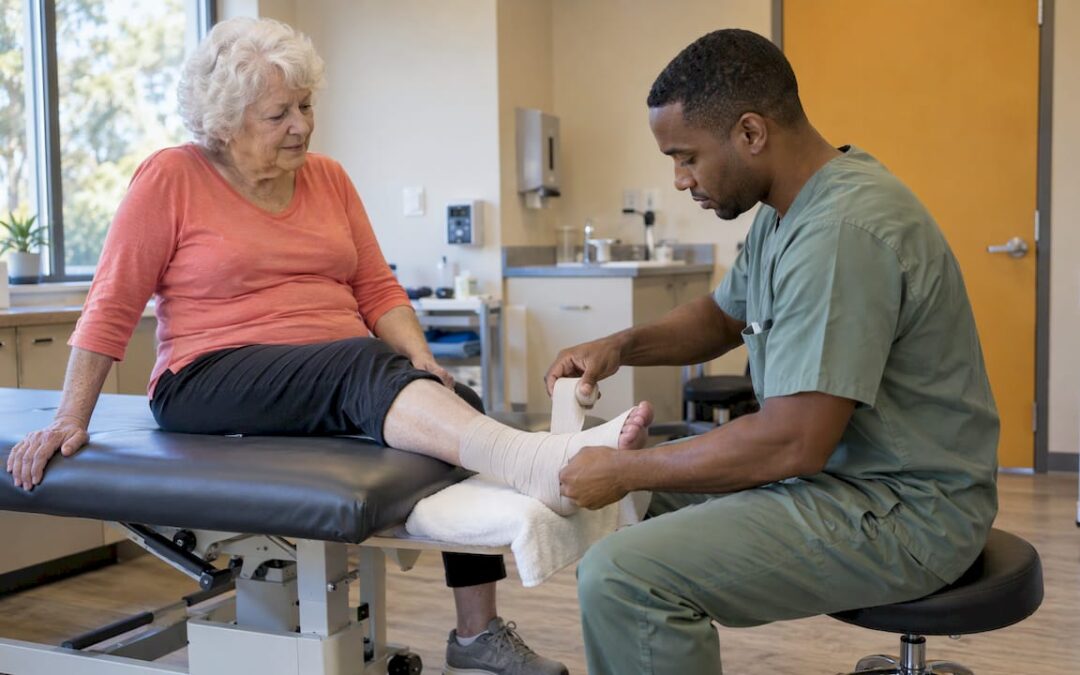
Compression can reduce swelling after a fracture, and the best evidence comes from ankle fractures treated with multilayer bandages or fitted compression stockings. It should always start with your surgeon or orthopedic provider. A fresh fracture is a situation where the type of compression, the pressure and the timing all need a clinician’s approval. This guide covers what the research shows, how bandages differ from compression boots, which warning signs mean a call to your provider, and when compression sessions can join a bone-health plan.
TL;DR
- Trials in ankle fractures found that multilayer compression and compression stockings reduced swelling more than ice and elevation alone or a basic elastic wrap.
- Compression helps move fluid. It does not make a bone knit faster, and no trial here shows that it does.
- Elevation, ice and cast care come first for the first 48 to 72 hours. Numbness, color change or a tight cast means calling your provider the same day.
- Boots and sleeves are a different tool from a fitted bandage. Ask your clinician before using any pneumatic device near a healing fracture.
- If you have osteoporosis or osteopenia, swelling care and bone-strength work run side by side. Our centers focus on the second part.
Table of Contents
- Why a fracture swells
- What the research shows on compression after a fracture
- Compression is not a bone-healing treatment
- What to do first for fracture swelling
- Warning signs: call your provider the same day
- Compression boots, sleeves and bandages are different tools
- How pressure affects fluid movement
- Safety checks before any compression session
- Ankle injuries and swelling: a related case
- Osteoporosis, osteopenia and swelling care
- Our perspective
- Where our sessions fit
- Other therapies and fracture timing
- A practical routine to discuss with your clinician
- FAQ
- Sources
Why a fracture swells
A broken bone bleeds into the surrounding tissue, and the body sends extra fluid to the area. The result is swelling that often peaks in the first days and can linger for weeks, especially in the ankle, foot and wrist, where gravity pulls fluid down and tissue is thin.
The American Academy of Orthopaedic Surgeons notes that swelling from an injury can create pressure inside a splint or cast during the first 48 to 72 hours. That is why early swelling control is part of the treatment plan, not a comfort extra.
Swelling matters for three practical reasons:
- It adds pain and tightness.
- It stiffens nearby joints, including uninjured toes and fingers.
- In surgical cases, it can affect when the surgical team is comfortable operating and how the incision settles.
A 2020 article in the Journal of the American Academy of Orthopaedic Surgeons goes further. It describes lymphatic flow as playing a notable role in regulating bone formation and remodeling, and says chronic fluid accumulation may interfere with proper healing. It also names compression as first-line conservative treatment for lymphedema. That connects swelling control to the larger recovery picture, though it does not mean compression speeds up bone repair.
What the research shows on compression after a fracture
The most useful trials come from ankle and hindfoot fractures.
Multilayer compression versus ice and elevation
A 2014 randomized trial of ankle and hindfoot fractures compared multilayer compression with ice and elevation. After two days, swelling dropped by 23% before surgery and 22% after surgery in the compression group. In the control group the drops were 5% and 7%. The difference was statistically significant.

The same trial tested intermittent impulse compression without an added bandage or elevation. It did not significantly beat ice, and the authors could not recommend it as a superior option. The lesson is practical: how compression is applied matters, and pairing it with elevation matters.
Compression stockings versus a tubular bandage
In a 2014 trial of 90 patients with ankle fractures, fitted ankle injury stockings reduced swelling at every time point. At six months the mean Olerud-Molander ankle score was 98 in the stocking group and 67 in the Tubigrip group. That score measures ankle function and symptoms, and a higher number is better.

The same trial looked at deep vein thrombosis on duplex imaging at four weeks. Five of 43 patients (12%) in the stocking group and ten of 43 (23%) in the Tubigrip group had a clot. That difference was not statistically significant, and the authors said a larger study would be needed to confirm any protective effect. So the trial supports swelling and function benefits, and it leaves the clot question open.
Cold compression plus exercises
A retrospective study of 60 patients with periarticular ankle fractures found that early local cold compression combined with rehabilitation exercises significantly reduced swelling and pain. It also improved ankle function and sped up range-of-motion recovery. Retrospective designs are weaker than randomized trials, but the result points in the same direction.
Where the evidence is thinner
For acute joint injuries more broadly, a systematic review of compression wraps found evidence limited mostly to ankle sprains, with low to very low certainty. It could not show a clear benefit or harm compared with no compression, a splint or a brace as first aid. In plain terms: the stronger signals are in ankle fractures with structured compression, and other sites have less research behind them.
Compression is not a bone-healing treatment
Compression therapy moves fluid. It reduces edema and can make a limb feel lighter and less tight. Nothing in the research above shows it knits bone or shortens how long a fracture takes to heal. The JAOS article links lymphatic health to the healing environment, which is a reason to care about swelling, and it stops short of claiming that compression repairs bone.
Bone repair depends on the fracture type, your age, nutrition, medications, and following your surgeon’s weight-bearing instructions. If a fracture happened with a minor fall or a cough, it is also a signal to look at bone density, which is a separate conversation with your primary care doctor or an endocrinologist.
What to do first for fracture swelling
Before any device, the basics do most of the work. These come from MedlinePlus and the AAOS:
- Elevate. Raise the limb above heart level while resting. For ankle fractures, MedlinePlus advises sitting with the foot higher than the knee at least four times a day.
- Ice. For an ankle fracture, the same page suggests an ice pack for 20 minutes every hour while awake for the first two days, then 10 to 20 minutes three times a day as needed. Keep the cast or splint dry.
- Move what you are allowed to move. The AAOS suggests gently moving uninjured but swollen fingers or toes to limit swelling and stiffness.
- Remove rings from fingers or toes on the injured limb. Swelling can work its way down and make them larger.
- Ask before using anti-inflammatories. MedlinePlus notes that ibuprofen or naproxen may affect fracture healing, so talk with your provider before taking them for long.
- Skip scratching or putting anything inside the cast.
Compression comes on top of this, and your clinician decides when and how.
Warning signs: call your provider the same day
Swelling under a cast can become a medical problem. The AAOS lists increased pain, numbness and tingling, burning or stinging, excessive swelling below the cast, and loss of active movement in the toes or fingers as signs needing immediate attention. MedlinePlus adds a cast that feels too tight, skin that itches or burns, and skin that looks pale, blue, black or white.
Do not respond to those signs by adding your own wrap or boot. Call the provider who placed the cast.
Compression boots, sleeves and bandages are different tools
People searching for this topic often mix up three things.
| Tool | What it is | Typical role |
|---|---|---|
| Multilayer bandage | Layered wraps applied by a clinician | Studied in ankle fracture swelling |
| Compression stocking | Fitted garment with graded pressure | Studied after ankle fracture, with functional gains |
| Pneumatic boots or sleeves | Air chambers that inflate in sequence | Used for lymphatic support and edema; fracture use needs clinician direction |
The pneumatic category has its own research. In a 2015 study of 18 patients with lymphedema, daily sequential pneumatic compression over 24 to 36 months was associated with tissue fluid channels forming as pathways to evacuate edema fluid. That is chronic lymphedema, a different condition from a fresh fracture. A 2024 study in elderly patients after femoral neck fracture surgery examined pneumatic compression plus heparin for clot prevention, which shows these devices are used in orthopedic care under medical direction.
If you want a closer look at the lymphatic side, our lymphatic compression therapy guide walks through how sessions work, and our overview of compression therapy’s medical uses covers where the evidence is strongest.
How pressure affects fluid movement
More pressure is not better. A 2023 review in Current Dermatology Reports explains that edema reduction tracks with compression pressure in a range of roughly 10 to 40 mmHg. Higher pressures showed an inverse relationship with less reduction. It also notes that lymphatic drainage falls when external pressure exceeds that of the lymphatic pump.
That is why sessions are set to the person, and why a fracture needs pressure and coverage decided with your clinician. Settings, how long you wear them and which part of the limb is covered all matter.
Safety checks before any compression session
A 2020 international consensus statement says every patient receiving compression therapy should be screened for conditions that raise the risk of complications. It describes severe complications such as nerve damage, venous thromboembolism, arterial thrombosis and skin or limb necrosis as very rare, occurring in predisposed patients or with improper use. Screening is the safeguard.
Talk to your surgeon, orthopedist or primary care doctor before compression if any of these apply:
- A recent or healing fracture, especially one with hardware or a cast
- Known or suspected blood clot, or a history of one
- Heart failure or swelling from a heart condition
- Poor arterial circulation in the legs
- Active vein inflammation, or skin infection or open wounds on the limb
- Numbness or reduced feeling in the limb
See our guide to compression boots contraindications for a longer checklist you can bring to the appointment.
Ankle injuries and swelling: a related case
Many readers asking about swelling have an ankle injury rather than a confirmed fracture. A sprain and a fracture can look alike, so get imaging if you cannot bear weight or the pain is severe. Once a clinician has ruled out a break, the recovery phases for a sprain follow a clear pattern, and this overview of ankle sprain recovery phases explains swelling, mobility and exercises across the weeks.
Osteoporosis, osteopenia and swelling care
If you have low bone density, a fracture is more than a one-time event. It marks a point where you and your doctor review bone health. Compression for swelling and strengthening for bone answer different questions:
- Swelling: managed with elevation, ice, cast care and, when your clinician approves, compression.
- Bone strength: built over months with progressive loading, nutrition, and medical treatment where prescribed.
Our clients with osteoporosis or osteopenia often ask whether the two overlap. They are separate tracks, and we keep them separate. Our fracture risk reduction page explains the bone side, and our osteogenic loading for osteoporosis guide describes what weekly sessions involve.
Our perspective
We meet people every week who have had a fracture, or who are afraid of one. Most of them ask about swelling first because it is what they feel. We think that is the right instinct, and we also think it should lead to a bigger question: why did the bone break?
Compression therapy is part of our wellness menu because moving fluid and easing heaviness is useful, and sessions are quick and relaxing. We offer it alongside red light therapy, PEMF mats, vibration plates and hydromassage lounges. We do not present it as a way to knit a bone, and we never ask anyone to skip their surgeon’s instructions.
Our core work is osteogenic loading: one brief, supervised session per week designed to stimulate bone growth, without drugs. Our approach is built around measurable progress in bone density. If you are recovering from a fracture, we ask for your clinician’s clearance before we plan any session, and we match every therapy to where you are in healing.
Aaron
Where our sessions fit
Once your provider has cleared you, compression can be one part of a recovery routine that also protects your skeleton long term. If a doctor has told you your bone density is low, the most useful next step is a plan for the bone itself. Our centers in Rancho Cordova, El Dorado Hills and Granite Bay offer weekly osteogenic loading with supervision, plus compression therapy and other recovery options for adults with osteoporosis or osteopenia.
To see how a session works and ask whether it suits your situation, visit our Osteogenic Loading page. If you are curious about the evidence first, read our osteogenic loading evidence summary.
Other therapies and fracture timing
People often ask whether other recovery tools are safe near a fresh fracture. The honest answer is that each has its own screening list, and a healing fracture is a reason to ask first.
- PEMF: read the PEMF contraindications and our page on PEMF with supervised loading.
- Vibration plates: see the vibration plate contraindications and the evidence on vibration plates and osteoporosis.
- Compression for varicose veins: a separate use, covered in our varicose veins guide.
The pattern is the same each time: clearance first, settings matched to you, and sessions stopped if something feels wrong.
A practical routine to discuss with your clinician
This is a framework to bring to an appointment, not a prescription.
- Days 1 to 3: Elevate above heart level, ice as instructed, keep the cast dry, move free toes or fingers.
- First weeks: Ask whether a multilayer bandage, fitted stocking or other compression suits your fracture type and whether you had surgery.
- When the cast comes off: Ask about graded stockings or lymphatic sessions for lingering swelling, and about pressure and duration.
- Throughout: Track swelling at the same time each day, such as morning versus evening, and report increases.
- After healing: Ask for a bone density review if the fracture came from a low-impact event, then plan strengthening.
FAQ
How do you make fracture swelling go down?
Start with elevation above heart level and ice as your provider instructs. Move fingers or toes that are free of the cast. Compression can add to this when your clinician approves it, as trials in ankle fractures found less swelling with multilayer bandages or fitted stockings.
Can compression boots help swelling from a broken bone?
They might help in some cases, but a healing fracture is a reason to ask your surgeon first. One trial found intermittent impulse compression without a bandage or elevation did not significantly beat ice for ankle and hindfoot swelling. Get clearance and settings from your clinician before trying any boots.
Does compression therapy make a fracture heal faster?
The research here shows that compression reduces swelling and may help function, but it does not show faster bone healing. Bone repair depends on the fracture, your health and your surgeon’s plan. Compression supports comfort and fluid movement during that process.
Is compression therapy safe with osteoporosis or osteopenia?
Many people with low bone density use compression, but screening matters. The consensus statement advises that every patient be screened for conditions raising complication risk. Share your diagnosis, any recent fracture and your medications with your doctor first.
When should I call my doctor about swelling in a cast?
Call the same day for increasing pain, numbness, tingling, burning, color change, a cast that feels too tight, or loss of movement in your toes or fingers. These signs can mean circulation is affected.
Sources
- AAOS OrthoInfo: Care of Casts and Splints
- JAAOS: Managing Lymphedema in Fracture Care
- Rohner-Spengler et al. 2014, multilayer compression in ankle and hindfoot fractures
- Sultan et al. 2014, compression stockings in ankle fractures
- Early local cold compression after periarticular ankle fracture
- Compression Wrapping for Acute Closed Extremity Joint Injuries
- MedlinePlus: Closed reduction of a fractured bone, aftercare
- MedlinePlus: Ankle fracture, aftercare
- Risks and contraindications of medical compression, 2020 consensus
- Compression Therapy in Dermatology, Current Dermatology Reports
- Intermittent Pneumatic Compression and edema tissue fluid channels
- Intermittent pneumatic compression after femoral neck fracture surgery