
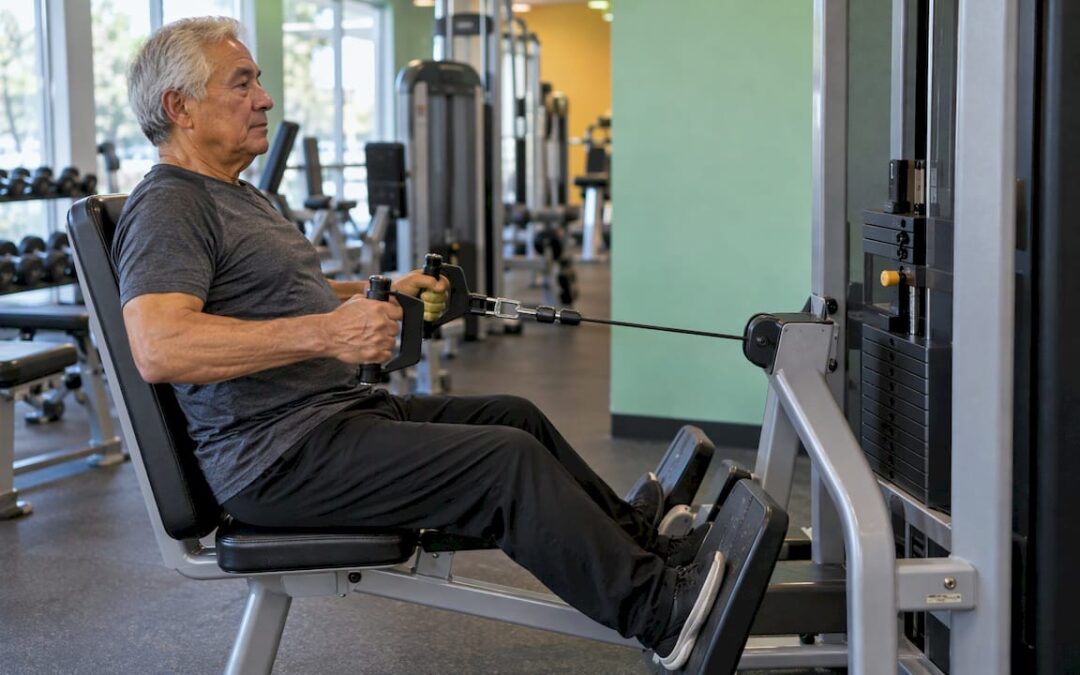
Resistance training is one of the best-supported exercise choices for people with osteoporosis or osteopenia. Done progressively and with good technique, lifting weights, using machines or working against bands gives bone the mechanical signal it needs to adapt. It also builds the muscle and balance that help prevent falls. Most guidelines point to two to three sessions a week, starting light and building toward heavier loads, ideally with supervision.
TL;DR
- Resistance training stresses bone and muscle together, and a 2021 meta-analysis found high-load programs raised bone mineral density (BMD) at the spine, femoral neck and total hip in people with osteoporosis and osteopenia.
- Aim for two to three sessions a week. Start with lighter loads while you learn technique, then progress toward 8 to 12 repetitions at a challenging weight.
- Favor controlled, upright or supported lifts. Avoid heavy forward bending and forceful twisting of the spine.
- Supervision matters. Guidelines say programs should be designed and overseen by trained professionals who understand skeletal fragility.
- Resistance training works best alongside weight-bearing activity and balance work.
Table of Contents
- Why lifting helps bones
- What the research shows
- How often and how hard
- Your first three to six months
- Exercises to build a program around
- Movements to modify or avoid
- A sample week
- A supervised option near Sacramento
- FAQ
- Sources
Why lifting helps bones
Bone is living tissue. When muscle pulls on it under load, bone responds through remodeling, the ongoing cycle of breaking down and rebuilding. The National Institute of Arthritis and Musculoskeletal and Skin Diseases (NIAMS) says a combination of weight-bearing exercise, resistance training and balance training is best for building and maintaining healthy bones and preventing falls and fractures. Resistance exercises stress the bones they work, which can make those bones stronger.
There is a second benefit that matters just as much for fracture risk. Stronger legs, hips and back muscles improve your stability, so you are less likely to fall in the first place. That is why the best programs do not treat bone density as the only goal.
What the research shows
The numbers vary by study design, but the direction is consistent.
People with osteoporosis and osteopenia. A 2021 meta-analysis of nine randomized trials found that high-load resistance training significantly increased BMD in the lumbar spine, femoral neck and total hip in patients with osteoporosis and osteopenia. The trials included 259 people in the training groups and 236 in the control groups.
Postmenopausal women. A 2023 review of 80 studies with 5,581 participants found exercise training improved BMD at the lumbar spine, femoral neck and total hip. It found no significant difference in the effect between women with osteopenia or osteoporosis and women with normal bone. Earlier, a 2020 meta-analysis of dynamic resistance exercise reported low-to-moderate but significant gains at the same three sites.
Guideline support. The Academy of Geriatric Physical Therapy guideline recommends, with Grade B evidence, that physical therapists advise postmenopausal women to do long-duration, adequately dosed progressive resistance training to slow the decline of femoral neck BMD. It can be done alone or with impact training such as walking or aerobics.
Men. The same guideline notes there is not yet enough evidence to make a recommendation for exercise to improve BMD in men. Men still benefit from muscle strength and fall prevention, so talk with your clinician about a plan.
The Bone Health and Osteoporosis Foundation clinician’s guide describes the realistic expectation: in research settings, structured exercise programs have produced modest increases in bone density. Think of resistance training as a steady, long-term investment, not a quick fix.

How often and how hard
The research agrees on the broad picture, with some differences in the details.
| Source | Frequency | Intensity and volume |
|---|---|---|
| UK consensus statement | 2 to 3 days a week | Progress toward the maximum weight you can lift 8 to 12 times, building to three sets per exercise |
| Daly et al. evidence-based guide | At least 2 to 3 times a week | 2 to 3 sets of 8 to 12 repetitions at 70 to 85% of maximal strength, increased over time, targeting large muscles that cross the hip or spine |
| 2023 position statement | 2 to 3 days a week for 3 to 12 months | 50 to 85% of one-repetition maximum (1RM), 5 to 12 repetitions per set, 3 to 10 exercises for major muscle groups |
| German-language-region DVO guideline | At least two, preferably three sessions a week | Moderate-to-high intensity (70 to 85% 1RM) after an initial familiarization phase |
Two findings are worth knowing. The 2023 position statement reports that most studies show high-intensity loading (70 to 90% of 1RM) is more effective for BMD in postmenopausal women, and that three sessions a week beat two when everything else was equal. A 2023 network meta-analysis also found moderate-intensity training three days a week was the best option for improving lumbar spine, femoral neck, total hip and trochanter BMD in postmenopausal women.
Not every analysis points the same way. The 2020 meta-analysis found lower frequency (under two sessions a week) produced larger BMD changes at the lumbar spine and total hip than higher frequency. The practical takeaway is that more is not automatically better. Bone needs recovery time, and a well-dosed program you can keep doing beats an aggressive one you abandon.
Adherence to a structured plan seems to matter too. A 2023 review of 32 studies found that programs closely following American College of Sports Medicine recommendations improved lumbar spine and femoral neck BMD more than programs that followed them loosely or in unclear ways.
For general health, NIAMS notes that U.S. Department of Health and Human Services guidelines call for adults to do muscle-strengthening activities of at least moderate intensity on at least two days a week, on top of aerobic activity.
Your first three to six months
If you have been inactive, or you have a diagnosis and have never lifted, the start matters more than the peak.
The DVO practice guideline recommends a cautious, progressive approach during the first three to six months. That means low ground-reaction forces or moderate-intensity resistance work below 70% of 1RM, applied carefully to prevent overload. It advises avoiding explosive or high-velocity movements early on. Once you are familiar with the exercises, the stimulus should progress to levels high enough to challenge bone.
The UK consensus statement says the same thing in practical terms. Start with lower loads while you learn correct technique, then work toward heavier loads, with supervision ideal to ensure good form and keep injury risk low. The International Osteoporosis Foundation (IOF) gives a Grade A recommendation that aerobic activity and progressive resistance training are safe for people with osteoporosis, with intensity starting light to moderate and rising based on what you can do. The UK statement adds that there is little evidence physical activity causes significant harm and that benefits generally outweigh risks.
A simple progression looks like this:
- Weeks 1 to 4: Learn the movements with body weight, light bands or light machines. Focus on posture and slow, controlled tempo.
- Weeks 5 to 12: Add load gradually. Work toward two sets of 10 to 12 repetitions, finishing each set tired but with clean form.
- Months 3 to 6: Move toward heavier loads and 8 to 12 repetitions, adding a third set when form stays solid.
- After six months: Review your plan with your clinician or trainer, vary the program in blocks, and keep progressing the load over time.
If you want a gentler on-ramp, our guide to resistance bands for osteoporosis covers a safe way to start.
Exercises to build a program around
Target the large muscle groups that cross the hip and spine, since those are the areas where fractures hurt most.
Mayo Clinic recommends strength training, especially for the upper back, using free weights, resistance bands or your own body weight to strengthen muscles, tendons and bones. The American Academy of Orthopaedic Surgeons lists several options for people with osteoporosis or osteopenia, including lifting weights without straining the back (lying down can protect the vertebrae), sit-to-stand exercises, and wall slides into a slight knee bend held for 10 seconds.
A balanced session might include:
- Leg press or squat to a chair: loads the hips and thighs.
- Sit-to-stand: builds the leg strength you use every day.
- Seated or supported row: strengthens the upper back, which supports posture.
- Chest press (lying or machine): works the upper body without loading the spine in flexion.
- Back extension, gentle and supported: strengthens the muscles that hold you upright.
- Hip abduction and extension: supports walking and stability.
Pair strength work with posture practice. Our short daily posture plan fits neatly around your lifting days. For fall prevention, add balance training for seniors. Tai chi is another option, and our look at tai chi for osteoporosis explains where the benefit is clearest.
Movements to modify or avoid
Safe lifting is about how you move, not only how much you lift. The IOF advises avoiding powerful twisting movements of the trunk. For people at increased risk of fracture, it also advises avoiding deep backbends and forward bending of the spine, particularly while carrying an object, because that raises the risk of compression fractures in the thoracic vertebrae.
Mayo Clinic adds that people with osteoporosis should steer clear of high-impact exercise such as jumping, running or jogging, and of bending forward at the waist or twisting at the waist. Its list of exercises to avoid includes toe touches, sit-ups, golf, tennis, bowling and some yoga poses.
In the gym, that translates to:
- Hinging at the hips with a neutral spine instead of rounding your back.
- Choosing machines or supported positions when you are learning.
- Skipping heavy rotational lifts and trunk twists.
- Keeping loads controlled and tempo slow, with no jerking or bouncing.
- Stopping if you feel sharp or new back pain, and telling your clinician.
Impact is a more nuanced topic, and what is appropriate depends on your bone health and your clinician’s advice. See our guides on high-impact exercise for osteoporosis and the exercises to avoid with osteoporosis.
If you have had a hip fracture, the IOF says higher-intensity exercise such as resistance training can be implemented progressively about one month after in-patient rehabilitation. Follow your surgeon’s and physical therapist’s plan for timing.
The BHOF guide states that programs for people with skeletal fragility should be developed and supervised by certified fitness personnel experienced with this population. It also notes that high-intensity programs combining resistance, balance and weight-bearing activity have been documented to improve fall outcomes, and that muscle growth has been reported even in frail older adults with sarcopenia. Ask your physician for clearance and, where possible, work with a physical therapist or an experienced trainer.
Our perspective
Most people with osteopenia or osteoporosis tell us the same thing: they know they should lift, and they are afraid of getting hurt. That fear is reasonable. It is also the reason we built our work around supervision.
At OsteoStrong we use osteogenic loading, a brief, supervised session once a week on specialized equipment. Our protocol is designed to be evidence-based and non-pharmaceutical, and it lets members work with measurable, tracked results rather than guesswork. We do not see it as a replacement for walking, balance work or a good diet. We see it as a structured, guided way to give your skeleton a strong, purposeful stimulus without a long gym routine.
What we want you to take from the research is simple. Bone responds to load, progression matters, and good technique protects you. Whether you begin with bands at home or with a supervised session, the habit that counts is the one you can keep up every week.
Aaron
A sample week
Here is an example of how the pieces can fit together. It is a template to discuss with your clinician, not a prescription.
| Day | Focus |
|---|---|
| Monday | Full-body resistance session: legs, upper back, chest, hips |
| Tuesday | Walking and balance practice |
| Wednesday | Rest or gentle mobility and posture work |
| Thursday | Second full-body resistance session, with the same lifts and slightly different loads |
| Friday | Walking, tai chi or balance work |
| Saturday | Optional third resistance session, or active rest |
| Sunday | Rest |
At least two non-consecutive resistance days a week matches what the guidelines above describe. Add a third once your technique is solid and you are recovering well.
Food supports the work too. Our evidence-based guide to increasing bone density covers nutrition and other levers, and our overview of osteoporosis exercise guidelines brings the safe-movement basics together.
A supervised option near Sacramento
If you would rather not design your own program, we can help. At our centers in Rancho Cordova, El Dorado Hills and Granite Bay, members come in once a week for a short, supervised osteogenic loading session, designed to stimulate bone growth with trained staff guiding every movement.
You can see how the approach works in our overview of weekly osteogenic loading for osteoporosis, or visit the Rancho Cordova East center page to get started.
FAQ
Is lifting weights safe if I have osteoporosis?
For most people, yes, when it is progressive and well supervised. The IOF gives a Grade A recommendation that progressive resistance training is safe for people with osteoporosis, starting light to moderate. Avoid forceful twisting and heavy forward bending, and get clearance from your physician first.
How often should I do resistance training for osteoporosis?
Two to three non-consecutive days a week is the common recommendation across the UK consensus statement and the 2023 position statement. Some analyses favor three sessions a week for BMD, while others found fewer sessions did well, so the best plan is the one you can keep up with good recovery.
What is the best exercise for osteoporosis?
No single exercise wins. NIAMS recommends combining weight-bearing exercise, resistance training and balance training. Within resistance work, focus on large muscle groups that cross the hip and spine, plus the upper back.
Can resistance training reverse osteoporosis?
Research shows it can improve BMD at key sites, though the gains reported in structured programs are modest. It also builds muscle and balance, which lower fall risk. Discuss it alongside any medical treatment your doctor has prescribed.
Do men benefit from resistance training for bone health?
Men gain strength and fall protection from resistance training. The APTA guideline says there is currently insufficient evidence to make a recommendation specifically for improving BMD in men, so ask your clinician to tailor a plan.
Sources
- Impact of high-load resistance training on bone mineral density (2021 meta-analysis)
- Exercise for Your Bone Health, NIAMS
- Physical Therapist Management of Patients With Suspected or Confirmed Osteoporosis, APTA guideline
- The clinician’s guide to prevention and treatment of osteoporosis, BHOF
- Exercise training and bone mineral density in postmenopausal women (2023)
- Effects of dynamic resistance exercise on bone mineral density (2020)
- Comparative efficacy of different resistance training protocols (2023)
- Effects of exercise based on ACSM recommendations on bone (2023)
- Strong, steady and straight: UK consensus statement
- Exercise for the prevention of osteoporosis in postmenopausal women (Daly et al.)
- Position Statement: Exercise Guidelines for Osteoporosis Management (2023)
- Exercise for fracture prevention, DVO practice guideline
- Exercise for individuals with osteoporosis, International Osteoporosis Foundation
- Exercising with osteoporosis: Stay active the safe way, Mayo Clinic
- Osteoporosis Prevention and Treatment, OrthoInfo, AAOS