
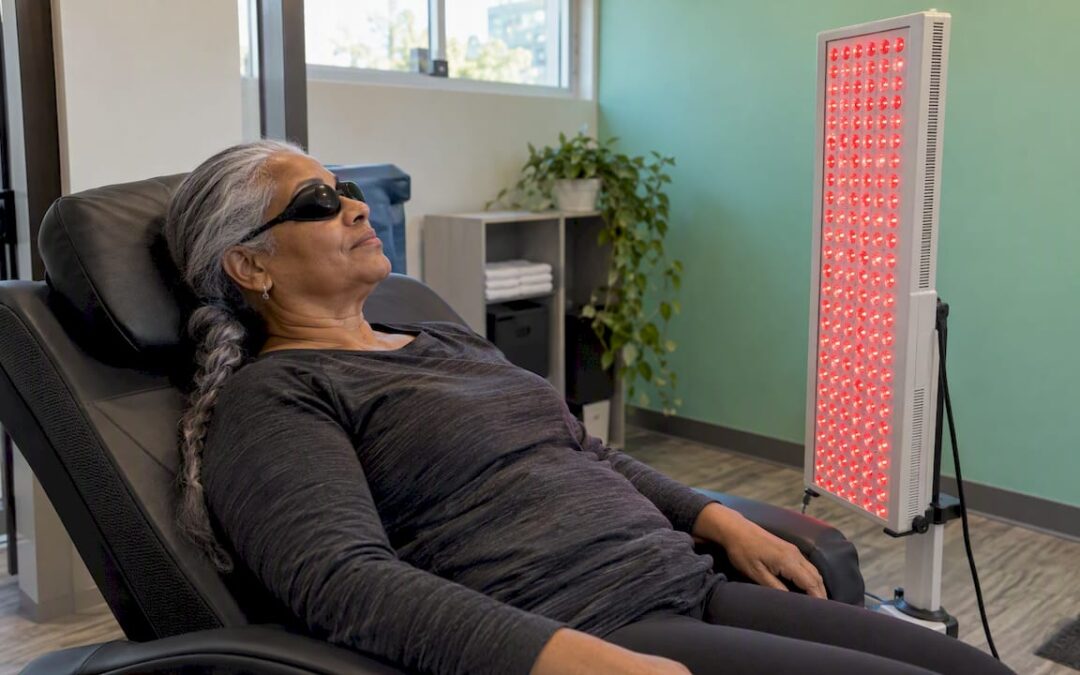
Red light therapy is considered low risk when you use a cleared device as directed, but your eyes are the one place where you should not improvise. Wear the protective goggles the device instructions call for, never stare into the LEDs, and stop if you notice lingering afterimages or any unusual vision symptoms. Sunglasses are not a substitute for proper goggles. Below, we explain what the research shows, where the real concerns are, and how to protect your eyes whether you use a panel at home or a supervised session.
TL;DR
- Dermatologists advise wearing protective goggles every time the device instructions require them, and sunglasses are not a substitute.
- The FDA considers FDA-cleared red-light devices to pose a low risk to the public, but clearance says nothing about how well a device works.
- The serious retinal injuries in the literature come from repeated, high-dose red-light exposure aimed at the eye for myopia, not from body-focused wellness sessions.
- Temporary afterimages are the most common eye symptom. If they last longer than 5 minutes, or anything else seems off, stop and call an eye care professional.
- People with photosensitivity disorders or who take photosensitizing medications should check with their clinician before any red light session.
Table of Contents
- Does red light affect the eyes?
- What the research says about the retina
- Do you need goggles for red light therapy?
- Red versus near-infrared, LED versus laser
- Warning signs and when to stop
- Who should check with a clinician first
- Eye safety for people with osteopenia or osteoporosis
- Home device checklist
- Perspective
- Try red light with supervision
- FAQ
- Sources
Does red light affect the eyes?
Yes, light of any kind reaches the retina, and bright light close to the eye is something to manage. Red light therapy devices, often called photobiomodulation devices, use LEDs that emit visible red light and sometimes near-infrared light. Near-infrared light is invisible, so your eyes give you no discomfort signal to tell you it is there. That is one reason the goggle rule exists even when the light looks “gentle.”
For most people using a device on the body, the practical risk is small. The American Academy of Dermatology notes that the FDA considers FDA-cleared red-light devices to pose a low risk to the public. It also points out that clearance does not indicate how effective a device is. In other words, “cleared” speaks to safety under intended use, not to results.
The word “cleared” matters. Physicians in the United States have warned that unregulated red light devices sold online pose a risk of retinal damage and vision loss. A cheap unlabeled panel with no stated output and no eye guidance is a different product from a cleared device used under supervision.
What the research says about the retina
Most of the retina-specific safety research comes from a single use: low-level red light aimed at children’s eyes to slow nearsightedness. That is not what a wellness session does, but it shows what can happen when the dose to the eye is high and repeated.
The cautionary findings
A 2024 analysis of two red-light instruments made for myopia found that for both devices, three minutes of continuous viewing approached or surpassed the maximum permissible exposure, which puts the retina at risk of photochemical and thermal damage. The same paper cites a case study of a 12-year-old who sustained retinal damage after five months of repeated low-level red-light therapy. It also notes that the American National Standards Institute recommends not viewing light of similar intensity for at least 48 hours after reaching that limit.
The American Academy of Ophthalmology states that the FDA has not approved red light therapy for treating nearsightedness in children. Its guidance on red light for aging eyes adds that red light is not an approved eye treatment and that more human clinical-trial data are needed before it is used for eye disease.

The reassuring findings
The picture is not alarming for the typical user. A 2024 systematic review of repeated low-level red-light therapy identified no cases of permanent vision loss, though reversible drops in visual acuity and OCT abnormalities appeared in some case reports. The same review estimated the incidence of side effects at 0.088 per 100 patient-years.
A 2025 study in the Journal of Optometry found that five minutes of diffuse, low-irradiance red LED exposure in healthy adults did not cause immediate, significant changes in retinal or choroidal structures.
Put together: short, diffuse exposure to a cleared device looks well tolerated, while concentrated, repeated, close-range exposure aimed at the eye is where harm has been documented. A systematic review by Chang and colleagues summed up the field this way: evidence for effectiveness is compelling but more robust data are required to confirm safety. That is a fair reason to stay cautious and keep your eyes covered.
Do you need goggles for red light therapy?
If the device instructions say to wear them, yes. Dermatologists recommend protective goggles every time the instructions require them. Here is a practical way to decide.
| Situation | What to do |
|---|---|
| Panel or lamp facing your face | Wear goggles made for red light therapy, and keep your eyes closed too |
| Panel aimed at your back, hips or legs, face turned away | Follow the manufacturer’s instructions; goggles are still the safe default if the light is bright in your field of view |
| Handheld wand near the face | Goggles, and never point it toward the eyes |
| Face mask worn as designed | Follow the mask’s own eye-shield instructions |
| Device with no eye guidance and no stated output | Do not use it near the face |
Three habits matter more than any single product:
- Never look directly at the LEDs, even briefly, even with your eyes “just squinting.”
- Choose goggles designed for this purpose, matched to the wavelengths of your device. Ordinary sunglasses are not a substitute.
- Keep your eyes closed under the goggles. Closed lids reduce brightness but do not make a bright, close-range light harmless, so treat closed eyes as an extra layer, not the only one.
Are closed eyes enough?
For a brief session with a device pointed away from your face, closed eyes may feel adequate, and some brands say so. But the guidance that carries weight, the dermatology advice above, ties protection to the device instructions rather than to a rule of thumb. If your instructions call for goggles, closed eyes alone do not meet that bar. Near-infrared output is invisible, so “it doesn’t feel bright” is not proof of low exposure.
Red versus near-infrared, LED versus laser
Two distinctions shape how careful you need to be.
Red versus near-infrared. Visible red light at least tells you it is on. Near-infrared does not. If your device combines both, which many do, treat it as the more cautious case and use protection accordingly.
LED versus laser. Most consumer and clinic wellness panels use LEDs that spread light over a wide area. Lasers concentrate light into a narrow beam, which raises the stakes for the eye considerably. Never use a laser-class device near the face without eye protection rated for its wavelength and specific instructions from the maker.

The myopia research shows why output and exposure time matter: the maximum permissible exposure is a threshold defined by intensity and duration, and the devices tested reached it within minutes at close range. That is also why a supervised session, with fixed distances and timed doses, is a more controlled setting than a home device you hold or position yourself.
Warning signs and when to stop
Temporary afterimages are the most common ocular symptom after red light treatment and generally resolve within about 6 minutes in the studies reviewed. Other guidance is more conservative: a university eye-research lab advises that if afterimages last longer than 5 minutes or you notice unusual symptoms, you should stop using the device and talk to an eye care professional.
Stop the session and call an ophthalmologist or optometrist if you notice:
- Afterimages or spots that last more than 5 minutes
- Blurred vision, a dark patch or a change in central vision
- Eye pain, or light sensitivity that does not settle
- Any symptom that is new after starting red light sessions
Do not wait to see whether these fade on their own.
Who should check with a clinician first
The American Academy of Ophthalmology’s EyeWiki lists photobiomodulation as contraindicated for people with photosensitivity disorders such as epilepsy or severe photophobia, and for those taking photosensitizing medications. The same page says fundus photography and OCT before and during therapy are needed to identify side effects when light is used to treat retinal disease, which is a clinical setting, not a home routine.
If you take any medication that makes you sensitive to light, have a seizure disorder, or already have a retinal condition, ask your prescribing doctor or eye specialist before using any red light device. Our guide to red light therapy contraindications walks through the broader list of situations where red light is a poor fit.
Eye safety for people with osteopenia or osteoporosis
Many of the people we see are adults managing bone density, often over 50, and age brings its own eye considerations such as cataracts, macular degeneration or glaucoma. Red light is not a treatment for any of those conditions, and the American Academy of Ophthalmology is clear that it is not an approved eye therapy. If you have an eye condition, tell your eye doctor you are considering red light and tell us before your first session.
It also helps to know what red light is and is not in a bone health routine. In our setting it is a supportive wellness therapy used alongside osteogenic loading, not a replacement for it. You can read how sessions are typically structured in our guide to red light therapy sessions with osteogenic loading, and why dose matters in our red light dosage guide for bone health.
Home device checklist
If you use a device at home, run through this list before the first session:
- Confirm the device is FDA-cleared for its stated use, and read the cleared indication rather than the marketing page.
- Find the manufacturer’s written eye-protection instructions. If there are none, that is a reason not to buy it.
- Buy goggles intended for red and near-infrared light, and check they fit snugly without gaps.
- Set a timer and keep to the recommended distance and duration. More is not better, and the myopia research shows how quickly exposure limits can be reached at close range.
- Keep children and pets out of the room and never aim the device at another person’s eyes.
- Note any afterimages or visual changes in a log, and stop if they last longer than 5 minutes.
Perspective
We built our approach around one idea: bone health responds to the right stimulus, delivered consistently and safely. Red light therapy is one of the wellness tools we offer alongside osteogenic loading, and we treat it with the same care as everything else in the center.
That care starts with the eyes. The research on red light and the retina is mostly about high-dose, repeated exposure aimed at the eye, which is very different from a timed body session. Still, we do not think “probably fine” is a good standard when vision is involved. In a supervised session the distance, the timing and the eye protection are handled for you, so there is nothing to guess at.
Our clients come in once a week for a brief, supervised osteogenic loading session, and red light fits into that rhythm without adding complexity. If you have osteopenia or osteoporosis and you are curious about red light, ask us about eye protection first. We would rather answer that question twice than have you wonder about it alone.
Aaron
Try red light with supervision
If you would rather not manage goggles, distances and timers on your own, we can do that for you. Our centers in Rancho Cordova, El Dorado Hills and Granite Bay pair weekly osteogenic loading for bone density with supportive therapies, including red light therapy. Our team can walk you through eye protection before you start.
See how osteogenic loading at OsteoStrong works and ask about adding red light to your visit.
FAQ
Is red light therapy safe for eyes?
For cleared devices used as directed, the FDA considers the risk to the public low. The concern is direct, close-range or repeated exposure to the eye, which is why dermatologists advise wearing the goggles your device instructions call for. Ask an eye doctor first if you have a retinal condition.
Do I have to wear eye protection with red light therapy?
If the device instructions require it, yes, and sunglasses do not count. Use goggles designed for red and near-infrared light, and keep your eyes closed beneath them. If the device has no eye guidance at all, choose a different device.
Can red light therapy damage the retina?
Damage has been documented, mainly in children using repeated low-level red-light devices for myopia, including one reported case of retinal injury after five months. A 2024 systematic review found no cases of permanent vision loss, but reversible changes did occur. Cleared body-focused devices used with eye protection are a different exposure, but there is no reason to take chances.
What should I do if I see spots after a session?
Temporary afterimages are the most commonly reported symptom and usually fade within minutes. If they last longer than 5 minutes, or you notice blurred vision, a dark patch or eye pain, stop using the device and contact an eye care professional.
Is red light therapy approved to treat eye problems?
No. The American Academy of Ophthalmology states that red light is not an approved eye treatment, and the FDA has not approved it for childhood nearsightedness. Using it on your body for wellness is a separate matter from treating the eye.
Sources
- American Academy of Dermatology: Is red light therapy right for your skin?
- American Academy of Ophthalmology: Can red light therapy slow nearsightedness in children?
- American Academy of Ophthalmology: Does red light protect aging eyes?
- PMC: Red light instruments for myopia exceed safety limits
- ScienceDirect: Safety of repeated low-level red-light therapy for myopia
- Journal of Optometry: Transient ocular effects of red light exposure
- PMC: Light therapy for myopia prevention and control
- PolyU: Safety of red-light therapy for myopia control
- AAO EyeWiki: Photobiomodulation in retina diseases