
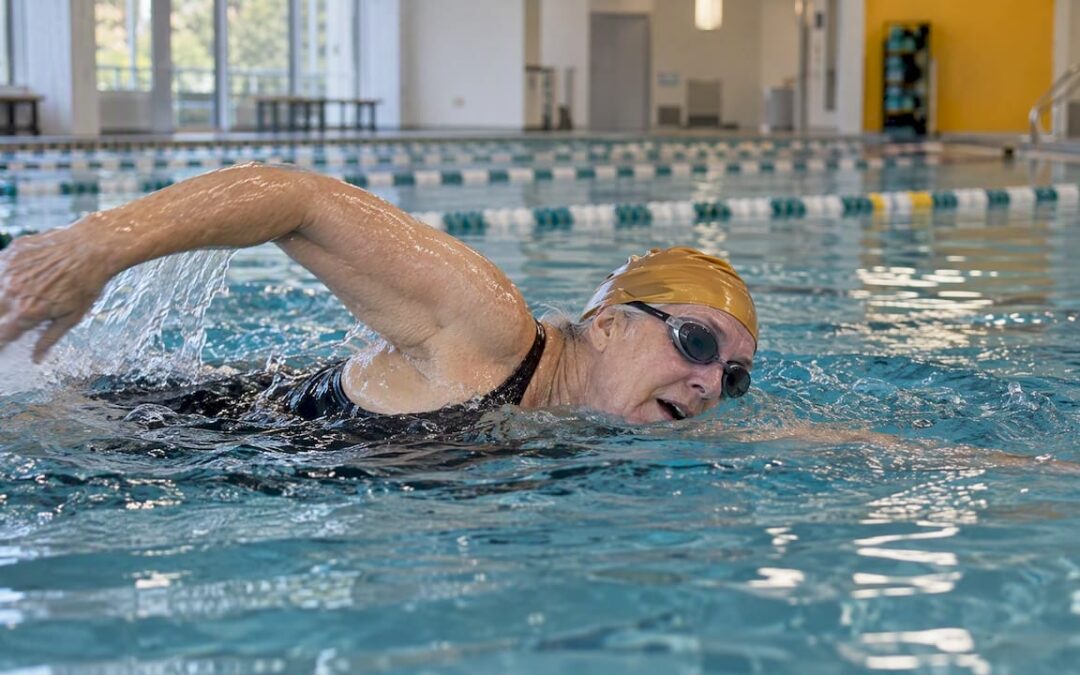
Swimming alone usually does not increase bone density the way weight-bearing or resistance training does, because water supports your body weight and removes most of the gravitational load your skeleton needs. Targeted aquatic programs with resistance and enough volume, in some studies around 3 to 6 hours per week, can help slow bone loss in certain groups, especially postmenopausal women. Keep swimming for cardiovascular fitness and joint relief, and pair it with bone-loading resistance work or a supervised loading program if your goal is stronger bones.
TL;DR:
- Studies found improved lumbar spine density among postmenopausal women doing 3 to 6 weekly hours of aquatic exercise, often with added resistance.
- Comparisons found that aquatic and land programs both improved bone density over inactivity, although the latter produced larger gains overall.
- Schedule 2 to 3 pool sessions of 30 to 60 minutes weekly, including resistance work in one, alongside separate land based strength training.
- After a vertebral fracture or multiple low trauma fractures, keep impact to brisk walking unless a qualified professional clears more strenuous activity.
Table of Contents
- What high-quality studies say about swimming and bone mineral density
- How swimming stacks up against land-based weight-bearing and resistance exercise
- When swimming or aquatic exercise has shown benefits
- Practical modifications: how to make pool sessions deliver more skeletal stimulus
- A realistic weekly template: swimming plus bone-building sessions
- Safety rules and when to get medical or PT advice
- Clinical perspective: pairing swimming with targeted bone-loading work
- A supervised option for targeted bone stimulus
- FAQ
- Sources
What high-quality studies say about swimming and bone mineral density
The research on swimming and bone mineral density (BMD) is more nuanced than a simple yes or no. Several systematic reviews have looked at aquatic exercise broadly, and a smaller set has focused specifically on swimming, and the two bodies of evidence tell slightly different stories.
A systematic review and meta-analysis of water-based exercise in middle-aged and older adults found statistically significant improvements in lumbar spine and femoral neck BMD compared with sedentary controls. The same review found that land-based exercise produced larger gains overall, and that aquatic programs built around resistance outperformed purely aerobic water exercise. That distinction matters: a water aerobics class with resistance tubing is a different stimulus than laps of freestyle.
A separate systematic review that asked the question more directly, Is Bone Tissue Really Affected by Swimming?, reported that competitive swimmers often have BMD similar to sedentary people and lower BMD than athletes in high-impact sports like gymnastics or track. The same review noted some evidence that swimming later in life may slow the rate of age-related bone loss, though it flagged inconsistent measurement methods across studies as a limiting factor.
A third review, this one a meta-analysis specifically on swimming as a treatment approach in osteoporosis, concluded that swimming may improve lumbar spine BMD in postmenopausal women who train roughly 3 to 6 hours a week, while cautioning that the evidence is limited and the included studies vary widely in design.
A few points help explain why the findings differ from study to study:
- Measurement method varies: some studies use DXA (dual-energy X-ray absorptiometry), the clinical standard, while others use pQCT or quantitative ultrasound, which measure different bone properties and are not always directly comparable.
- Population differs: competitive swimmers, recreational swimmers, and postmenopausal beginners respond differently to the same activity.
- Program design differs: a resistance-focused aquatic class is a different stimulus than unstructured lap swimming, even though both get labeled “swimming” in casual conversation.
- Study quality varies: sample sizes are often small and follow-up periods short, which limits how confidently we can generalize the results.
A 2023 systematic review on aquatic exercise in older adults found statistically significant effects on lumbar spine and proximal femur BMD compared with nontraining controls, and it specifically noted that many of the aquatic programs studied used resistance devices to increase intensity rather than relying on swimming strokes alone. That single detail runs through nearly all the positive findings in this field: when aquatic exercise helps bone, it is usually because resistance was added, not because of swimming in its plain form.
Taken together, the picture is one of modest, inconsistent benefit for well-structured aquatic exercise, and a less convincing picture for recreational swimming on its own.
How swimming stacks up against land-based weight-bearing and resistance exercise
Bone adapts to mechanical stress. When a bone is loaded above its accustomed level, specialized cells respond by adding density where the strain is highest. This is why a tennis player’s playing arm often has denser bone than the other, and why astronauts lose bone mass in microgravity even though they remain active.
Water changes this equation. Swimming is a hypogravity activity: the water supports a large share of body weight, which cuts ground reaction forces to nearly zero. According to Harvard Health, bone strengthens in response to bodyweight or external resistance, and non-weight-bearing activities like swimming miss that gravitational signal. That is the core mechanical reason swimming underperforms land-based exercise for building density, not a flaw in swimming as a sport, but a basic feature of how bone physiology works.
Head-to-head comparisons back this up. The review of water-based exercise mentioned earlier found that land-based programs produced larger BMD gains than aquatic ones in middle-aged and older adults, even though both showed measurable improvement over sedentary controls. Comparative research on different exercise types similarly found that jumping and impact loading produce stronger osteogenic effects than swimming, reflecting the direct relationship between impact force and bone response. Orthopedic guidance from the American Academy of Orthopaedic Surgeons repeats the same principle: weight-bearing activities build bone more effectively than non-weight-bearing ones, even though non-weight-bearing exercise still strengthens muscle and supports function.
A few exceptions narrow the gap somewhat:
- Resistance-equipped aquatic classes that use paddles, water weights, or resistance tubing create more muscular tension than free swimming and come closer to replicating a land-based strength stimulus.
- Higher-intensity aquatic circuits combining short bursts of effort with rest intervals can approach the training load of a moderate land-based session, even if the mechanical loading on bone remains lower.
- Populations who cannot tolerate land-based impact sometimes see aquatic programs deliver real, if smaller, benefit simply because it is the most loading they can safely perform.
The practical implication is straightforward: if increasing BMD is the goal, swimmers who want that outcome need to add dedicated bone-loading work, whether through resistance training, impact exercise, or a supervised loading program, because swimming by itself is not generating the mechanical signal bone needs to grow denser.
When swimming or aquatic exercise has shown benefits
Not everyone needs maximal bone-building stimulus right now, and for some groups, aquatic exercise is a reasonable, evidence-supported tool rather than a consolation prize.
Postmenopausal women are the population where aquatic exercise shows up most consistently in the positive research. The meta-analysis focused on swimming in osteoporosis found lumbar spine BMD improvements in postmenopausal swimmers training 3 to 6 hours per week, a training volume well above what most recreational swimmers log. A related study found that postmenopausal swimmers training 3 to 6 hours a week had better lumbar spine density than those training less than 3 hours, which suggests a dose relationship: more consistent, higher-volume aquatic training correlates with better outcomes, even if the mechanism remains less direct than land-based loading.
Dose appears to matter more than activity choice alone: studies finding benefit in postmenopausal women generally clustered around 3 to 6 hours of aquatic training per week, often incorporating resistance-style movements rather than continuous lap swimming.
Several factors shape whether any individual sees benefit from aquatic exercise:
- Age and menopausal status: postmenopausal women, who lose bone more rapidly due to declining estrogen, appear to be the group most likely to see a measurable aquatic-exercise effect.
- Training history: long-term swimmers and older adults who have swum for years may show a slower rate of age-related bone loss, though this association is hard to separate from the fact that lifelong swimmers also tend to be leaner and more generally active, both of which independently affect BMD.
- Program intensity: structured, resistance-inclusive sessions outperform casual recreational swimming in nearly every study that distinguishes between the two.
- Nutrition status: adequate calcium and vitamin D intake alongside exercise matters for whether any training stimulus translates into measurable bone benefit.
The honest summary is that swimming’s bone benefit, where it exists, is modest, dose-dependent, and strongest in postmenopausal women doing resistance-oriented aquatic training at meaningful volume, not in casual lap swimming a couple of times a week.
Practical modifications: how to make pool sessions deliver more skeletal stimulus
If you swim regularly and want your pool time to do more for your skeleton, the fix is not to swim harder laps, it is to change what you do in the water.
- Add resistance tools. Water weights, paddles, kickboards used for resisted pushing, and resistance cuffs increase the muscular force your body generates against the water, which creates more loading on the joints and bones involved.
- Build pushing and pulling intervals into your session. Structured sets of resisted arm pulls, leg presses against resistance, or water-based rowing motions ask more of your muscles than freestyle laps alone.
- Use shallow-water plyometric progressions where appropriate. Controlled jumps or hops in shallow water create more impact than swimming while still reducing landing forces compared with dry land, which can suit people easing back into impact work.
- Apply progressive overload. Treat your aquatic resistance work the way you would a strength program: increase resistance, reps, or session frequency over weeks rather than repeating the same routine indefinitely.
- Track perceived effort, not just time in the pool. A session that feels moderately challenging by the end is doing more for your muscles and joints than one that feels like easy cardio throughout.
The Frontiers meta-analysis on aquatic exercise in older adults specifically noted that programs using resistance devices to increase water resistance produced more consistent BMD effects, which lines up with the logic above: you are trying to replicate land-based strength training conditions as closely as water allows.
Land-based resistance sessions remain the better choice when the primary goal is maximal BMD stimulus, since nothing in the water fully replaces gravity and ground reaction force. The practical answer for most people is not choosing one over the other, but running both: resistance-modified pool sessions for joint-friendly conditioning, and land-based strength or impact work for direct bone stimulus.
Pro Tip: Swap one easy lap-swimming session per week for a resistance-focused water circuit using paddles or cuffs, and you will likely notice more muscle fatigue by the end, a sign you are generating more loading than steady freestyle alone provides.

A realistic weekly template: swimming plus bone-building sessions
A workable week does not require choosing between swimming and bone-targeted training. It requires sequencing them so each does the job it is actually good at.
- 2 to 3 aquatic sessions, 30 to 60 minutes each, at least one of which includes resistance tools or structured intervals rather than relaxed laps.
- Land-based resistance sessions focused on major muscle groups and weight-bearing movement patterns like squats, step-ups, and rows.
- Daily balance and posture micro-sessions, 5 to 10 minutes, covering single-leg stands, gentle spinal extension work, and posture checks, particularly important for older adults at higher fall risk.
A few guardrails make this plan work without overloading your schedule:
- Aim for roughly 150 minutes of moderate-intensity aerobic activity per week, combining swimming and any other cardio you enjoy, while keeping the resistance sessions as a separate, non-negotiable block rather than folding them into aerobic time.
- If you have joint pain, arthritis, or limited mobility, lean more heavily on shallow-water resistance work and consider a supervised clinic program that can load bone safely without high joint stress.
- Build in one full rest or light-activity day so your muscles and joints recover between resistance sessions.
- Reassess the plan every 8 to 12 weeks and adjust resistance load, session length, or frequency based on how you are responding.
If you want a deeper framework for the resistance side of this plan, a guide to osteogenic loading for osteoporosis management walks through weekly structure in more detail, and a clinician-backed kyphosis exercise plan is a useful resource if posture and spinal position are part of your concern, since good spinal mechanics matter during both land and water sessions.
Safety rules and when to get medical or PT advice
Bone-health exercise guidance is not one-size-fits-all, and the stakes are different for someone with normal bone density than for someone with a history of fracture.
The Too Fit To Fracture consensus statement recommends resistance and impact exercise to maximize bone strength, daily balance training, and specific spine-sparing technique education, including avoiding end-range spinal flexion, particularly for people with reduced bone density. For people who have had a vertebral fracture or multiple low-trauma fractures, the same consensus recommends limiting impact intensity to no more than brisk walking unless a qualified professional has specifically cleared higher-impact activity.
A short list of situations that call for professional input before changing your routine:
- A recent fracture, especially a vertebral compression fracture, before resuming or starting any new exercise program.
- Significant kyphosis (forward spinal curvature), which changes how safely certain movements, including some swimming strokes, can be performed.
- New or unexplained pain during or after exercise, in the back, hips, or joints.
- A history of falls or a condition that affects balance, where a physical therapist can assess fall risk directly.
Aquatic programs genuinely shine at reducing joint stress and, because many pool-based balance exercises lower fall risk on land as a side benefit, they are reasonable even for people who need to be cautious with impact. The tradeoff is that this same low-impact quality is exactly what limits aquatic exercise’s direct effect on bone density, so for most people with diagnosed low bone mass, water-based work should sit alongside, not instead of, supervised resistance or loading work.
Pro Tip: If you have osteoporosis or a prior fracture, ask a physical therapist to review your swimming strokes specifically, since some arm and spine positions in competitive strokes involve more spinal rotation or flexion than is ideal for a fragile spine.
Clinical perspective: pairing swimming with targeted bone-loading work
The swimming-and-bone-density question gets oversimplified in both directions. Some people treat swimming as bone exercise because it is exercise, full stop. Others write it off entirely because it is not weight-bearing. Neither framing is useful. Swimming does real work: it builds cardiorespiratory fitness, protects joints, and keeps people moving who might otherwise be sidelined by pain or injury. It simply is not the tool for the specific job of adding bone density, and conflating general fitness with skeletal stimulus is where most of the public confusion comes from.
What we see in practice is that people make better decisions once they stop asking “is swimming good or bad for bones” and start asking “what is swimming doing for me, and what else do I need.” A well-rounded plan usually involves swimming for the heart and joints, resistance or loading work for the skeleton, and attention to nutrition and balance for the rest. Clinic-based programs that combine supervised loading sessions with exercise and nutrition guidance exist precisely because no single activity covers every piece of bone health. The right combination depends on your bone density results, fracture history, and what your body can tolerate, which is a conversation worth having with a clinician rather than settling through guesswork.
— Aaron
A supervised option for targeted bone stimulus
If you swim regularly and your scans show low bone density, adding a supervised loading session can address the specific gap that swimming does not fill. We offer supervised osteogenic loading sessions using equipment designed to apply controlled mechanical force to the skeleton, rather than asking you to add extra gym time to your week.
This approach sits alongside the evidence-based picture laid out above: swimming for fitness and joint health, resistance or impact work for bone density, and a supervised loading option for people who want a structured, low-time-commitment way to add that stimulus. We built our sessions to work with the rest of your routine rather than replace it.
- A supervised session rather than a daily or hours-per-week time commitment.
- Designed specifically to apply mechanical loading to the skeleton, the stimulus that aquatic exercise alone does not provide.
- Available alongside other recovery and wellness services, including red light therapy and vibration plates, for people building a broader bone-health routine.
You can learn more about how a session works and see if it fits your routine on our Osteogenic Loading page.
This article is general information, not a substitute for advice from a qualified doctor. Consult a qualified healthcare professional about your own circumstances before acting on anything here.
FAQ
What exercise should be avoided with osteoporosis?
High-impact or high-flexion movements that bend or twist the spine, such as deep forward bends, sit-ups, or toe-touches, are generally discouraged for people with osteoporosis because they increase the risk of vertebral compression fracture. The Too Fit To Fracture consensus specifically recommends spine-sparing technique and limiting impact intensity to brisk walking for anyone with a prior vertebral fracture, unless a qualified professional has cleared more.
Is aqua aerobics good for people with osteoporosis?
Aqua aerobics is a safe, joint-friendly way to stay active and build cardiovascular fitness for people with osteoporosis, and resistance-equipped classes have shown statistically significant BMD benefits in older adults compared with no training. It works best as a complement to land-based resistance training rather than a replacement for it, since water reduces the gravitational loading bone needs most.
What activity is best for bone density?
Weight-bearing and resistance exercises, including walking, strength training, and impact activities like jumping, produce the strongest bone density response because they generate direct mechanical loading on the skeleton. Comparative research has found that jumping and impact loading produce stronger osteogenic effects than swimming, which is why most bone-health guidance centers on resistance and impact work rather than swimming or cycling alone.
How do I increase femoral neck bone density?
Femoral neck density responds best to weight-bearing resistance exercise targeting the hips and legs, such as squats, step-ups, and loaded walking, along with adequate calcium and vitamin D intake. Some aquatic programs have also shown modest femoral neck improvements when they include resistance work, as seen in a 2023 systematic review on older adults, though land-based loading generally produces larger gains.