
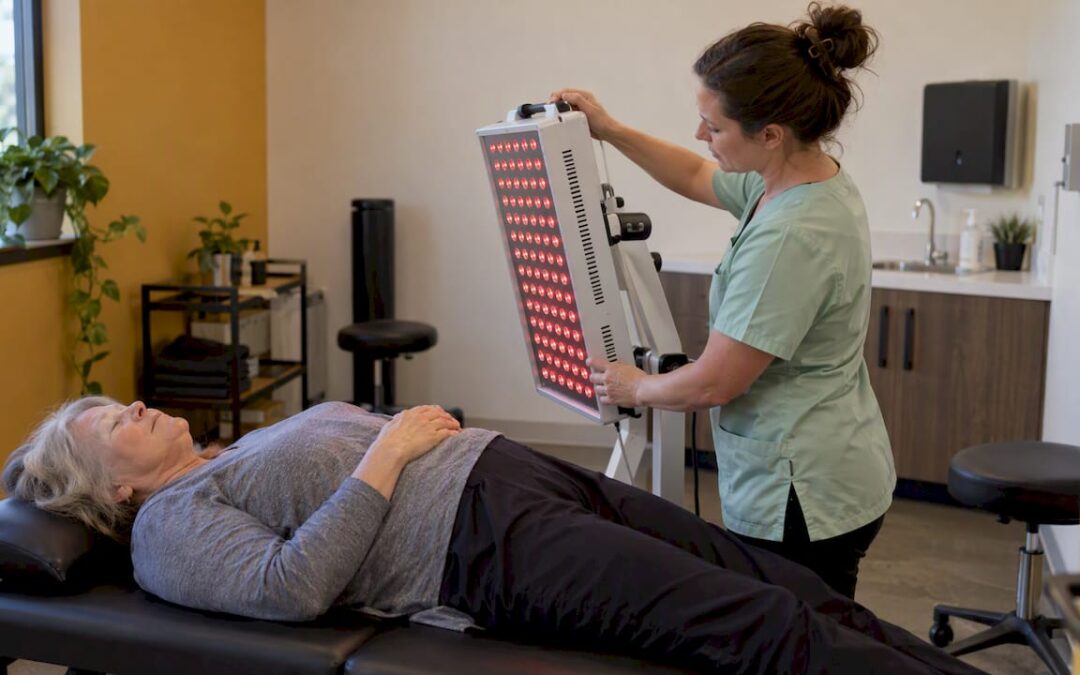
Red and near-infrared photobiomodulation can lower inflammatory activity in some conditions, but the benefit depends heavily on the condition, wavelength, and dose. An umbrella review of randomized trials found real signals for knee osteoarthritis disability and fibromyalgia fatigue, though most outcomes carried low or very-low certainty. We treat it as a complementary tool for symptom support, best used under supervised, protocol-consistent conditions rather than as a guaranteed fix.
TL;DR:
- A knee osteoarthritis review of 10 studies and 542 participants found less pain at rest, no mobility gain, and very low certainty.
- The strongest broader signals were moderate certainty improvements in fibromyalgia fatigue, while neuropathic pain findings remain difficult to compare because protocols vary.
- Red wavelengths around 630 to 660 nm target superficial tissue, while near infrared light around 800 to 850 nm reaches deeper muscle and joint tissue.
- Because the dose response is biphasic, longer or more frequent sessions can reduce benefit; ask providers to disclose wavelength, irradiance, and treatment distance.
- Protect your eyes, avoid treating open or infected wounds, and check with a clinician before sessions if you take medication that increases photosensitivity.
Table of Contents
- How Photobiomodulation Affects Inflammation at the Cellular Level
- What Clinical Trials Actually Show About Red Light and Inflammation
- Which Conditions Respond Best to Red Light Therapy
- Safe and Effective Red Light Use: Parameters, Dosing, and Precautions
- OsteoStrong Supervised Red Light Sessions: What to Expect
- How Long and How Often Red Light Sessions Should Run
- Combining Red Light Therapy With Osteogenic Loading and PEMF
- What Long-Term Red Light Use Looks Like for Inflammation
- Expert Perspective: Evaluating Red Light Claims With a Skeptical Eye
- Book a Supervised Red Light and Wellness Session With OsteoStrong
- FAQ
- Sources
How Photobiomodulation Affects Inflammation at the Cellular Level
Red and near-infrared light penetrates skin and gets absorbed by chromophores inside cells, most notably cytochrome c oxidase in the mitochondria. That absorption appears to boost ATP production and trigger a release of nitric oxide, a molecule involved in blood flow and cell signaling. A mechanistic review describes how this cascade can modulate reactive oxygen species, shift calcium signaling, and change the activity of transcription factors that control inflammatory gene expression. Mitochondrial function itself depends on peptides like MOTS-c, which researchers have linked to cellular energy regulation; you can read more about mitochondrial-derived peptides if the biology interests you.
What makes this tricky is the biphasic dose response: low doses tend to stimulate cellular activity, while higher doses can inhibit it entirely. Wavelength, irradiance, and exposure time all interact, so doubling the treatment time does not simply double the benefit.
- Visible red light (around 630 to 660 nm) tends to affect more superficial tissue.
- Near-infrared light (around 800 to 850 nm) penetrates deeper, reaching muscle and joint tissue.
- The same device can help or do nothing depending on how long and how close it is held to the skin.
A 2017 mechanistic review found that spectrum, irradiance, and exposure time change outcomes across immune-cell studies, meaning the same light source can produce opposite effects depending on how it’s dosed.
What Clinical Trials Actually Show About Red Light and Inflammation
The laboratory mechanisms are well documented, but human trial evidence is more mixed and depends heavily on what you’re measuring. A 2025 umbrella review pooling multiple meta-analyses and randomized trials found photobiomodulation produced significant effects across several endpoints. The catch: most of those outcomes carried low or very-low certainty ratings. The strongest, moderate-certainty signals showed up for knee osteoarthritis disability and fibromyalgia fatigue, two specific and well-studied endpoints rather than a blanket inflammation claim.
Knee osteoarthritis has its own dedicated evidence base. A 2024 meta-analysis of 10 placebo-controlled studies covering 542 participants found a statistically significant reduction in pain at rest, with a standardized mean difference of negative 0.7 compared to placebo. However, the certainty was rated very low, and the same analysis found no improvement on the Timed Up and Go mobility test. That distinction matters: a treatment can ease pain at rest without meaningfully changing how someone walks or functions day to day.
Most outcomes across the pooled trials carried low or very-low certainty, even where statistically significant effects appeared.
More recently, a 2026 systematic review of randomized trials covering chronic pain in adults, spanning studies from 2015 through 2025, reported a low incidence of adverse events and some pain benefits. The same review flagged heterogeneous technical parameters across studies as a limit on how confidently those findings generalize. Fibromyalgia and certain neuropathic pain studies show a similar pattern: plausible benefit, but wide variation in wavelength, dose, and session length makes it hard to say which protocol actually drives the result.
Here’s what ties the evidence together:
- Umbrella-level data supports real, if uneven, anti-inflammatory signals for specific conditions.
- Knee osteoarthritis shows pain relief at rest but not functional mobility gains.
- Chronic pain and fibromyalgia trials show promise but suffer from protocol inconsistency.
- Cell and animal studies explain the biology but should never be treated as home-use dosing instructions.
A preclinical mouse study using 640 nm and 880 nm exposures found reductions in pro-inflammatory cytokines like IL-1β and IL-18, alongside increases in anti-inflammatory IL-10. A human-cell study using 650 nm light at 6 J/cm² on periodontal-ligament stem cells found increased ATP and reduced cytokine production after 24 hours. Both support the underlying mechanism. Neither validates a specific human treatment schedule.
Which Conditions Respond Best to Red Light Therapy
Not every inflammatory complaint responds the same way, and the evidence quality varies a lot by condition.
- Knee osteoarthritis pain at rest has the most consistent human trial support, backed by a meta-analysis showing reduced pain versus placebo, even though certainty remains low.
- Fibromyalgia fatigue and pain showed moderate-certainty improvement in the 2025 umbrella review, making it one of the stronger signals in the current literature.
- Neuropathic pain has some supportive randomized trial data, though session parameters vary enough that comparing studies directly is difficult.
- Systemic inflammation markers and autoimmune disease activity are commonly claimed targets, but the evidence here is thinner and more inconsistent than the condition-specific pain data above.
- Joint mobility and functional recovery tend to lag behind pain relief. The same knee osteoarthritis research that found less pain at rest found no change in Timed Up and Go scores.
The practical takeaway is straightforward: symptom relief, especially pain, has more backing than claims about reversing systemic inflammation or restoring function. If you’re using red light for a specific joint or muscle complaint, expectations around comfort are more reasonable than expectations around reshaping an underlying disease process.
Safe and Effective Red Light Use: Parameters, Dosing, and Precautions
Getting a benefit from red or near-infrared light depends on matching wavelength, irradiance, and exposure time to the tissue you’re targeting, not just pointing a device at the area longer. Red wavelengths around 630 to 660 nm suit superficial skin and joint issues, while near-infrared wavelengths around 800 to 850 nm reach deeper muscle and connective tissue. Irradiance, measured in milliwatts per square centimeter, and energy density, measured in joules per square centimeter, both shape the outcome.
- Look for devices or providers that disclose wavelength, irradiance, and distance from skin, since studies that omit these parameters are hard to compare or replicate.
- Start with shorter sessions and lower intensity, since the biphasic response means more exposure doesn’t guarantee more benefit.
- Protect your eyes during any session, and avoid treating open or infected wounds.
- Check whether any medication you take increases photosensitivity before starting sessions.
- Stop and seek medical care if you notice blistering, persistent redness, or visual changes after a session.
Pro Tip: Ask any provider what wavelength and irradiance their device uses before your first session: a straight answer is a good sign, a shrug is not.
Supervised sessions differ from unsupervised home use in a few concrete ways. Staff can set a consistent dose based on established parameters rather than guesswork, monitor your skin and response across repeated visits, and coordinate the session with other therapies you’re already using. Before booking anywhere, it’s reasonable to ask what wavelength the device emits, how irradiance is measured, and how the facility documents outcomes over time. For a deeper look at who should be cautious with this therapy, see our guide to red light therapy contraindications.
OsteoStrong Supervised Red Light Sessions: What to Expect
We offer dim red light sessions as part of a supervised wellness program that also includes osteogenic loading and other recovery-focused equipment. Staff set the session parameters rather than leaving dosing to guesswork, which matters given how sensitive outcomes are to wavelength and exposure time.
Supervision means consistent eye protection, a session length matched to the rest of your visit, and the ability to track how you respond over repeated weekly sessions alongside your osteogenic loading routine. If you’re evaluating contraindications before starting, our page on red light therapy contraindications covers who should check with a provider first. For sessions aimed at sleep rather than inflammation, see our dim red light for sleep guide, and for examples of what changes clients report over time, our before and after results page is worth a look.
How Long and How Often Red Light Sessions Should Run
Session length and frequency in the research vary enough that no single number applies universally, which is part of why protocol transparency matters more than chasing a specific minute count. Trials reviewed in the 2026 chronic pain systematic review used a range of schedules, and the heterogeneity in technical parameters was itself flagged as a limit on drawing one standardized recommendation.
In practice, most clinical protocols for joint and muscle complaints run short sessions, often in the range of several minutes per area, repeated two to three times weekly rather than daily. The biphasic dose response is the reason more frequent or longer sessions aren’t automatically better: overshooting the dose can blunt or reverse the benefit you’re after.
If you’re starting red light therapy for a specific complaint like knee pain, a conservative approach looks like shorter sessions at a lower, consistent irradiance, held steady for several weeks before judging whether it’s helping. Expecting a single session to resolve joint pain or stiffness sets you up for disappointment. The clinical trials showing pain reduction at rest involved repeated sessions over multiple weeks, not one-off exposure. A supervised setting makes it easier to keep that schedule consistent, since staff can track how many sessions you’ve completed and adjust based on your response rather than you guessing at home.

Combining Red Light Therapy With Osteogenic Loading and PEMF
Red light therapy rarely works in isolation in a clinic setting, and that’s by design. Osteogenic loading, the core mechanical stimulus we use to encourage bone density gains, works through a completely different pathway than photobiomodulation: it applies brief, controlled mechanical force to stimulate osteogenic response, while red light targets mitochondrial and inflammatory signaling. Pairing the two in the same visit means you’re addressing bone stimulus and soft-tissue comfort in one session rather than two separate appointments.
PEMF mats add a third layer, using pulsed electromagnetic fields that some clients use for general recovery support alongside their loading session. We don’t claim these modalities amplify each other through a proven combined mechanism. What we can say is that using red light for joint or muscle comfort right around your weekly osteogenic loading session is a practical way to fold recovery support into a visit you’re already making. If you want more detail on how PEMF fits into a broader recovery plan, our page on PEMF therapy benefits breaks down where the evidence is stronger and where it’s thinner, similar to the caution we’d apply to red light itself.
What Long-Term Red Light Use Looks Like for Inflammation
Most of the clinical trial evidence behind red light’s anti-inflammatory signals comes from programs running several weeks, not single sessions, and the research doesn’t yet describe what happens with years of continuous use. That’s an honest gap in the literature rather than a reason for alarm. The 2025 umbrella review and the 2026 chronic pain review both describe trial durations measured in weeks, with moderate-certainty benefits for conditions like fibromyalgia fatigue showing up within that window.
For maintenance, the more sensible approach is treating red light as an ongoing comfort tool rather than a treatment with a defined endpoint, similar to how you might use compression therapy or a hydromassage lounge for recurring muscle tension. Sessions scheduled consistently, two to three times weekly or folded into an existing weekly visit, align with how the supportive trials were structured. There’s no published evidence that stopping and restarting causes harm, but there’s also no data suggesting continuous use produces escalating benefit beyond what shorter trial periods already showed. Consistency over months, paired with realistic expectations about what’s being maintained, fits the evidence better than either daily high-dose use or sporadic, inconsistent sessions.

Expert Perspective: Evaluating Red Light Claims With a Skeptical Eye
The honest read on red light therapy is that it works better as a pain-management tool than as an inflammation cure, and most marketing blurs that line. Judge any claim by whether it cites a condition-specific randomized trial and whether the provider discloses wavelength and irradiance. If photosensitizing medication is part of your routine, or the inflammation you’re treating is tied to an infection, autoimmune flare, or progressive disease, supervised sessions and a conversation with your physician matter more than any device spec sheet.
— Aaron
Book a Supervised Red Light and Wellness Session With OsteoStrong
Choosing between an unsupervised device and a staff-monitored session comes down to how much the dosing details matter for your situation, and for joint pain, chronic conditions, or anyone on photosensitizing medication, they matter a lot. Our weekly visits pair dim red light sessions with osteogenic loading and other recovery tools in one supervised setting where staff manage the parameters instead of leaving them to guesswork.

This fits best for adults managing osteoporosis, osteopenia, joint pain, or general recovery who want consistency without tracking irradiance and session timing themselves. Find a location and learn more about what a session includes at Centers.
This article is general information, not a substitute for advice from a qualified doctor. Consult a qualified healthcare professional about your own circumstances before acting on anything here.
FAQ
Can kids use red light therapy for eczema?
Pediatric use of red light therapy for eczema isn’t well established in clinical trials, and most of the supportive research discussed here involves adults with joint or chronic pain conditions. A pediatrician or dermatologist should weigh in before using any light-based therapy on a child’s skin condition.
Does red light therapy work on a 70 year old woman?
Age itself isn’t a barrier in the trials reviewed here. The knee osteoarthritis meta-analysis and the broader umbrella review included adult populations across a range of ages, with benefits tied to the condition being treated rather than age alone.
Where should you not use red light therapy?
Red light therapy should be avoided on open or infected wounds, and caution is warranted for anyone taking photosensitizing medications, based on safety guidance from clinical reviews. Eye protection is recommended during any session regardless of treatment area.
What color light is best for inflammation?
Red light, typically in the 630 to 660 nm range, tends to work on more superficial tissue, while near-infrared light around 800 to 850 nm reaches deeper muscle and joint tissue according to mechanistic research. The better choice depends on whether the inflammation is near the skin surface or in a deeper joint or muscle.
Sources
- Mechanisms and applications of the anti-inflammatory effects of photobiomodulation
- Effects of photobiomodulation on multiple health outcomes: an umbrella review of randomized clinical trials
- Effectiveness of Photobiomodulation in Reducing Pain and Disability in Patients With Knee Osteoarthritis
- Systematic review of randomized trials of photobiomodulation for chronic pain
Trackbacks/Pingbacks