
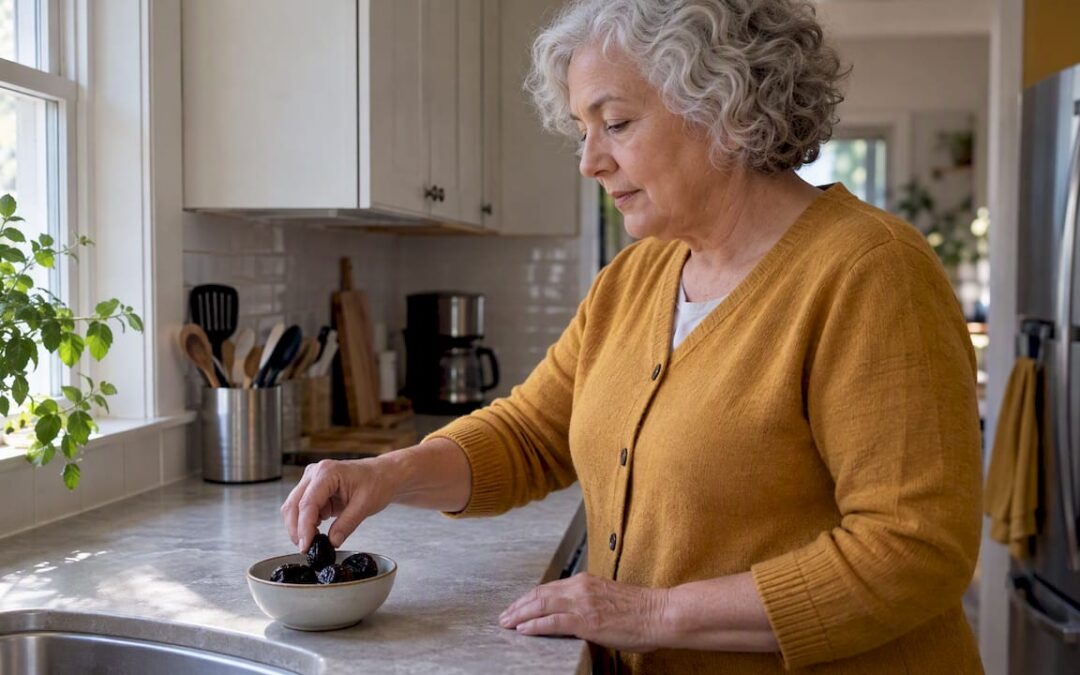
Clinical trials show that eating about 4 to 6 prunes daily (50 grams) can help preserve total hip bone density in postmenopausal women over a year. The effect is modest and site-specific, not a cure for osteoporosis. Evidence in men remains limited and mixed, so the clearest benefit right now applies to postmenopausal women managing low bone density.
TL;DR:
- At 50 grams daily, participants maintained total hip density while controls lost 1.1%; 100 grams brought more dropouts without clearer hip benefit.
- Reviews report mixed results at individual bone sites, and a 2025 analysis found no significant overall BMD effect; trials have not established fracture prevention.
- Men’s evidence remains mixed: studies lasting three months found favorable bone turnover markers, but a yearlong trial found no significant change at standard DXA sites.
- Start with 1 to 2 prunes and increase gradually, splitting portions to ease digestion; ask a clinician first if you take warfarin or manage diabetes.
- Use prunes alongside prescribed osteoporosis treatment, calcium, vitamin D, and exercise that places weight on bones, rather than replacing established care.
Table of Contents
- Trial results and meta-analyses: what the data actually show
- How many prunes were tested and how to equate that to daily portions
- Why prunes may affect bone: nutrients and plausible biology
- Who is likely to benefit: postmenopausal women, men, and research gaps
- How to add prunes safely into your routine and what to watch for
- Clinic perspective: how prunes fit into a complete bone-health plan
- Author perspective and practical next steps
- Clinic option: osteogenic loading as a complementary approach
- FAQ
- Sources
Trial results and meta-analyses: what the data actually show
The strongest evidence comes from a 12-month randomized controlled trial known as the Prune Study. Postmenopausal women who ate 50 grams of prunes daily, roughly 4 to 6 prunes, maintained their total hip bone mineral density, while the control group lost 1.1% of total hip BMD over the same period. Interestingly, the 100-gram group in that same trial had higher dropout rates and did not show a clear hip benefit over control, which complicates the simple “more is better” assumption.
A related analysis from the same research tracked bone structure at the tibia, the shin bone that bears significant weight during walking. It found that daily prune intake preserved cortical bone structure and estimated bone strength at that site over 12 months in postmenopausal women.
Broader reviews paint a more cautious picture:
- A systematic review and meta-analysis of randomized trials found modest, site-specific benefits, with a borderline effect at the lumbar spine, but overall certainty remains limited by small sample sizes and inconsistent study designs.
- A separate 2025 systematic review found no significant pooled effect on BMD overall, though it did report reduced TRAP-5b, a marker of bone resorption, suggesting biochemical activity without a consistent BMD translation.
- Most trials run from single research centers with modest enrollment, and they measure bone density rather than actual fractures, which limits how confidently we can translate these findings into fracture prevention.
Prunes preserved hip BMD in a 12-month trial while the control group lost 1.1% of total hip bone density, a gap that illustrates the trial’s core finding even though the absolute numbers are small.
How many prunes were tested and how to equate that to daily portions
Trial doses translate easily into kitchen measurements. Fifty grams works out to about 4 to 6 prunes, depending on size, and was the dose linked to hip bone preservation over 12 months. One hundred grams, about 10 to 12 prunes, was tested in some trials for spine and ulna outcomes but came with a tradeoff.
- The 50-gram dose had better participant retention across trial periods of 6 to 12 months.
- The 100-gram dose produced more gastrointestinal complaints and higher dropout in some studies.
- Fifty grams of prunes adds roughly 110 to 120 calories, a modest addition for most daily diets.
Splitting the daily amount, say 2 prunes at breakfast and 2 to 4 later, tends to reduce digestive complaints compared with eating the full portion at once.
Pro Tip: Start at 2 prunes a day for the first week, then build up to 4 to 6 once your digestion adjusts.

Why prunes may affect bone: nutrients and plausible biology
Prunes carry a mix of compounds that researchers believe act together rather than through one single ingredient, an idea some nutrition experts call a “nutrient matrix”.
- Polyphenols, plant compounds with antioxidant properties.
- Vitamin K, involved in bone protein function.
- Boron and potassium, trace minerals studied for bone metabolism.
- Fiber, which may support mineral absorption through gut effects.
Proposed pathways include reduced inflammation and oxidative stress, shifts in bone turnover markers such as OPG, RANKL, and TRAP-5b, and improved mineral handling through fiber and prebiotic-like effects in the gut. Animal studies and early human trials support this biological plausibility, including work showing that pairing prunes with prebiotic fiber improved mineral absorption and bone outcomes in rodent models. None of this amounts to confirmed mechanistic proof in people, but it gives the clinical results a reasonable biological backstory.
Who is likely to benefit: postmenopausal women, men, and research gaps
The strongest evidence applies to postmenopausal women with osteopenia, where trials measured hip and spine bone density using DXA scans, the standard imaging method for bone density. Results for men are less settled.
- Short-term, 3-month trials in men showed favorable changes in bone turnover markers with 50 to 100 grams of prunes daily.
- A 12-month trial in men found no significant change at common DXA-measured BMD sites, though it hinted at possible benefits to tibial bone geometry.
- Research gaps include a lack of fracture outcome data, limited diversity across age and ethnic groups, and few long-term adherence studies.
Researchers broadly agree that larger, longer, and more diverse trials are needed before BMD changes can be confidently linked to fewer fractures.
How to add prunes safely into your routine and what to watch for
Prunes work well as a snack, stirred into oatmeal or yogurt, or chopped into salads for texture. Starting with 1 to 2 prunes a day and building toward 4 to 6 as tolerated avoids the gastrointestinal discomfort some trial participants reported at higher doses.
- Spread intake across the day rather than eating the full portion at once.
- Drink enough water and pair prunes with other fiber sources to ease digestion.
- Reduce the amount or pause if you notice cramping or loose stools.
- Check with a clinician before increasing intake if you take anticoagulants like warfarin, since prunes contain vitamin K, or if you manage diabetes, since dried fruit affects blood sugar.
Pro Tip: Keep a simple food log for the first two weeks so you and your provider can see how your body responds before committing to a daily habit.
Clinic perspective: how prunes fit into a complete bone-health plan
Prunes work as an adjunct, not a replacement for prescribed osteoporosis medication, calcium, vitamin D, or weight-bearing exercise. Professional bone-health organizations list dried plums as a bone-supportive food precisely within that framing, alongside established prevention measures rather than in place of them.
We see dietary strategies like this as one input among several. Weekly supervised osteogenic loading sessions serve as a clinic-delivered complement to what someone eats at home, not a substitute for it.
A reasonable action checklist: talk with your clinician, consider a DXA follow-up at 6 to 12 months, add 4 to 6 prunes daily, keep calcium and vitamin D intake consistent, and pursue supervised loading or weight-bearing exercise where appropriate.

Author perspective and practical next steps
The honest takeaway is that prunes offer a modest, site-specific benefit, not a dramatic one, and they work best as part of a combined strategy rather than a standalone fix. If you want to try this, 50 grams daily for 6 to 12 months is the dose with the best evidence and the fewest dropouts. Track how you feel, and if you already have osteopenia or osteoporosis, prioritize regular DXA monitoring over any single dietary change.
— Aaron
Clinic option: osteogenic loading as a complementary approach
Osteogenic loading is a brief, supervised weekly session that applies controlled force to the skeleton to stimulate bone-building activity, delivered through equipment designed for that specific purpose.

- It may suit people with low bone density who want a supervised, measurable approach alongside diet and medication.
- Sessions take only minutes per week, which fits around existing routines.
- It pairs naturally with dietary steps like adding prunes, rather than replacing them.
If you want to explore how a weekly session fits alongside what you already eat and take, you can learn more about osteogenic loading and find a location near you.
FAQ
How many prunes a day for bone density?
The dose most linked to preserved hip bone density in postmenopausal women is 50 grams daily, roughly 4 to 6 prunes. Higher amounts, around 100 grams, have been tested but showed more gastrointestinal dropout without a clearer hip benefit.
What is one food people suffering from osteoporosis should eat more of?
Prunes are often highlighted because trial evidence shows they can help preserve bone density at the hip and support bone structure at the tibia. They work best alongside calcium, vitamin D, and prescribed treatment rather than as a replacement for them.
Which is better for osteoporosis, prunes or dates?
Prunes have direct randomized trial evidence showing site-specific bone density preservation, while dates have not been studied in the same way for bone outcomes. Based on current research, prunes are the better-supported choice for bone health specifically.
What is the downside of eating prunes?
The main downside is gastrointestinal discomfort, including bloating or loose stools, especially at higher intakes like 100 grams a day. Prunes also contain vitamin K, which matters for anyone on blood-thinning medication, so checking with a clinician first is a sensible step; a practical bone-health checklist can help you track other daily habits alongside diet.
Sources
- Prunes preserve hip bone mineral density in a 12-month randomized controlled trial in postmenopausal women: the Prune Study
- Randomized trial reporting prune effects on tibial cortical structure and estimated strength
- Short-term prune trials in men and a 12-month male study — mixed BMD results
- Prunes and bone health: review of animal and human evidence