
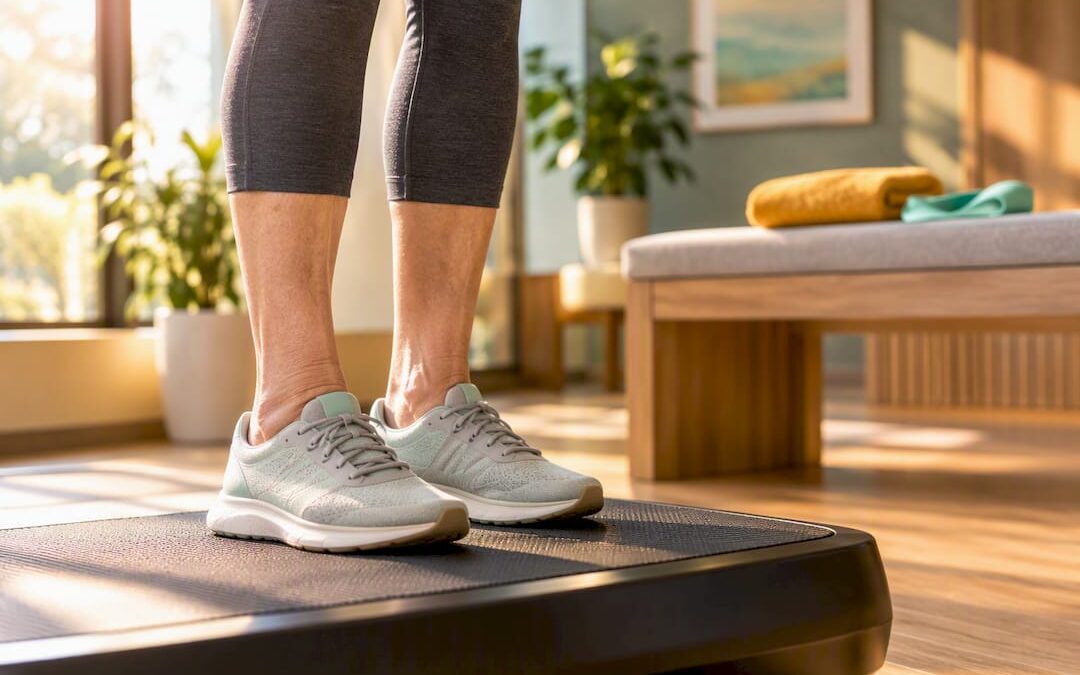
Low intensity vibration shows modest, real bone benefits in some randomized trials, mostly preserved or slightly increased bone mineral density at the spine and hip, plus measurable gains in bone microstructure and strength. It is not a proven fracture-prevention therapy on its own, and results depend heavily on device settings and how consistently you use it. Think of low intensity vibration (LIV) as a legitimate mechanical stimulus for bone, best used alongside standard osteoporosis care rather than instead of it.
TL;DR:
- Consistent adherence to low intensity vibration protocols, especially at around 30 Hz and 0.2 to 0.3 g, is crucial for achieving modest bone benefits.
- Devices should specify their frequency and acceleration levels; most effective protocols involve sessions of 10 to 20 minutes daily, focused on vertical low-force signals.
- Vibration therapy is safest when used as an adjunct to standard osteoporosis treatment, with medical clearance recommended after recent fractures or existing hardware.
- Evidence shows LIV can protect or slightly increase bone density and improve microstructure, but results vary significantly depending on device settings and user consistency.
- Supervised, clinician-guided programs help optimize outcomes through personalized load calibration, enhancing adherence and safety over unsupervised home use.
Table of Contents
- What Is Low Intensity Vibration Osteoporosis Therapy?
- How Does Vibration Improve Bone Density?
- What Do Clinical Trials Show About Vibration Therapy for Osteoporosis?
- Is Vibration Therapy Safe for People With Osteoporosis?
- What Frequency and Duration of Vibration Is Best for Bone Health?
- How Does Vibration Therapy Fit Into Osteoporosis Treatment?
- What Are the Biggest Unanswered Questions About Vibration Therapy?
- What Vibration Therapy Research Means for You
- A Supervised Approach to Mechanical Bone Loading
- Sources
- FAQ
What Is Low Intensity Vibration Osteoporosis Therapy?
Low intensity vibration osteoporosis therapy uses a platform that delivers small, rapid mechanical oscillations to the body, typically under 1 g of acceleration at frequencies around 20 to 40 Hz. The displacement is tiny, often less than a millimeter, and the sensation is closer to a gentle buzz under your feet than a shake. That distinction between “low intensity” and ordinary whole-body vibration (WBV) machines you see at gym matters more than most marketing copy admits.
High-intensity WBV platforms, the kind built for athletic training, generate far larger g-forces and amplitudes, sometimes several times body weight in peak load. Those forces can build muscle power in healthy adults, but in someone with fragile vertebrae or a recent hip fracture, that same jolt is a liability rather than a benefit. Clinical reviews consistently recommend devices that stay below 1 g while running at higher frequencies, precisely because that combination appears to stimulate bone cells without the joint and muscle strain that comes with bigger displacements.
The mechanistic reasoning behind LIV traces back to work from researchers like Dr. Clinton Rubin, whose framing treats these low-magnitude, high-frequency signals as a stand-in for the normal muscle “hum” your postural muscles generate all day just to keep you upright. That signal, according to research on vibration as a non-drug therapy, appears biologically active even at accelerations too small to feel as a jolt.
Two device formats dominate the clinical literature and the consumer market:
- Scale-like plates: Small platforms you stand on, often prescribed for home use, delivering the low-acceleration signal used in most successful trials.
- Gym-style WBV platforms: Larger machines built for athletic conditioning, generating higher g-forces and amplitude that fall outside the parameters tested for bone benefit in osteoporosis populations.
If a device description does not state its frequency and peak acceleration, you cannot know which category it falls into. That single omission is the most common way this therapy gets misapplied.
How Does Vibration Improve Bone Density?
Bone cells sense mechanical loading through more than one channel, and acceleration appears to be one of them, distinct from the direct tissue strain that comes from lifting weight or absorbing impact. That distinction explains why a signal too small to bend bone tissue can still trigger a cellular response.
Inside bone marrow, mesenchymal stem cells face a fork in the road: they can become osteoblasts, the cells that build bone, or adipocytes, the cells that store fat. Evidence gathered in the JBMR trial on postmenopausal women found reductions in bone marrow fat fraction after a year of daily LIV exposure, a signal consistent with mechanical loading nudging that decision toward bone formation rather than fat storage. Whether that shift meaningfully alters the osteoblast to osteoclast balance long term is still being worked out, and some proposed pathways involving Wnt/beta catenin signaling remain more theoretical than confirmed in human trials.
There is a second, less discussed pathway that has nothing to do with bone cells directly: balance and muscle activation. Standing on a vibrating platform recruits small stabilizing muscles in the ankles, calves, and core that ordinary standing barely touches. For someone with osteoporosis, the actual clinical threat is rarely the disease itself; it is the fall that turns fragile bone into a fracture. A therapy that improves postural control even modestly could reduce fracture risk through a completely different mechanism than bone density gains, and several reviews treat this neuromuscular effect as just as clinically relevant as any BMD number.
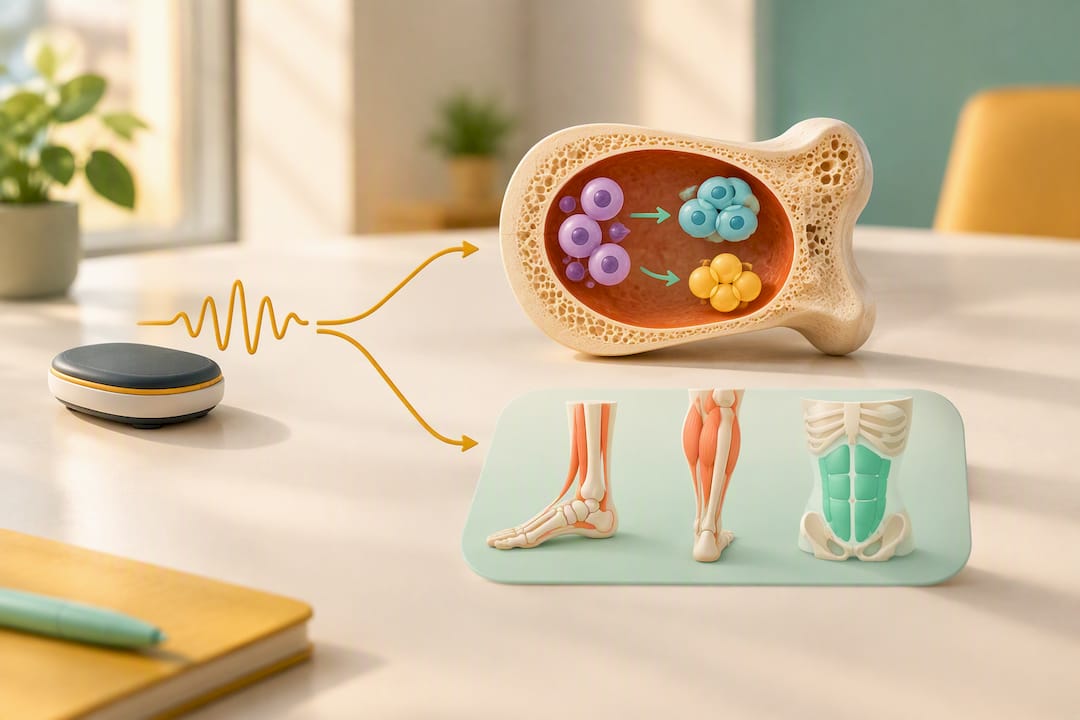
That two-track mechanism, direct cellular signaling plus neuromuscular training, is part of why researchers keep testing LIV even when density outcomes are inconsistent. A therapy that helps you catch yourself before a fall matters even if it never moves a DXA scan.
What Do Clinical Trials Show About Vibration Therapy for Osteoporosis?
The strongest evidence for vibration therapy osteoporosis outcomes comes from randomized, placebo-controlled trials, and the picture they paint is one of consistent modest benefit rather than dramatic reversal. Trials from Rubin and colleagues found that LIV, delivered at roughly 0.2 to 0.3 g and around 30 Hz for brief daily sessions, protected or slightly increased bone mineral density at the spine and femoral neck in postmenopausal women over months to a year, according to research on vibration therapy’s benefits and risks. Compared to a control group that continued losing bone at the expected rate, “protected” density is itself a real outcome, even when the headline number looks unremarkable.
A separate 12-month randomized, double-blinded trial in pre-osteoporotic postmenopausal women used almost identical settings, 30 Hz and 0.3 g for 10 minutes daily, and measured outcomes beyond standard DXA scans. Researchers found a statistically significant improvement in distal tibia stiffness on advanced imaging, along with the marrow fat reduction mentioned earlier, according to the JBMR 2020 trial. DXA-measured bone density changes in that same trial were modest, which highlights a recurring theme in this research: bone can be getting structurally stronger in ways that standard density scans do not fully capture.
Not every trial finds a benefit, and that inconsistency is not a footnote, it is the central challenge in interpreting this literature. Some studies report no measurable difference from placebo, and clinical summaries aimed at patients, including a Weill Cornell CERT review, describe the overall evidence base as mixed rather than settled, noting that “good evidence” for meaningful benefit is still lacking in a portion of the literature.
| Trial characteristic | Rubin-type RCTs | JBMR 2020 (Rajapakse et al.) |
|---|---|---|
| Frequency | ~30 Hz | 30 Hz |
| Acceleration | 0.2 to 0.3 g | 0.3 g |
| Session length | Brief daily sessions | 10 minutes daily |
| Duration | 6 to 12 months | 12 months |
| Primary finding | Spine/femoral BMD protected or slightly increased | Tibial stiffness improved, marrow fat reduced |
| DXA outcome | Modest, compliance-dependent | Modest |
Two variables explain most of the spread between positive and null results: adherence and baseline bone status. When researchers isolate the participants who actually used the device consistently, per-protocol or high-adherence subgroups, effect sizes climb noticeably compared to the intention-to-treat averages that include people who barely touched the machine, a pattern documented in the vibration therapy risk and benefit review. Skip half your sessions and you are, in effect, running a different, weaker experiment than the one that produced the published results.
The other major source of inconsistency is device heterogeneity itself. Trials have used different frequencies, different accelerations, vertical versus horizontal displacement, and different session lengths, and a 2025 review of vibration therapy advances points to exactly this variation as the reason results do not line up cleanly across studies. Two trials both labeled “low intensity vibration” can be testing meaningfully different interventions, which is part of why no single number, like “expect a 2% BMD gain,” should be treated as a guarantee.
Is Vibration Therapy Safe for People With Osteoporosis?
Reported adverse effects in properly dosed LIV trials are rare, which is exactly what you would expect from a signal designed to sit below the threshold that causes tissue damage. That safety profile is the main reason clinicians distinguish it so sharply from high-intensity WBV, where documented harms include muscle soreness, joint pain, and in some cases symptoms resembling overuse injury from the larger forces involved.
That does not mean every person with low bone density should step onto a plate unsupervised. Some groups need medical clearance first, and skipping that step is the most common safety mistake people make with this therapy.
- Recent fracture or spinal compression: Any active healing bone should be cleared by an orthopedic provider before adding a new mechanical stimulus.
- Certain implants or hardware: Orthopedic hardware, pacemakers, or other implanted devices may carry specific vibration contraindications your device manufacturer or physician can flag.
- Cardiovascular instability: Conditions involving blood pressure swings or dizziness on standing deserve a conversation with a physician before starting, since standing tolerance itself is part of the exposure.
- Severe, uncontrolled osteoporosis with high fracture risk: A DXA-confirmed high fracture risk score warrants a supervised setting rather than an unmonitored home device, at least initially.
Patient-facing resources, including an overview from the Royal Osteoporosis Society, echo this same caution: the evidence for bone-specific benefit is still developing, and the therapy is best framed as a possible adjunct, not a standalone fix, particularly for people with more fragile skeletons.
Pro Tip: Start any new vibration program at the lowest available intensity setting and shortest session length, then increase gradually only if you feel no pain, dizziness, or unusual joint discomfort after the first several sessions.
What Frequency and Duration of Vibration Is Best for Bone Health?
Trials that produced measurable bone benefit clustered around a narrow band of settings, and that narrow band is worth memorizing if you are comparing devices or programs.
- Frequency near 30 Hz. Most successful trials operated in the 20 to 40 Hz range, with 30 Hz appearing most often in the studies with positive findings.
- Acceleration under 1 g, typically 0.2 to 0.3 g. This low-magnitude threshold is the defining feature that separates therapeutic LIV from athletic WBV, according to clinical practice reviews.
- Session length of 10 to 20 minutes, done daily in most protocols, rather than longer sessions done infrequently.
- Vertical displacement measured in fractions of a millimeter, small enough that you should not feel a jarring sensation; horizontal-displacement devices exist too, though vertical designs dominate the published trials.
- Adherence at or above roughly 80% of prescribed sessions, the threshold above which several trials reported their strongest per-protocol effect sizes.
That last point deserves emphasis: a device with perfect specifications delivers nothing if it sits unused in a closet. Consistency, not intensity, is what separates the trials that found benefit from the ones that did not.
How Does Vibration Therapy Fit Into Osteoporosis Treatment?
Low intensity vibration works best as an addition to your existing osteoporosis care, not a substitute for it. People who cannot tolerate higher-impact exercise, whether from joint pain, balance concerns, or general frailty, appear to get relatively more benefit from LIV, since it functions in part as a mechanical exercise surrogate for those who cannot safely jump, run, or lift heavy loads, a pattern noted in research on vibration’s role in bone-preserving therapy. If your osteoporosis management already includes a bisphosphonate, denosumab, or another bone-building medication, some trial designs suggest an additive benefit from combining pharmacologic therapy with mechanical loading, though this is not universal across studies.
Before starting, a few conversations with your physician or bone health provider are worth having directly:
- What does your most recent DXA scan show at the spine, hip, and femoral neck specifically?
- What is your calculated fracture risk score, and does that change what intensity or supervision level makes sense?
- Do any current medications have timing considerations that interact with a new exercise or loading routine?
- Should your first sessions happen under direct supervision rather than at home?
Program structure matters here too. A home device offers convenience and daily access, which supports the adherence that trials show drives results, but it also means no one is watching your form or catching early warning signs. A supervised clinic setting trades some of that convenience for professional oversight and individualized load assessment, an approach closer to how osteogenic loading programs are structured, with sessions calibrated to the individual rather than left to a one-size-fits-all home setting.
What Are the Biggest Unanswered Questions About Vibration Therapy?
The evidence base has a structural problem that no amount of new small trials fully solves: nobody has run a large trial using fracture as the primary endpoint. Bone density and microstructure improvements are useful surrogate markers, but they are still stand-ins for the outcome that actually matters to a person with osteoporosis, namely, not breaking a hip.
Device heterogeneity compounds the problem. With trials using different frequencies, accelerations, session lengths, and displacement directions, there is currently no agreed dosing standard the way there is for, say, a specific medication’s milligram dose. The 2025 Frontiers review calls directly for standardized protocols and larger trials, a call that reflects how fragmented the current literature really is.
Longer-term outcomes remain largely unknown too. Most published trials run 6 to 12 months, which tells you almost nothing about what happens after five or ten years of consistent use, or whether benefits plateau, continue, or fade with age-related bone changes. Research into personalized dosing, essentially matching vibration parameters to an individual’s bone status and risk profile rather than applying a blanket protocol, along with studies specifically in clinically high-risk populations like those with prior fragility fractures, would close some of the most consequential gaps in this field.
What Vibration Therapy Research Means for You
The honest reading of this evidence is that LIV is a legitimate, low-risk mechanical stimulus for bone, not a breakthrough cure, and treating it as either useless or miraculous misreads the trial data. People most likely to see benefit share a few traits: limited ability to do higher-impact exercise, lower baseline bone quality where even small structural gains matter, and the discipline to actually show up for sessions consistently, since adherence drove nearly every positive result in this research.
If you are considering it, the practical next step is a conversation with your physician about your specific DXA numbers and fracture risk, followed by a supervised trial period where someone tracks your adherence and reviews follow-up bone density scans against your baseline. Vibration therapy for osteoporosis rewards patience and consistency far more than it rewards finding the “strongest” machine.
— Aaron
A Supervised Approach to Mechanical Bone Loading
If the research above left you wondering how to translate 30 Hz and 0.3 g settings into something you can actually do consistently, that is exactly the gap supervised programs are built to close. Supervised osteogenic loading sessions apply calibrated mechanical loading once per week under staff guidance, which solves the adherence and individualization problems that plague home vibration devices, no guessing about settings, no unsupervised risk for someone with fragile bones. Sessions may be paired with supporting therapies like vibration plates, red light therapy, and compression therapy, coordinated around a specific bone health picture rather than a generic protocol.
This is not a replacement for your physician’s guidance on medication or fracture risk, it is a structured, evidence-aligned complement delivered with individual assessment built in. If you want to see whether a weekly supervised session fits your situation, visit the Osteostrong center near you to learn about scheduling a consultation and discuss your bone health goals directly with staff trained in this approach.
Sources
- Clinical applications of vibration therapy in orthopaedic practice – PMC
- Advances in vibration therapy for the treatment of osteoporosis – Frontiers (2025)
FAQ
What Is the Best Low Intensity Vibration Setting for Osteoporosis?
Trials with the strongest results used roughly 30 Hz frequency with acceleration around 0.2 to 0.3 g, well under the 1 g threshold that separates therapeutic LIV from higher-intensity vibration platforms. Sessions ran 10 to 20 minutes daily, and clinical practice guidance recommends confirming these numbers before choosing any device.
Does Vibration Therapy Actually Help With Osteoporosis?
Some randomized trials show LIV protects or modestly increases bone density at the spine and hip, and improves bone microstructure measures beyond what standard DXA scans capture, according to trial data on vibration’s bone effects. It is not proven to prevent fractures outright, and benefits depend heavily on consistent use and correct device settings.
What Frequency of Vibration Is Good for Bone Density?
Most successful studies used frequencies in the 20 to 40 Hz range, with 30 Hz being the most common setting in trials that reported measurable bone benefit. Higher frequency paired with low acceleration, rather than high force, is the combination associated with positive outcomes in the research literature.
What Are Considered the Worst Osteoporosis Medications?
No medication is universally labeled “worst,” since drug choice depends on your fracture risk, kidney function, and treatment history, and that decision belongs to your prescribing physician rather than a general guide. What the vibration therapy research does support is that mechanical loading, whether through a device or through supervised sessions, can work alongside medication rather than replace the need for that individualized medical decision.
Can Osteostrong’s Sessions Replace Vibration Therapy Research Findings?
Supervised osteogenic loading is a distinct, supervised mechanical loading approach rather than a home vibration device, and it is offered as a complement to a broader bone health plan. Pricing and scheduling details are available directly through the center locator for a consultation tailored to DXA results and fracture risk.