
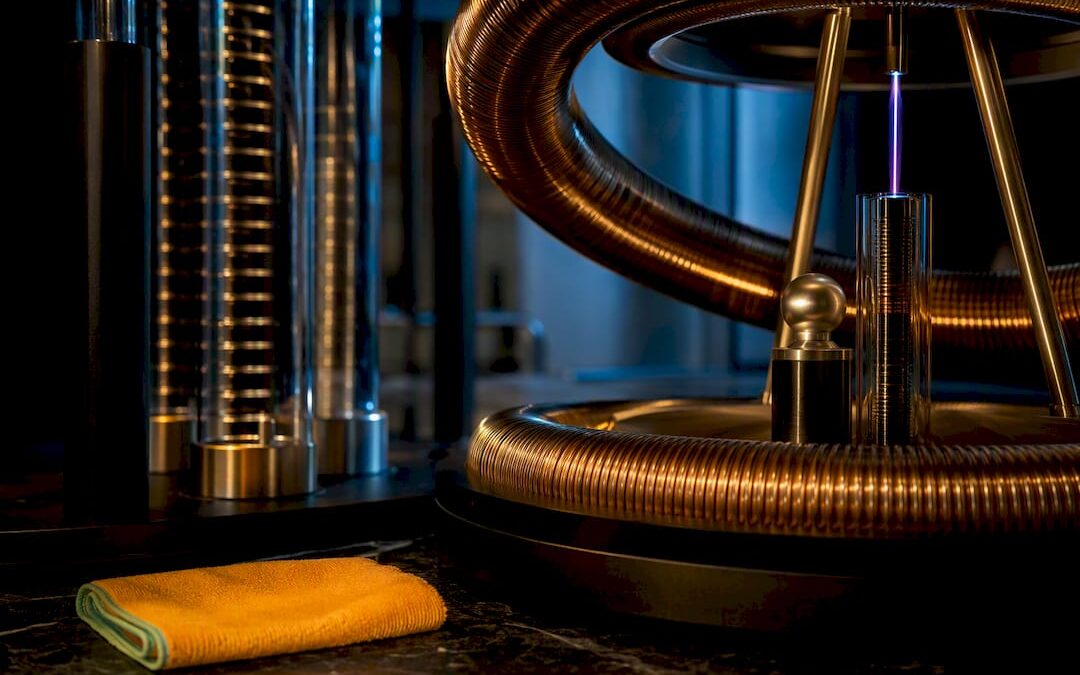
The BioCharger NG claims to deliver four energies at once (light-based photobiomodulation, PEMF, pulsed electric fields, and frequency harmonics) to support broad wellness outcomes, but independent scientific review has not confirmed those broad claims. Some individual modalities, particularly PEMF and photobiomodulation, carry supportive research in narrow clinical contexts. The bundled device, marketed as a whole-body recharging tool, still lacks peer-reviewed clinical trials to back its wider promises.
TL;DR:
- The BioCharger NG claims to deliver four energies simultaneously, but there is no peer-reviewed clinical evidence proving it produces broad wellness benefits.
- The device’s technology is based on engineering patents, not on proven health outcomes, and the scientific support for combined modalities remains unverified.
- Independent reviews categorize the BioCharger as pseudoscience, citing the lack of controlled trials and reliance on testimonials rather than objective data.
- Safety considerations include potential impacts on photosensitive individuals and those with implanted electronic devices, requiring pre-session screening and physician consultation.
- Sessions typically last 10 to 15 minutes with subjective benefits reported, but these are unconfirmed and mostly influenced by placebo effects.
Table of Contents
- What Is BioCharger Science, and How Does the Device Work?
- What Do Photobiomodulation, PEMF, and Frequency Therapy Actually Do?
- Manufacturer Claims vs. What the Evidence Actually Shows
- What Do Independent Scientific Reviews Say About the BioCharger?
- Is the BioCharger Safe? Contraindications to Know
- What Does a BioCharger Session Actually Feel Like?
- Which Patents Support the BioCharger’s Technology?
- Which Specific Frequencies Does the BioCharger Use, and Why?
- How Does BioCharger Technology Compare to Established Electromagnetic Therapy?
- Is the BioCharger Regulated as a Medical Device?
- Have Any Studies Tested the BioCharger’s Efficacy?
- How Did BioCharger Technology Develop Historically?
- A Clinic’s Honest Take on Offering BioCharger Sessions
- Try BioCharger Sessions at Osteostrong
- Sources
- FAQ
What Is BioCharger Science, and How Does the Device Work?
BioCharger science refers to the engineering and physiological claims behind a hardware system built around a large toroid coil, a Tesla-coil-based generator, spectrum tubes, and a central arc rod. Manufacturer materials describe the BioCharger NG as producing light, magnetic pulses, electric fields, and audible or subharmonic frequencies from a single console, aimed at the body without any physical contact.
The pitch is simultaneity. Rather than running one therapy at a time, the device claims to layer all four energies into a single output stream, governed by preset combinations the company calls “recipes.” Each recipe adjusts frequency ranges, light spectrum, and pulse timing for a stated purpose, whether that’s labeled as recovery, sleep support, or general vitality.
A typical setup looks like this:
- The toroid coil, mounted above or beside the seated user, generates the electromagnetic field.
- Spectrum tubes emit visible and near-visible light across specific wavelengths.
- The arc rod produces the audible harmonic tones layered into the session.
- A touchscreen console lets an operator select from prebuilt programs without adjusting hardware manually.
Sessions run 10 to 15 minutes, with the user seated a few feet from the unit, fully clothed, with no physical contact required. That touchless design is central to the manufacturer’s pitch: no needles, no topical products, nothing absorbed or injected. Whether that touchless delivery actually produces the physiological effects claimed for each recipe is a separate question, and one independent reviewers have pushed back on.
What Do Photobiomodulation, PEMF, and Frequency Therapy Actually Do?
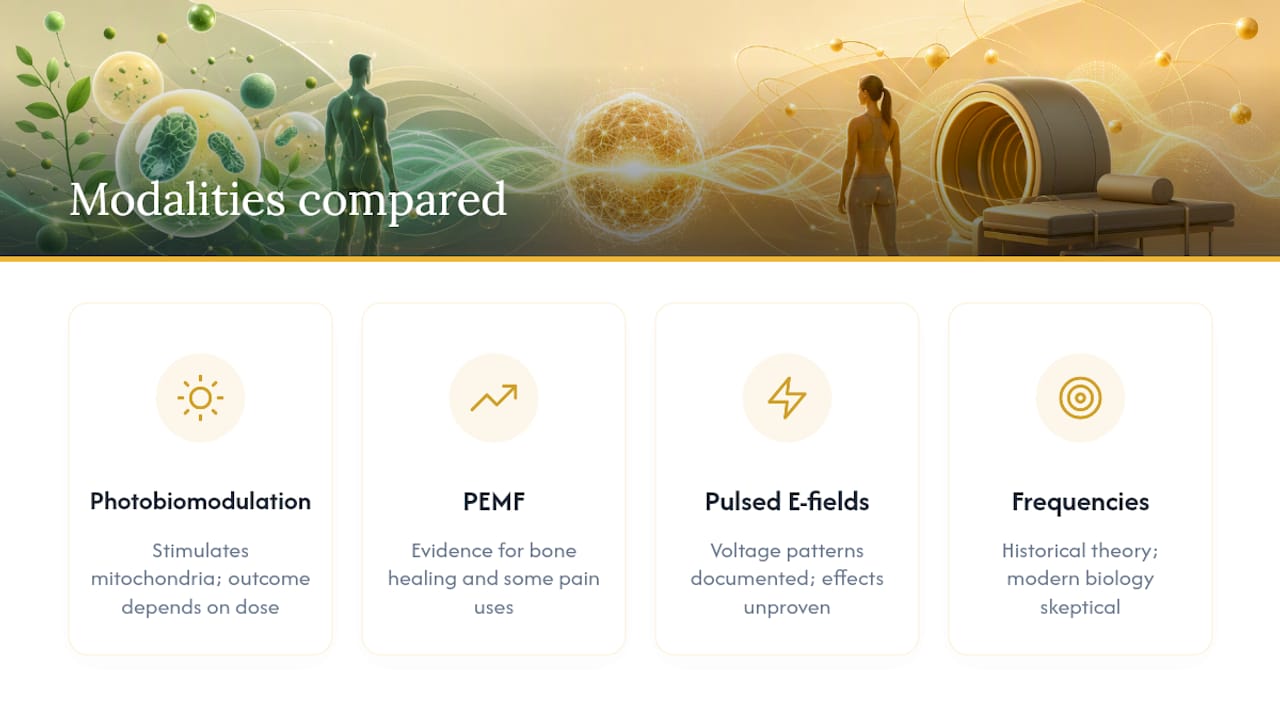
Each of the four claimed energies has its own research history, and the strength of that research varies enormously by modality.
Photobiomodulation uses red and near-infrared light to stimulate mitochondria, the cell structures that produce ATP, the molecule cells use for energy. Some clinical studies support photobiomodulation for wound healing and localized pain reduction, but outcomes depend heavily on wavelength, dose, and treatment duration. A light panel calibrated for one condition rarely transfers its results to a different use case without new testing.
PEMF (pulsed electromagnetic field therapy) has research backing in specific contexts such as bone healing and certain pain applications. Findings tied to PEMF and photobiomodulation research show effects are tightly linked to device parameters and study design, not to the general concept of “electromagnetic exposure.” A protocol that helps one condition at one frequency doesn’t automatically extend to unrelated goals.
Pulsed electric fields, sometimes described in engineering terms as high-voltage variable-frequency output, are easier to describe mechanically than biologically. The company can document the voltage and pulse pattern their hardware generates. What that pattern does inside a living body, beyond generalized statements, is far less established.
Frequencies and harmonics trace back to early 20th-century figures like Nikola Tesla, Georges Lakhovsky, and Royal Rife, whose work on oscillation and resonance predates modern cell biology by decades. Modern researchers remain skeptical of frequency-matching claims because the premise, that cells “vibrate” at specific frequencies and can be recharged by matching an external signal, isn’t supported by mainstream cell biology.
Pro Tip: If a device claims a specific frequency “targets” a specific organ or condition, ask whether that claim comes from a peer-reviewed dosing study or from historical theory alone. The two are not interchangeable.
The pattern across all four: single-modality research exists in narrow slices, but stacking four energies into one session and applying a “recipe” for a broad goal is an inferential leap the underlying studies don’t support.
Manufacturer Claims vs. What the Evidence Actually Shows
BioCharger’s own materials describe more than 30 years of research and development, a library of over 600 recipes, and a device capable of delivering four energies simultaneously through a patented system. Those are the company’s claims, and they’re worth separating clearly from what has been independently verified.
The manufacturer cites specific U.S. patents to support its technical novelty, including patents describing high-voltage, variable-frequency field generation and multi-wave oscillator design. According to the company’s own compendium documentation, these patents protect the hardware’s ability to generate and combine multiple energy types from a single console.
Here’s the distinction that matters most: a patent proves an invention is new and non-obvious to a patent examiner. It does not prove the invention produces any specific health outcome in humans. Those are two entirely different bars, evaluated by two entirely different processes.
- Patents are reviewed by the U.S. Patent and Trademark Office for novelty and utility, not by medical regulators for safety or efficacy.
- Clinical efficacy claims require randomized, controlled trials with defined endpoints, blinding where possible, and peer review.
- A device can hold multiple valid patents while having zero peer-reviewed trials demonstrating it improves any measurable health outcome.
- Manufacturer white papers and internal documentation, however detailed, are not a substitute for independent, third-party clinical research.
This is exactly the gap independent reviewers have flagged. The company references historical figures like Tesla and Lakhovsky to frame its technology as grounded in established physics, but science communicators note that historical references to pioneers in electromagnetism are not the same as modern clinical validation. Citing a 100-year-old theory of resonance doesn’t satisfy the evidentiary standard a 2026 clinical claim needs to meet.
The specific gap: no peer-reviewed, randomized clinical trial has demonstrated that the bundled four-energy BioCharger protocol produces the broad wellness outcomes described in its marketing. Individual components have research trails. The combined device, used as marketed, does not.
What Do Independent Scientific Reviews Say About the BioCharger?
Independent reviewers have not been gentle. The McGill Office for Science and Society categorizes the BioCharger as pseudoscience, pointing out that no readily available peer-reviewed clinical papers demonstrate its efficacy, and that its marketing leans on testimonials rather than controlled data.
Science-Based Medicine goes further, describing the device’s reliance on “subtle energy” concepts as a red flag common to pseudoscientific wellness products: language borrowed from real physics terms, applied to claims those terms don’t actually support.
A recurring theme in both critiques is the placebo effect. Sitting in a quiet room for 10 to 15 minutes, away from screens and obligations, tends to produce a subjective sense of calm or improved energy regardless of what device is running. That expectation effect explains a lot of positive testimonial evidence without requiring any unique property of the BioCharger itself.
- No large-scale, blinded, peer-reviewed trial on the bundled BioCharger protocol currently exists in the public record.
- Small or informal studies referenced by clinics generally lack blinding, controls, or objective endpoints.
- Reviewers classify BioCharger-style products as “energy medicine,” a category defined by scientific-sounding language without matching clinical validation.
Is the BioCharger Safe? Contraindications to Know
The BioCharger’s light and electromagnetic output carries real, if narrow, safety considerations. None of them are exotic, but they matter for specific people.
- Flashing lights. People with epilepsy or photosensitivity disorders should avoid sessions or consult a physician first, since rapid light pulses can trigger seizures in susceptible individuals.
- Implanted electronic devices. Anyone with a pacemaker, defibrillator, or other implanted electronic device should get physician clearance before a session, since electromagnetic fields can potentially interfere with device function.
- Corona discharge and ozone. High-voltage components can produce trace ozone through corona discharge; well-run clinics ventilate treatment rooms to manage indoor air quality.
- Screening before the first session. A responsible clinic asks about seizure history, implanted devices, and photosensitivity before ever starting the console.
Pro Tip: Before your first session anywhere, ask the staff directly what their pre-screening process covers. A clinic that skips this conversation entirely is a clinic worth questioning.
What Does a BioCharger Session Actually Feel Like?
Expect to sit a few feet from the console, fully clothed, for 10 to 15 minutes while lights pulse and a subtle hum plays. There’s no contact, no sensation of electric shock, and no physical exertion involved.
Clinics vary in how often they recommend sessions, and those offering this technology may benefit from expert guidance on Chiropractor SEO Services to reach more patients effectively. Some suggest weekly use as a recovery adjunct; others position it for occasional use tied to travel recovery or sleep support. There’s no clinical consensus dictating an optimal frequency, since no controlled trials have established one.
- Per-session pricing at wellness clinics commonly runs in the range that clinics set independently, since no fixed national price exists.
- Manufacturer-listed retail purchase prices for a personal unit run into five figures, reflecting its positioning as professional-grade equipment.
- Ask any clinic for their refund policy before purchasing a package.
- Ask whether staff running the device have manufacturer training or certification.
- Ask what specific evidence, if any, supports the recipe being used for your stated goal.
Reported benefits like better sleep or improved energy are routinely described by clinics offering the device as subjective, self-reported outcomes rather than measured clinical endpoints. That distinction should shape how much weight you put on any single testimonial.
Which Patents Support the BioCharger’s Technology?
The manufacturer cites U.S. patents including US10252072B2 and US11420070B2, which the company’s technical materials describe as covering high-voltage, variable-frequency field generation and the hardware’s ability to combine multiple energy types in one output.
- The patents protect engineering methods: how the multi-wave oscillator generates and modulates electromagnetic output.
- They document a real, examined invention. The USPTO does not evaluate health claims when granting a patent.
- Patent language proves the hardware does something novel electrically. It says nothing about what that output does inside a human body.
Treat patent numbers the way you’d treat a product’s engineering spec sheet: real, checkable, and entirely separate from proof that a therapy works.
Which Specific Frequencies Does the BioCharger Use, and Why?
BioCharger’s preset recipes specify combinations of light wavelength, magnetic pulse rate, and audible harmonic frequency, each tied to a labeled purpose such as recovery, focus, or relaxation. The company frames these combinations as drawing on frequency ranges associated with historical bioelectric research.
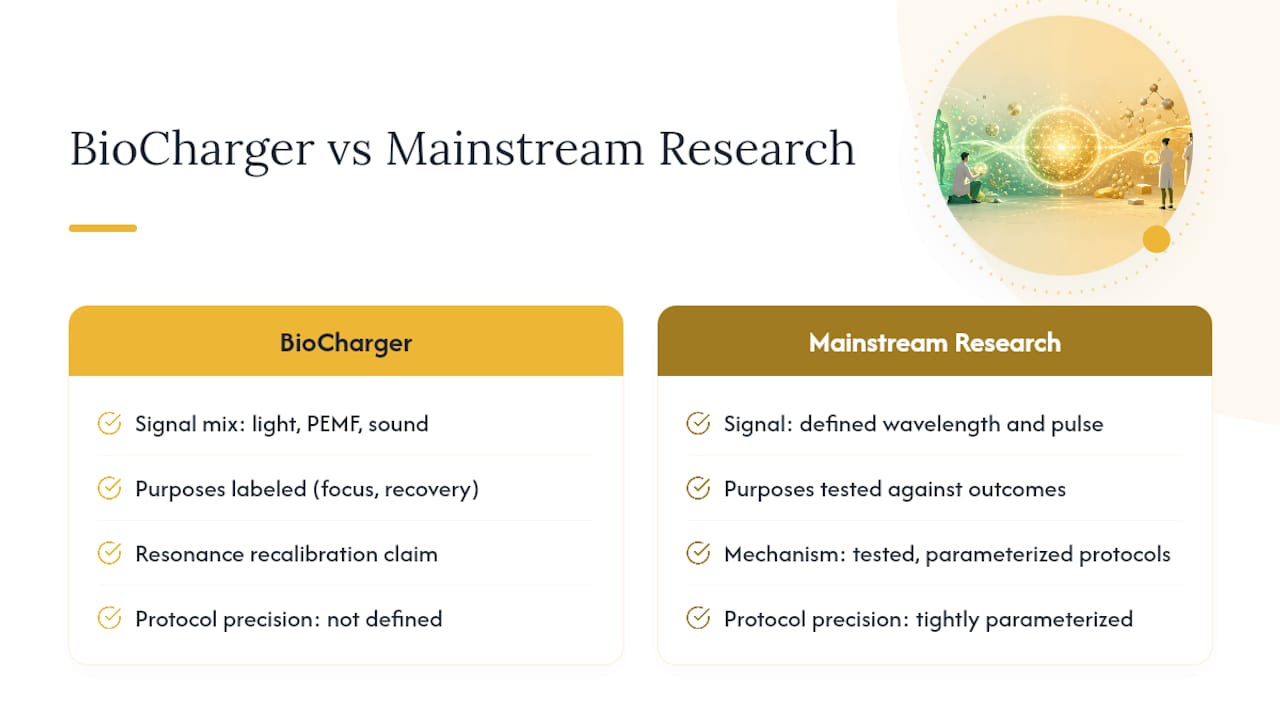
The biological premise behind frequency-matching, that specific external frequencies can “recalibrate” cellular function by matching a cell’s natural vibration, is not supported by mainstream cell biology. Cells don’t operate on a single resonant frequency that an external device can tune into and correct. Real photobiomodulation and PEMF research instead uses tightly parameterized protocols: a defined wavelength, a defined pulse duration, a defined dose, tested against a specific measurable outcome.
That’s the core tension in BioCharger’s frequency claims. The company can point to decades-old theoretical frameworks describing resonance and oscillation. What it can’t point to is a modern, controlled study showing that a specific harmonic recipe, layered with light and PEMF, produces a specific measurable biological change beyond what a person would report from sitting quietly for 15 minutes. The gap isn’t in the physics of frequency generation, which is verifiable engineering. It’s in the leap from “we can generate this frequency” to “this frequency changes your physiology in the way we claim.”
How Does BioCharger Technology Compare to Established Electromagnetic Therapy?
Established electromagnetic and light-based therapies, the kind used in physical therapy clinics and documented in peer-reviewed journals, share one trait BioCharger’s marketing generally lacks: narrow, testable claims. A PEMF device cleared for bone healing targets bone healing, at a specific frequency and intensity, tested against that specific outcome.
The BioCharger’s model runs the opposite direction. It combines four energy types into one session and applies broad recipes intended for goals ranging from sleep to athletic recovery to general vitality. That’s a fundamentally different evidentiary structure than a single-purpose PEMF bone stimulator with published trial data behind it.
This doesn’t mean every component technology is fabricated. PEMF and photobiomodulation both have legitimate places in rehabilitation and recovery settings, which is part of why clinics offering evidence-forward care, including ones that also use PEMF mats as a standalone modality, tend to be careful about which claims attach to which device. The difference is specificity: a PEMF mat used for a defined recovery protocol operates on a narrower, better-supported claim than a four-energy device marketed for broad wellness transformation.
Is the BioCharger Regulated as a Medical Device?
The BioCharger is marketed as a wellness device, not a medical device, which places it outside the FDA’s premarket approval and clearance pathways that apply to products making specific disease-treatment claims. That regulatory category matters more than it might seem.
Devices marketed for general wellness, relaxation, or “energy support” avoid the clinical trial requirements the FDA applies to devices claiming to diagnose, treat, cure, or prevent a specific medical condition. That’s a legal distinction, not a scientific one. It means BioCharger can market broadly without first proving those broad claims to a regulator, as long as it avoids specific disease-treatment language.
For consumers, this translates to a simple rule: wellness-device status means the burden of evaluating evidence falls on you, not on a regulatory body that has already vetted the claims. Nothing about being sold at a wellness clinic implies FDA clearance for the outcomes advertised.
Have Any Studies Tested the BioCharger’s Efficacy?
The honest answer is close to none, at least at the level independent science requires. No large-scale, randomized, peer-reviewed clinical trial evaluating the bundled BioCharger protocol currently exists in the public record. What does exist is a mix of manufacturer-referenced research on individual modalities and clinic-level anecdotal reporting.
Peer-reviewed research on PEMF and photobiomodulation independently supports narrow applications, but those studies test single modalities at fixed parameters, not a four-energy bundled recipe. Extrapolating from “PEMF helped bone healing in this specific study” to “the BioCharger’s PEMF-plus-light-plus-frequency recipe improves general wellness” isn’t a conclusion the original studies can support.
What clinics report instead are subjective outcome patterns: users saying they slept better or felt more energized after sessions. Useful as anecdotal signal, but without blinding, control groups, or objective measurement, those reports can’t distinguish a device effect from a placebo effect or simply the benefit of 15 quiet minutes away from a phone.
How Did BioCharger Technology Develop Historically?
BioCharger’s technical lineage draws on early 20th-century experiments with high-voltage electricity and oscillation, most notably Tesla coil design, along with later theoretical work by Georges Lakhovsky on cellular oscillation and Royal Rife’s frequency-based experiments. None of that research meets contemporary clinical trial standards, since it predates modern biomedical research methodology by generations.
The manufacturer frames this lineage as three decades of research and development culminating in patented hardware capable of generating and combining light, magnetic, electric, and harmonic output from one console. That framing is accurate as an engineering history. Tesla coils are real, well-understood technology, and building a device that layers multiple energy outputs is a legitimate hardware achievement.
Where the historical framing gets stretched is in implying that grounding a product in century-old theoretical physics substitutes for modern clinical testing. Lakhovsky and Rife’s original theories about cellular oscillation were never validated by the biomedical research standards that exist today, and citing them as a scientific foundation doesn’t close that gap. The hardware evolved considerably. The clinical validation standard it needs to meet did too, and that’s the part still missing.
A Clinic’s Honest Take on Offering BioCharger Sessions
We include BioCharger sessions because clients ask for them and some report feeling more relaxed or recovered afterward. We’re upfront that it’s a supportive addition, never a replacement for osteogenic loading, which has measurable bone density outcomes behind it. Good practice means setting realistic expectations and not overstating what a 15 minute session can do.
— Aaron
Try BioCharger Sessions at Osteostrong
BioCharger sessions are commonly offered alongside other wellness services such as osteogenic loading, red light therapy, PEMF mats, and compression therapy in some wellness centers.

To be clear about what this is: a BioCharger session at Osteostrong is a service offering, not new clinical proof of its efficacy. What Osteostrong can stand behind is the osteogenic loading protocol, a once-weekly, supervised session built around a specific, measurable goal, bone density improvement, rather than broad, hard-to-verify wellness claims. If you’re looking for a clinic that pairs an evidence-forward core service with complementary modalities like BioCharger under one roof, book a visit at a center near Rancho Cordova and ask staff directly what to expect from your first session.
Sources
- The BioCharger Is a Wellness Talisman
- BioCharger’s claims are too silly to take seriously
- The Science Behind the BioCharger: Light, PEMF & Frequencies
- Representative PEMF/photobiomodulation PubMed entry
FAQ
Does the BioCharger Really Work?
Individual modalities like PEMF and photobiomodulation have research support in narrow contexts, but no peer-reviewed clinical trial has confirmed the bundled BioCharger protocol produces its advertised broad wellness effects. Independent reviewers at McGill’s Office for Science and Society classify it as pseudoscience due to the lack of controlled clinical evidence.
How Much Does a BioCharger Session Cost?
Per-session pricing varies by clinic since no fixed national rate exists, and retail purchase prices for a personal unit run into five figures. Osteostrong offers BioCharger sessions alongside its core osteogenic loading service; current pricing for sessions and memberships is available on the clinic’s official website.
What Are the Potential Side Effects of Using the BioCharger?
The main concerns are flashing lights that can affect people with epilepsy or photosensitivity, and electromagnetic output that may interfere with implanted cardiac devices like pacemakers. Anyone with these conditions should get physician clearance before a session, and clinics should screen for them beforehand.
What Is a BioCharger Machine?
A BioCharger is a console built around a toroid coil, spectrum light tubes, and an arc rod that generates and combines four types of output, light, PEMF, pulsed electric fields, and audible frequencies, delivered without physical contact over a 10 to 15 minute session. The manufacturer cites patents like US10252072B2 and US11420070B2 covering the hardware’s field-generation design, though those patents document engineering novelty rather than clinical efficacy.