
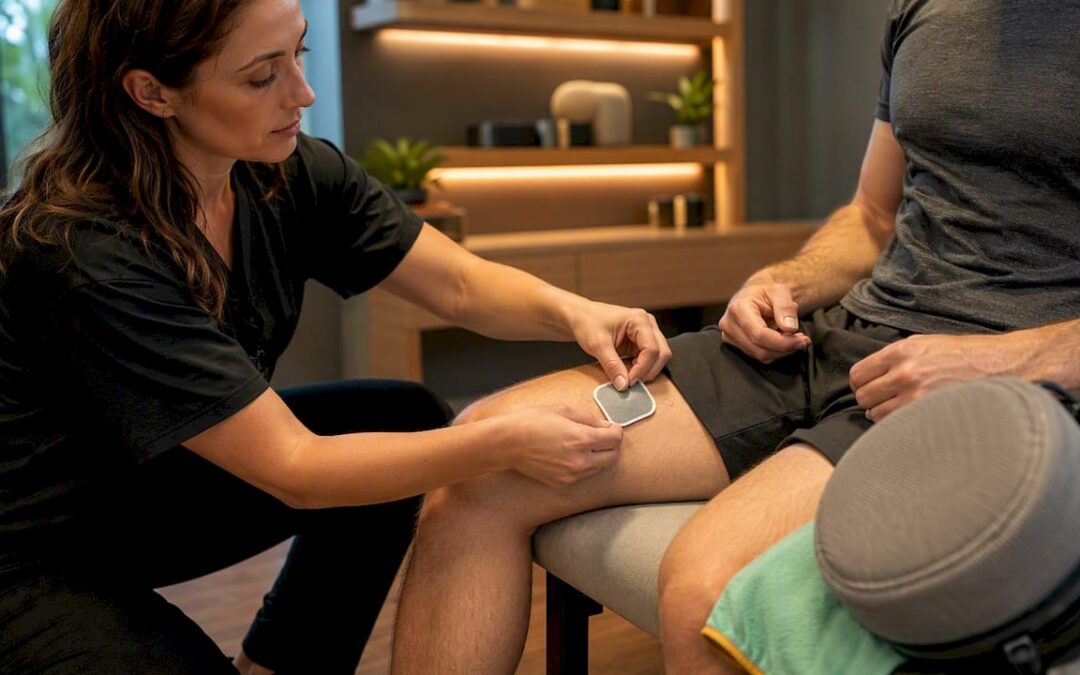
EMS activates motor nerves to force visible muscle contractions, making it the better pick for rehab, strength maintenance, and muscle re-education after injury or inactivity. PEMF delivers low-frequency magnetic pulses you cannot feel, and the clinical evidence leans toward sustained pain relief and tissue-level recovery rather than muscle building. If your goal is regaining strength after surgery, EMS is the logical starting point; if it’s chronic joint or soft-tissue pain that hasn’t responded to the basics, a supervised PEMF trial is worth discussing with a clinician before you spend money on either.
TL;DR:
- EMS provides immediate muscle contractions useful for rehabilitating muscle strength and preventing atrophy after injury or surgery, whereas PEMF’s effects develop gradually over weeks by promoting tissue repair.
- PEMF has shown significant pain reduction, cutting discomfort by about 36% over 14 days in clinical trials, alongside a 55% decrease in medication use, while EMS’s evidence centers on neuromuscular re-education rather than pain relief.
- Individuals with implanted electronic devices, pregnant women, or those with certain cardiac conditions should avoid PEMF, and both therapies require proper device quality and supervision to ensure safety.
- EMS sessions typically last 15 to 30 minutes and produce visible contractions, while PEMF sessions are usually 10 to 30 minutes and often go unnoticed, with results relying on multiple weekly treatments.
- Combining PEMF with structured loading or exercise enhances recovery outcomes, especially in bone health management, but neither therapy should replace medical treatment or comprehensive rehab plans.
Table of Contents
- PEMF vs. EMS: A Side-by-Side Look at What to Expect
- How Do EMS and PEMF Work Inside the Body?
- What Does the Clinical Evidence Actually Show?
- Which Scenarios Favor EMS, and Which Favor PEMF?
- Who Should Avoid PEMF or EMS, and What Are the Side Effects?
- How Do You Choose Between EMS and PEMF for Your Situation?
- How We Approach PEMF and EMS in Our Own Practice
- A Supervised Way to Explore PEMF for Bone Health
- Sources
- FAQ
PEMF vs. EMS: A Side-by-Side Look at What to Expect
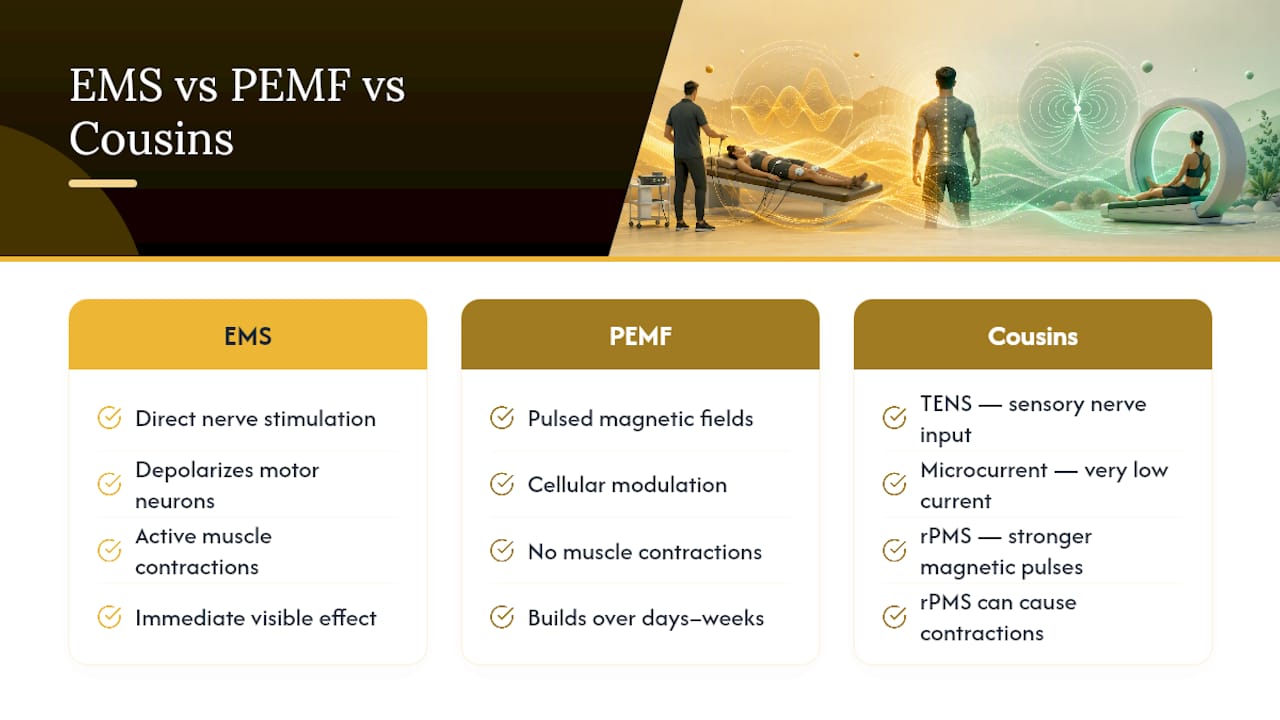
The fastest way to tell these two apart is by how they feel. EMS produces a visible muscle twitch or contraction because it directly triggers motor nerves. PEMF is usually sub-sensory, and most people feel nothing at all during a session.
That sensation gap traces back to what each device targets. Electrical stimulation devices split into distinct categories based on which nerves they engage: TENS calms sensory nerves for pain masking, EMS drives motor nerves for contraction, and PEMF/microcurrent work at a cellular level with no nerve-triggered movement at all.
Here’s how the two compare on the practical details that matter before you book a session or buy a device:
- Sensation: EMS causes visible, rhythmic muscle contractions; PEMF is typically imperceptible.
- Session length: EMS sessions often run 15 to 30 minutes; PEMF protocols in clinical trials commonly used 10 to 30 minute sessions over 2 to 4 weeks.
- Primary goal: EMS targets muscle activation, strength maintenance, and neuromuscular re-education; PEMF targets pain reduction, inflammation modulation, and tissue repair.
- Supervision needs: EMS is widely available as a consumer device with lower risk; PEMF benefits from clinical protocols and device-appropriate settings, especially for injury or bone-related use.
- Speed of results: EMS effects on muscle activation are immediate; PEMF’s pain and function benefits tend to build over one to several weeks.
Neither one is a universal upgrade over the other. They solve different problems, and picking the wrong one for your goal is the most common reason people say a therapy “didn’t work.”
How Do EMS and PEMF Work Inside the Body?
EMS works through direct nerve stimulation. Electrical current from surface pads depolarizes motor neurons, which forces the attached muscle fibers to contract, whether you’re trying to or not. That’s why it’s used so heavily in physical therapy: it can activate a muscle that’s inhibited by pain, swelling, or post-surgical guarding, helping prevent atrophy while a joint heals. The contraction also drives local blood flow, which is part of why EMS is associated with faster recovery of muscle activation after injuries like ACL reconstruction.
PEMF works on a different layer entirely. Instead of triggering nerves, pulsed magnetic fields pass through tissue and induce tiny electrical currents at the cellular level. Research on the mechanism points to modulation of inflammatory mediators, ion channel activity, and microcirculation, which plausibly explains the tissue repair and functional improvements reported in PEMF trials. Nothing contracts. Nothing gets a workout. The effect is closer to a slow-burn biological signal than a muscle-training stimulus.
This mechanism difference explains why the two therapies operate on different clocks. EMS effects are immediate and visible, but they fade once you stop training the muscle regularly. PEMF’s benefits build over days to weeks as cellular processes shift, which is also why single-session PEMF experiences tend to feel underwhelming compared to a course of treatment.
It’s worth separating PEMF from a few cousins people often lump together. TENS is not PEMF. It stimulates sensory nerves to block pain signals, closer in function to EMS’s nerve-based approach than to PEMF’s magnetic-field approach. Microcurrent therapy also uses electrical input, but at far lower intensity than EMS and through direct skin contact rather than magnetic induction. And repetitive peripheral magnetic stimulation, sometimes called rPMS, is a higher-intensity cousin of PEMF that can produce visible contractions of its own, blurring the line between the two categories in the newest research.
What Does the Clinical Evidence Actually Show?
The strongest single data point in this comparison comes from a multicenter, randomized clinical trial testing an FDA-cleared PEMF device against standard care for joint and soft-tissue pain.
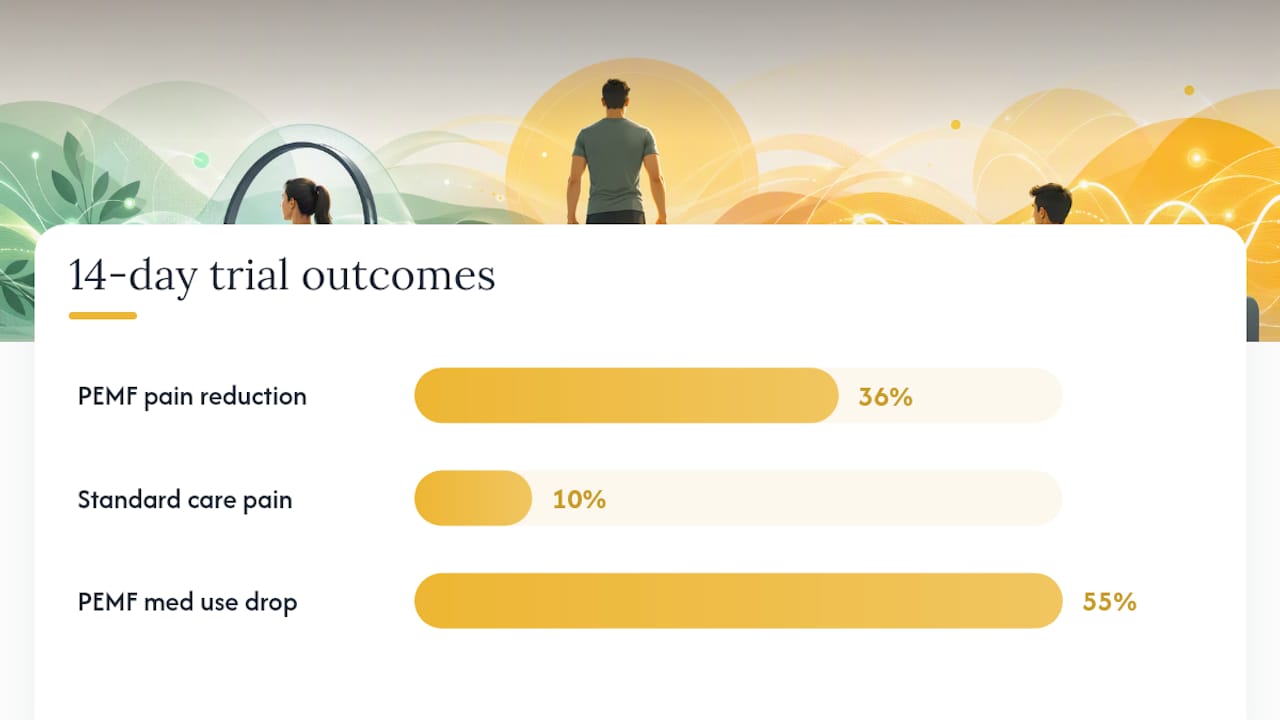
PEMF cut pain by roughly 36% over 14 days, compared with about 10% for standard care, and the PEMF group’s pharmacologic (medication) use dropped by 55%, according to the randomized multicenter trial published in PMC. That’s not a marginal edge. A drop that size, paired with fewer people reaching for pain medication, is the kind of result that gets a therapy taken seriously in a rehab setting rather than dismissed as a wellness gadget.
A broader look at the evidence adds useful nuance. A 2026 systematic review in Frontiers found that low-intensity PEMF, typically run at 1 to 200 Hz for 10 to 30 minute sessions across 2 to 4 weeks, tends to produce medium-term pain relief and functional improvement. Higher-intensity peripheral magnetic stimulation, by contrast, delivers faster short-term analgesia but with less established durability. The review frames these as a spectrum rather than competitors: gentler PEMF for sustained tissue-level recovery, stronger magnetic stimulation when you need pain control quickly.
EMS doesn’t have the same volume of pain-focused randomized trials. Its evidence base sits mostly in rehabilitation and muscle re-education research, which is a different clinical question than chronic pain reduction. That doesn’t make EMS weaker as a therapy. It makes it a tool built for a different job: preventing atrophy, maintaining neuromuscular pathways, and supporting strength during immobilization, not necessarily reducing pain signals at a tissue level.
None of this evidence is bulletproof. The Frontiers review points out that device heterogeneity, meaning wide variation in frequency, intensity, and applicator type between studies, makes direct comparisons difficult. Most PEMF trials also run over weeks, not months, so long-term durability data is thinner than the short-term numbers suggest. Placebo and expectation effects are a real concern too, especially with a sub-sensory therapy where patients can’t feel it “working” the way they can feel an EMS contraction.
Which Scenarios Favor EMS, and Which Favor PEMF?
Matching the therapy to the problem matters more than picking whichever one sounds more advanced.
Acute flare vs. chronic pain. For a fresh injury flare, standard care (ice, rest, anti-inflammatories under medical guidance) usually comes first. For chronic joint or soft-tissue pain that has plateaued on conventional treatment, PEMF has the stronger pain-specific evidence, particularly for medium-term relief.
Rehab and muscle atrophy. After surgery, a cast, or an extended period of inactivity, EMS is the more established tool for keeping muscle fibers firing and slowing atrophy while range of motion returns.
Postoperative and bone-related recovery. PEMF shows up as an adjunct therapy in some postoperative and bone-healing protocols, always under medical supervision rather than as a stand-alone fix.
Combined approaches. The Frontiers review’s underlying research suggests pairing PEMF with structured exercise or supervised loading tends to produce larger functional gains than PEMF alone. That combination principle applies broadly: neither therapy works as well in isolation as it does alongside movement, strength work, or a supervised loading program targeting the underlying tissue.
- Acute injury flare: standard care first, PEMF considered for lingering pain.
- Chronic joint or soft-tissue pain: PEMF has the better dedicated evidence.
- Post-surgical muscle inhibition: EMS for re-education and atrophy prevention.
- Bone healing support: PEMF used as a supervised adjunct, never a replacement for indicated treatment.
- Stalled recovery on either therapy alone: adding structured exercise or loading often unlocks more progress.
Who Should Avoid PEMF or EMS, and What Are the Side Effects?
PEMF carries a short but firm list of exclusions. Anyone with an implanted electronic device, such as a pacemaker or insulin pump, should avoid PEMF because the magnetic field can interfere with device function. Cleveland Clinic guidance also flags pregnancy as a precaution worth discussing with a provider first, and notes that PEMF should support a medically supervised plan rather than replace surgery or medication when either is actually indicated.
EMS has its own contraindication list, driven by the fact that it forces muscle contraction. People with certain cardiac conditions, implanted stimulators, or areas where contraction could be unsafe (over an active blood clot, for instance) should avoid EMS in those regions. Pregnant patients are typically advised to skip abdominal and lower-back placements specifically.
Side effects for both are generally mild when devices are used correctly. Skin irritation at the pad or applicator site is the most common EMS complaint. Mild soreness after a session isn’t unusual either, similar to how a muscle feels after unfamiliar exercise. PEMF side effects are rarer still, though some people report temporary lightheadedness or a warm sensation near the treatment area.
The bigger risk with both therapies isn’t physiological. It’s device quality. Consumer wellness products and true medical-grade devices vary widely in claims and calibration, and a device that isn’t built to the same standard as the ones used in clinical trials won’t reliably produce trial-level results. If a side effect worsens or doesn’t resolve within a day, stop use and check with a clinician rather than pushing through it.
How Do You Choose Between EMS and PEMF for Your Situation?
Run through these questions before committing money or time to either therapy:
- What’s the actual goal? Rebuilding muscle strength points toward EMS. Reducing chronic pain or supporting tissue recovery points toward PEMF.
- What’s the timeline? Need something you can feel working today? EMS gives immediate, visible feedback. Willing to commit to a multi-week course? PEMF’s benefits build gradually.
- Is there a contraindication? Implanted devices, pregnancy, or cardiac conditions change the calculus for either therapy, so this comes before price or convenience.
- Is supervision available? A clinic-grade device paired with professional guidance beats a consumer unit used without a protocol.
- What does it cost, and how often? Home EMS units run from budget-friendly to a few hundred dollars; PEMF mats and clinical sessions range more widely depending on device class and whether it’s a clinic visit or home purchase.
When you talk to a provider, ask directly: What evidence supports this for my specific condition? What protocol (frequency, session length, duration) will we use? What’s the realistic timeline before I should expect to notice a difference? Vague answers, or marketing language promising a cure rather than support, are red flags worth walking away from.
Pro Tip: Before buying any home device, ask the seller for the device’s specific frequency and intensity range, then compare it to the ranges used in the clinical trials you’re trying to replicate. If they can’t answer, that tells you something.
How We Approach PEMF and EMS in Our Own Practice
In clinical practice, we treat PEMF as a supportive addition to supervised osteogenic loading for patients focused on bone health, never as a stand-alone fix for low bone density. EMS shows up in a narrower, more targeted way, mostly in supervised rehab contexts where re-educating a muscle after inactivity is the actual goal. What we push back on is the idea that either therapy is a shortcut. The trial data on PEMF is genuinely encouraging, but it describes support for a broader recovery plan, not a replacement for loading, strength work, or medical care. Anyone selling it as a cure is overselling the evidence.
— Aaron
A Supervised Way to Explore PEMF for Bone Health
If you’re weighing PEMF specifically for bone health rather than general pain relief, the research supports pairing it with mechanical loading, not using it on its own. PEMF sessions are often offered as a complement to supervised osteogenic loading, not as a replacement for it.

A first visit typically includes a review of your bone health goals, a supervised osteogenic loading session, and an assessment of whether adding clinic-based PEMF makes sense for your situation. This setup tends to fit best for adults managing osteoporosis or osteopenia, or anyone being proactive about skeletal health rather than reacting to a diagnosis. It’s one option among several noninvasive paths worth exploring, and it won’t be the right fit for everyone. If it sounds relevant to your goals, the practical next step is booking an evaluation at Osteostrong’s Rancho Cordova East location to see whether supervised loading paired with PEMF makes sense for you.
Sources
The clinical claims in this article draw from a small set of higher-quality sources, listed here for anyone who wants to verify the numbers directly:
- Pulsed electromagnetic field (PEMF) therapy — Cleveland Clinic
- Efficacy and safety of low- and high-intensity magnetic field therapies for orthopedic pain: a systematic review — Frontiers (2026)
This article is general information, not a substitute for advice from a qualified doctor. Consult a qualified healthcare professional about your own circumstances before acting on anything here.
FAQ
When should you not use PEMF?
Avoid PEMF if you have an implanted electronic device like a pacemaker, and check with a clinician first if you’re pregnant or managing a condition that a provider hasn’t cleared for magnetic field exposure.
Is PEMF worth the money?
For chronic joint or soft-tissue pain, a randomized trial found PEMF reduced pain by about 36% versus 10% for standard care, along with a 55% drop in medication use, though results depend heavily on device quality and whether the session is supervised.
Is PEMF better than TENS?
They’re not interchangeable: TENS blocks pain signals through sensory nerves for temporary relief, while PEMF works at the cellular level for more sustained, medium-term pain and tissue benefits, so “better” depends on whether you need quick pain masking or longer-term support.
Is PEMF or red light therapy better?
Both are noninvasive and used for different goals, PEMF for pain and tissue-level recovery, red light therapy often for skin and surface-tissue effects, so the better option depends on the condition you’re targeting rather than one universally outperforming the other.