
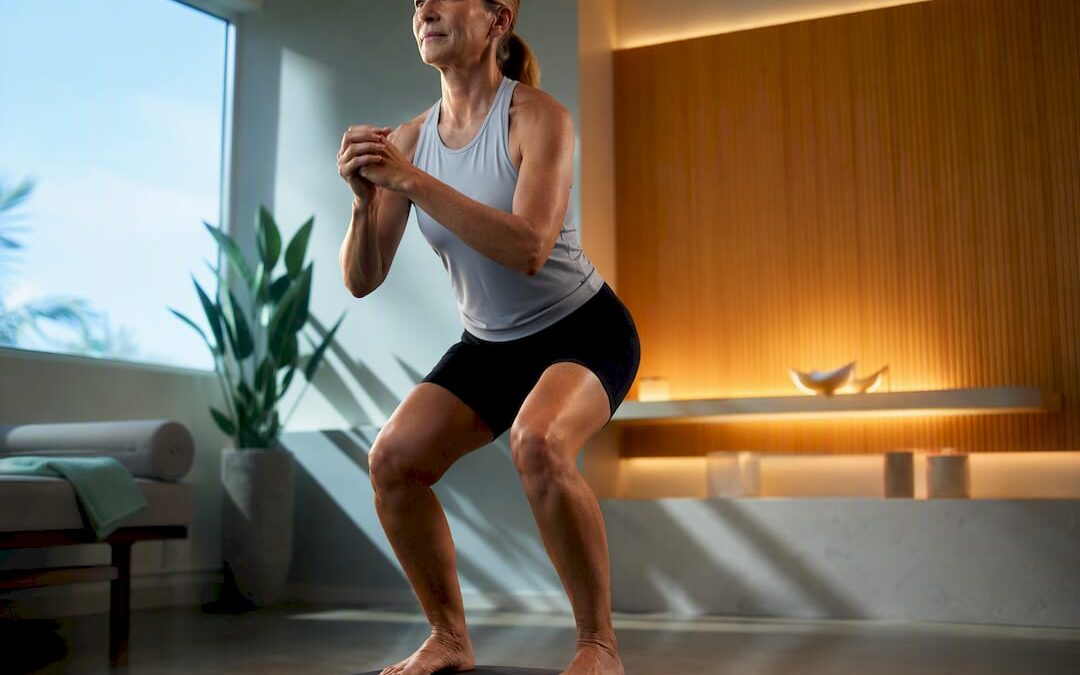
For balance and recovery, use a low frequency range. For circulation and general fitness, aim for a moderate frequency range. For bone support, protocols generally use a moderate frequency often near the middle of the moderate range, at low amplitude. For strength and power work, the frequency range is higher but within consumer research limits. Check with a doctor if you have a bone, joint, or cardiovascular condition, and start on the low end regardless of your goal.
TL;DR:
- Frequencies under 25 Hz support circulation and recovery, while 20 to 30 Hz promote general muscle toning and fitness, with about 30 Hz being a common bone support setting.
- Higher frequencies from 30 to 40 Hz activate fast-twitch fibers and neuromuscular power but can lead to quicker fatigue, especially at higher amplitudes.
- Amplitude has a greater impact on the load received than frequency, so increasing amplitude significantly raises transmitted force and neuromuscular activation.
- Safety considerations include avoiding vibration with pacemakers, recent surgery, severe osteoporosis, and other conditions, while proper stance and duration are crucial for safe use.
- Effective protocols involve gradual progression over weeks, tailoring frequency and amplitude to individual goals, body response, and health status, rather than aiming for maximum settings.
Table of Contents
- What Do Frequency and Amplitude Actually Mean on a Vibration Plate?
- How Does Each Frequency Range Affect Your Body?
- What Are the Best Frequency Settings for Common Goals?
- How Do Frequency, Amplitude, and Time Combine Into a Dose?
- What Safety Rules Apply Before You Start?
- How OsteoStrong Applies Frequency Settings in Practice
- Stop Chasing the Highest Number on the Dial
- Ready for a Supervised Vibration Plate Protocol?
- Sources
- FAQ
What Do Frequency and Amplitude Actually Mean on a Vibration Plate?
Frequency is how many times the platform oscillates per second, measured in Hertz (Hz). A setting of 30 Hz means the plate moves up and down, or side to side, 30 times every second. Amplitude is the distance the platform travels during each cycle, measured in millimeters, usually somewhere between 1 mm and 10 mm depending on the machine.
Neither number tells the whole story alone. What your body actually absorbs is closer to a combined measure researchers call peak acceleration, expressed in units of gravity (g). Two plates set to the identical Hz can deliver very different forces if their amplitudes differ, which is part of why “what frequency should I use” doesn’t have one universal answer.
Plate mechanics matter just as much as the dial setting:
- Linear or vertical plates move straight up and down, typically in the 20 to 50 Hz range, and tend to deliver a more direct, symmetrical load through both legs at once.
- Oscillating or pivotal plates rock side to side like a seesaw, mimicking a walking motion, usually running lower, often 5 to 20 Hz, at higher amplitude.
- 3D or triplanar plates combine vertical, front to back, and side to side motion, which lets manufacturers offer a wider effective range on one machine.
This is why MD Anderson points out that research-grade devices used in clinical trials often differ meaningfully from the consumer plates sold for home use. A 30 Hz setting on a precisely calibrated lab unit and a 30 Hz setting on a budget oscillating plate are not interchangeable experiences. Signal consistency, not the number on the display, determines what your muscles and skeleton actually receive.
How Does Each Frequency Range Affect Your Body?
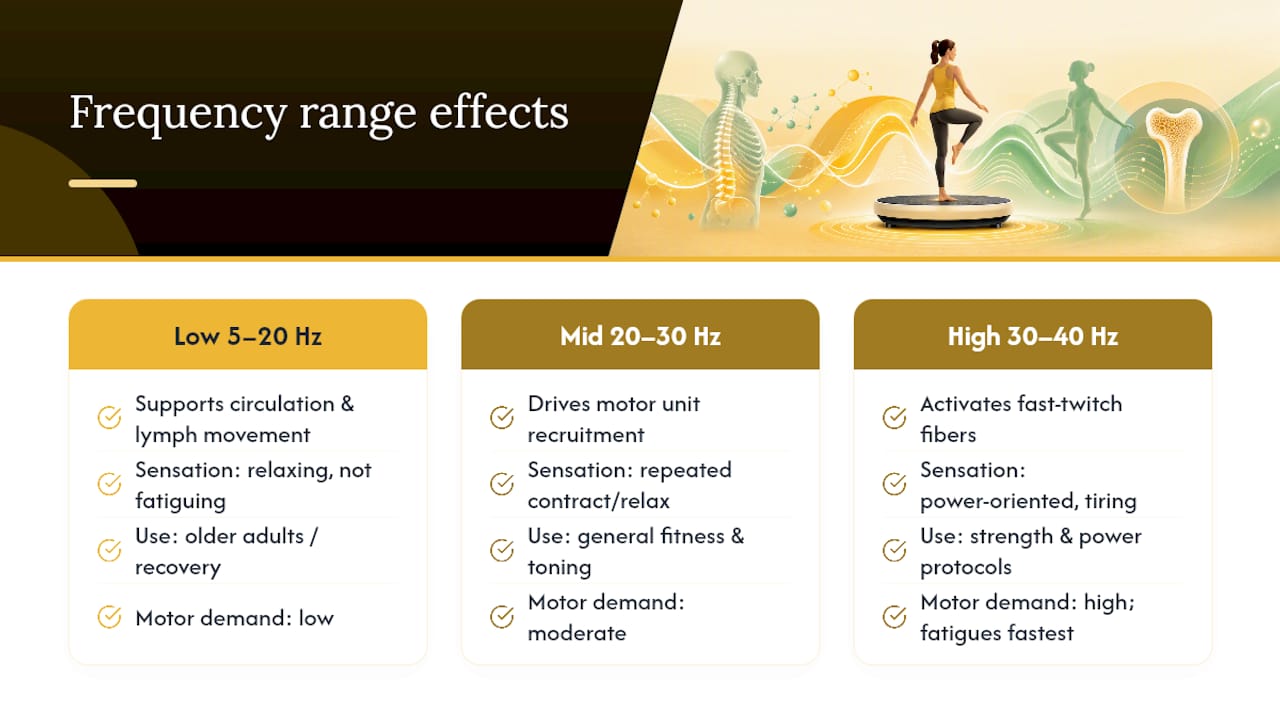
Low frequencies, roughly 5 to 20 Hz, produce a gentler mechanical stimulus that mainly supports circulation and lymphatic movement. Users often describe this range as relaxing rather than fatiguing, and it’s the range most commonly recommended for older adults just starting out or anyone recovering from illness or injury.
Mid-range frequencies, around 20 to 30 Hz, push harder into motor unit recruitment. This is where general fitness and toning protocols usually live, since the muscle has to contract and relax repeatedly to stabilize the body against the platform’s movement. Mayo Clinic describes this mechanism directly: whole-body vibration forces muscles to contract and relax dozens of times per second, which is the basic reflex loop behind most of the reported fitness benefits.
Higher frequencies, from 30 up to roughly 40 Hz, shift the emphasis toward fast-twitch fiber activation and neuromuscular power. This is the zone strength and power protocols target, and it’s also the zone that produces fatigue fastest.
A 2024 clinical review found that most whole-body vibration studies keep frequency under 50 Hz, and that around 30 Hz shows up repeatedly as a sweet spot for both muscle power output and some bone density outcomes, according to a clinical review of dosing across metabolic disease research. That same review notes an important nuance for older users: some trials found stronger muscle contraction at 20 Hz than at 40 Hz in this population, while a separate trial identified around 33 Hz as optimal for maximal power output specifically in older women. Bone mineral density trials, meanwhile, have tested frequencies anywhere from 20 to 40 Hz with genuinely mixed results.
The takeaway isn’t that one frequency wins for everyone. It’s that age, training status, and your specific goal all shift where the “best” setting actually sits, which is exactly why blanket advice like “always use 30 Hz” oversimplifies a body of evidence that’s still filling in its edges.
What Are the Best Frequency Settings for Common Goals?
Matching frequency to amplitude and session length matters more than chasing a single ideal number. The table below reflects a synthesis of clinical dosing guidance and common practitioner protocols.
These ranges align with a consolidated summary of frequency and amplitude guidance that’s broadly consistent with the clinical literature above, though the clinical review remains the stronger source for anything you’d call evidence-based.
Older adults and anyone in rehab should shift every column left: lower Hz, lower amplitude, shorter sessions. A person recovering from a hip fracture or managing significant osteoporosis has no business starting at 30 Hz regardless of what a bone-support chart suggests for the general population.
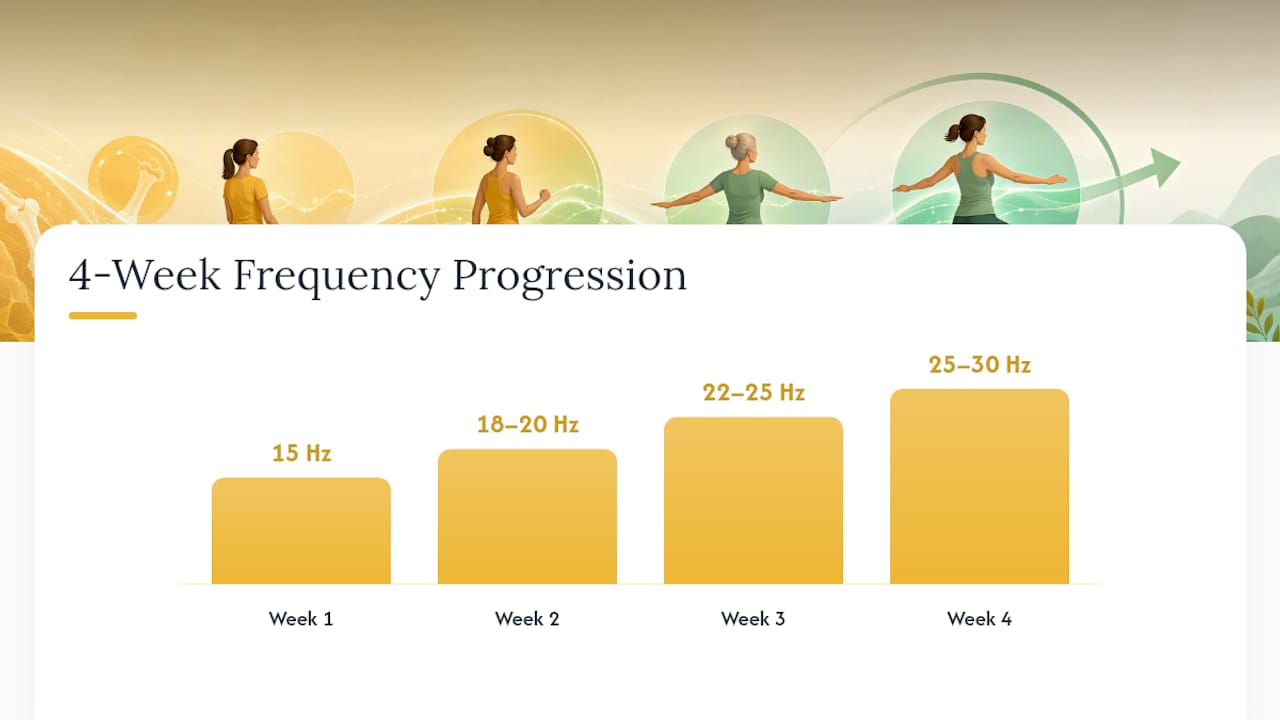
A simple four-week beginner progression for general fitness or bone support might look like this:
- Week 1: 15 Hz, low amplitude, 5 to 8 minutes, three sessions, focused purely on tolerance and form.
- Week 2: 18 to 20 Hz, low amplitude, 8 to 10 minutes, three sessions.
- Week 3: 22 to 25 Hz, low to moderate amplitude, 10 minutes, three to four sessions.
- Week 4: 25 to 30 Hz, amplitude matched to goal, 10 to 15 minutes, three to four sessions.
If dizziness, joint discomfort, or unusual fatigue shows up at any step, drop back a stage before pushing forward again.
How Do Frequency, Amplitude, and Time Combine Into a Dose?
Whole-body vibration dose is essentially frequency times amplitude times duration, and amplitude carries outsized weight in that equation. A small increase in amplitude raises the transmitted g-force far more than an equivalent increase in frequency, which is the single most useful fact for anyone adjusting settings at home.
One clinical review found that higher amplitude increased neuromuscular activation independent of frequency, and in some trials, low-amplitude combined with higher frequency actually maximized muscle activity, while bone-focused outcomes favored a different pairing entirely, per the same dosing literature review. In practice: two people standing on plates set to the same 25 Hz can experience very different loads if one machine runs at 1 mm amplitude and the other at 4 mm.
A few worked comparisons make this concrete:
- Bumping frequency from 20 Hz to 30 Hz at a fixed low amplitude produces a moderate increase in perceived intensity, mostly felt as faster muscle twitch.
- Bumping amplitude from 1 mm to 3 mm at that same 20 Hz produces a much larger jump in transmitted force, often felt immediately in the knees and lower back.
- Combining high frequency (35 to 40 Hz) with high amplitude stacks both effects, which is why that combination should be reserved for short bursts, not full sessions.
The practical rule that follows: if a bone-support protocol feels too intense, dial down amplitude first, not frequency, since amplitude changes the load more aggressively than frequency does. And cap any high-frequency, high-amplitude session at a few minutes rather than running it for a full 15 to 20 minute block.
What Safety Rules Apply Before You Start?
Certain conditions rule out whole-body vibration entirely, at least without direct medical clearance. Pregnancy, acute deep vein thrombosis, recent major surgery, and pacemakers or other implanted electronic devices sit firmly in this category. Retinal conditions, acute hernias, and severe, uncontrolled osteoporosis with active fracture risk deserve the same caution.
Relative cautions, meaning proceed only with a provider’s input, include joint replacements, uncontrolled diabetes, epilepsy, and significant balance disorders unrelated to the reason you’re using the plate in the first place.
Positioning affects how much force actually reaches your joints:
- Keep a slight bend in the knees rather than standing with locked joints, since a locked knee transmits far more shock straight up into the hip and spine.
- Avoid gripping handrails so tightly that you’re bearing weight through your arms instead of your legs, which defeats the point of a lower-body loading protocol.
- Shift foot position toward the center of the plate for a milder stimulus, or toward the edges for a stronger one, since amplitude increases with distance from the pivot point on oscillating plates.
Start every new protocol at the shortest duration and lowest settings, then watch for dizziness, sharp joint pain, or symptoms that worsen rather than fade after a session. Any of those is a signal to stop and reassess before continuing.
Pro Tip: Stand with feet hip-width apart and weight centered rather than shifted toward your toes or heels. Off-center weight distribution on a vibrating platform concentrates force unevenly through the ankle and knee, which is a common source of unnecessary soreness that has nothing to do with the frequency setting itself.
How OsteoStrong Applies Frequency Settings in Practice
At Osteostrong, vibration plates are one tool among several, not a standalone fix. Before anyone steps onto a plate, we screen for the contraindications outlined above, including bone fragility severe enough to need a different starting point, cardiovascular concerns, and recent orthopedic surgery.
Vibration work typically pairs with a session of osteogenic loading, the core protocol our centers are built around, along with modalities like PEMF or red light therapy depending on what a member’s visit calls for. Settings start conservative, usually lower frequency and lower amplitude, and progress gradually as tolerance and comfort improve over successive weekly visits.
Stop Chasing the Highest Number on the Dial
The instinct to crank a vibration plate to its maximum setting misunderstands what the research actually supports. Higher Hz isn’t automatically better. It’s just a different stimulus, one that fatigues muscle faster and puts more shock through joints that may not be ready for it.
What actually separates a good protocol from a gimmick is signal quality, progressive dosing, and matching frequency to a real goal instead of a marketing number on a box. Pair vibration work with progressive resistance training and balance-focused movement, and give your body weeks, not one session, to adapt. That combination builds durable strength and bone resilience. A single aggressive session on the highest setting does not.
— Aaron
Ready for a Supervised Vibration Plate Protocol?
Guessing at frequency settings alone is nothing like working through a protocol built around your bone density, joint history, and current fitness level. Osteostrong pairs vibration plate sessions with osteogenic loading under staff supervision, so settings get adjusted to you instead of a generic chart.
A first visit typically starts with a conversation about your health history and goals, followed by a walkthrough of how the equipment feels at conservative settings before anything progresses. There’s no need to arrive knowing your ideal Hz range in advance. If you’re in the Rancho Cordova, El Dorado Hills, or Granite Bay area and want to see how a supervised session actually feels, book a visit at OsteoStrong Rancho Cordova East and bring your questions with you.
Sources
- The Clinical Utility of Whole Body Vibration: A Review of the Different Types and Dosing for Application in Metabolic Diseases
- Vibration plates: Are there health benefits? | UT MD Anderson
- Whole-body vibration: An effective workout? – Mayo Clinic
This article is general information, not a substitute for advice from a qualified doctor. Consult a qualified healthcare professional about your own circumstances before acting on anything here.
FAQ
What frequency is best for a vibration plate?
It depends on your goal: 15 to 25 Hz for balance and circulation, 20 to 30 Hz for general fitness, around 30 Hz for bone support, and 30 to 40 Hz for strength and power, all typically under 50 Hz.
What is 10 minutes on a vibration plate equal to?
There’s no exact exercise equivalent, since results depend heavily on frequency, amplitude, and your starting fitness level, but Mayo Clinic notes that whole-body vibration works as an adjunct to standard exercise rather than a replacement for it.
How often should you use a vibration plate?
Most guidance, including from Mayo Clinic, points to roughly 15 minutes a day, three times a week, though beginners often start shorter and less frequent before building up.
How do I tone my stomach on a vibration plate?
Standing with a slight knee bend while engaging your core, combined with moderate frequency settings around 20 to 30 Hz, targets stabilizing muscles including the abdominals, though a vibration plate alone won’t replace targeted core training.
Can vibration plates help with bone density?
Some clinical trials show bone benefits at frequencies between 20 and 40 Hz with low amplitude, though results across studies are mixed, and vibration is often paired with osteogenic loading protocols for bone-focused clients.