

Photobiomodulation has moderate-certainty evidence of benefit for a specific, short list of conditions: burning mouth syndrome pain, knee osteoarthritis disability, fibromyalgia fatigue, androgenetic alopecia hair density, and modest cognitive gains in older adults. Beyond that list, most claims outrun the research. Results depend heavily on wavelength, dose, and device quality, and safety looks favorable, though a handful of contraindications matter.
TL;DR:
- Photobiomodulation shows moderate certainty of benefit mainly for burning mouth syndrome, knee osteoarthritis, fibromyalgia fatigue, androgenetic alopecia, and cognitive gains in older adults.
- Its effectiveness depends heavily on wavelength, dose, device quality, and target tissue condition, performing better on metabolically stressed or damaged cells than healthy tissue.
- Results often take weeks to months to appear, and benefits for pain and hair density tend to regress after stopping treatment, requiring ongoing sessions for maintenance.
- Safety is generally favorable, with mild side effects and strict contraindications including active cancer, infections, pregnancy, and photosensitivity; proper device and protocol details are essential.
- Variability in study protocols and limited long-term data mean PBM is best used as an adjunct within a broader treatment plan, especially when supervised by trained professionals.
Table of Contents
- How Photobiomodulation Works: The Mechanism at a Glance
- What Does the Clinical Evidence Say by Outcome?
- Why “Moderate Certainty” Doesn’t Mean “Proven”
- Is Photobiomodulation Safe? Side Effects and Contraindications
- Dosage and Devices: Why Wavelength and Power Density Matter
- How Long Does It Take to See Results, and Do They Last?
- Nitric Oxide, ROS, and the Pathways Beyond Mitochondria
- How Does PBM Compare With Other Treatments for the Same Conditions?
- Does PBM Keep Working Over Time?
- Who Responds Best to Photobiomodulation?
- A Clinical Wellness Perspective on Where PBM Fits
- Where Supervised Red Light Therapy Fits Into a Wellness Plan
- Sources
- FAQ
How Photobiomodulation Works: The Mechanism at a Glance
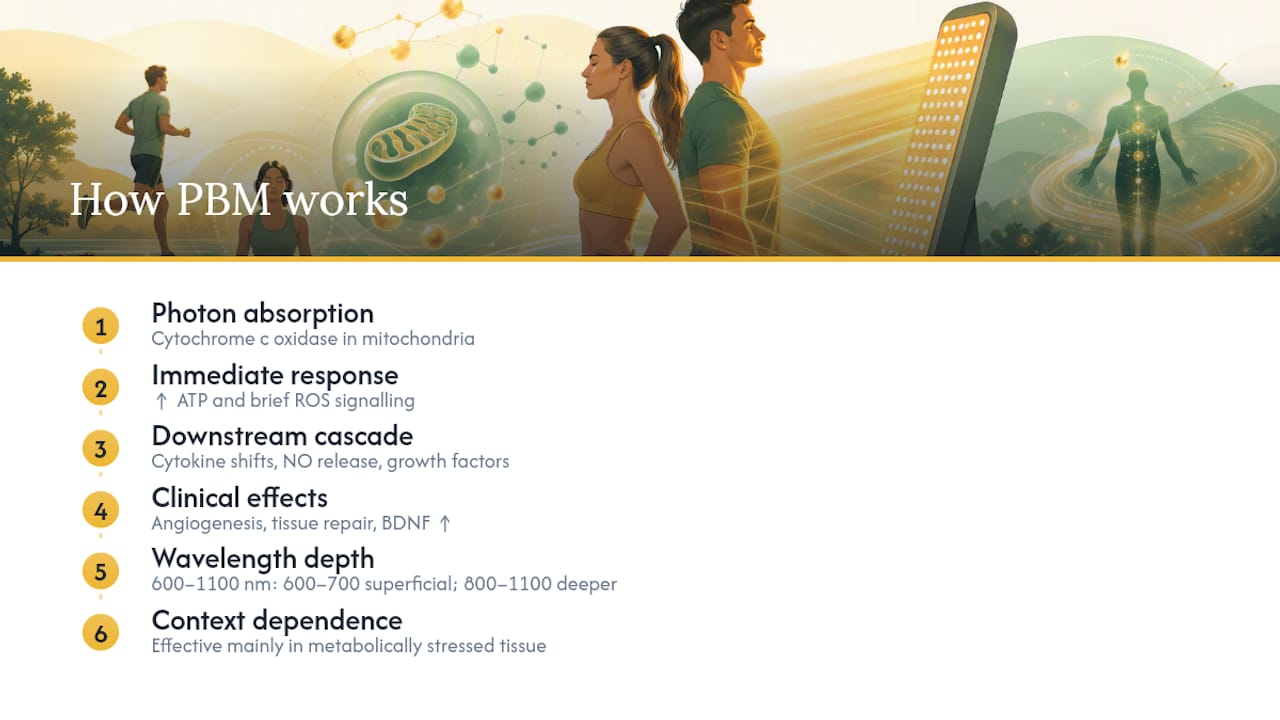
Red and near-infrared light does something oddly specific at the cellular level: it gets absorbed by cytochrome c oxidase, an enzyme sitting in the mitochondrial membrane that acts as the final gatekeeper in the chain that produces cellular energy. When photons in the right wavelength range hit that enzyme, they briefly speed up its activity. The immediate result is more ATP, the molecule cells burn for fuel, along with a short burst of reactive oxygen species that acts as a signal rather than a threat. That combination kicks off a cascade of secondary effects: shifts in inflammatory cytokine levels, nitric oxide release that relaxes blood vessels, and upregulation of growth factors involved in tissue repair.
This is not speculative biochemistry. A frequently cited mechanistic review lays out how photobiomodulation’s underlying mechanism connects mitochondrial photoreceptors to downstream changes in angiogenesis, cytokine modulation, and tissue repair across multiple tissue types. One of the more clinically relevant downstream effects involves brain-derived neurotrophic factor, or BDNF, a protein that supports neuron survival and plasticity. Its involvement is part of why researchers have started testing PBM for cognitive outcomes and not just skin and joints.
Wavelength determines how deep the light travels. Photobiomodulation research generally focuses on the “optical window” between roughly 600 and 1100 nanometers, the range where human tissue is relatively transparent to light while water and hemoglobin absorb it less aggressively than they do outside that band. Shorter wavelengths near 600 to 700 nanometers tend to concentrate their effect near the skin surface, useful for wound healing or superficial hair follicles. Longer near-infrared wavelengths closer to 800 to 1100 nanometers penetrate deeper, which is why they show up more often in protocols targeting joints, muscle, or even transcranial applications. Push past that range in either direction and the light either scatters too much to matter or gets absorbed before it reaches the target tissue.
Here’s the detail that surprises most people new to this topic: photobiomodulation does not do much to healthy, undamaged tissue. The effect is heavily context-dependent. Cells under metabolic stress, whether from injury, inflammation, or chronic disease, have mitochondria operating below capacity, and that’s precisely the condition where a modest photonic nudge produces a measurable shift in ATP output. A cell running at full capacity has little room to improve. This helps explain why lab studies on healthy volunteers sometimes show weak or null results while trials on people with active joint inflammation or oral mucosal pain show a real signal. It also means results from an athletic recovery study don’t necessarily predict what happens in a chronic pain population, and vice versa.
None of this is unique to one tissue type. The same basic mitochondrial mechanism has been proposed for skin, muscle, oral mucosa, joints, and even the brain, with the differences coming down to depth of penetration and local tissue physiology rather than a fundamentally different biological pathway.
What Does the Clinical Evidence Say by Outcome?
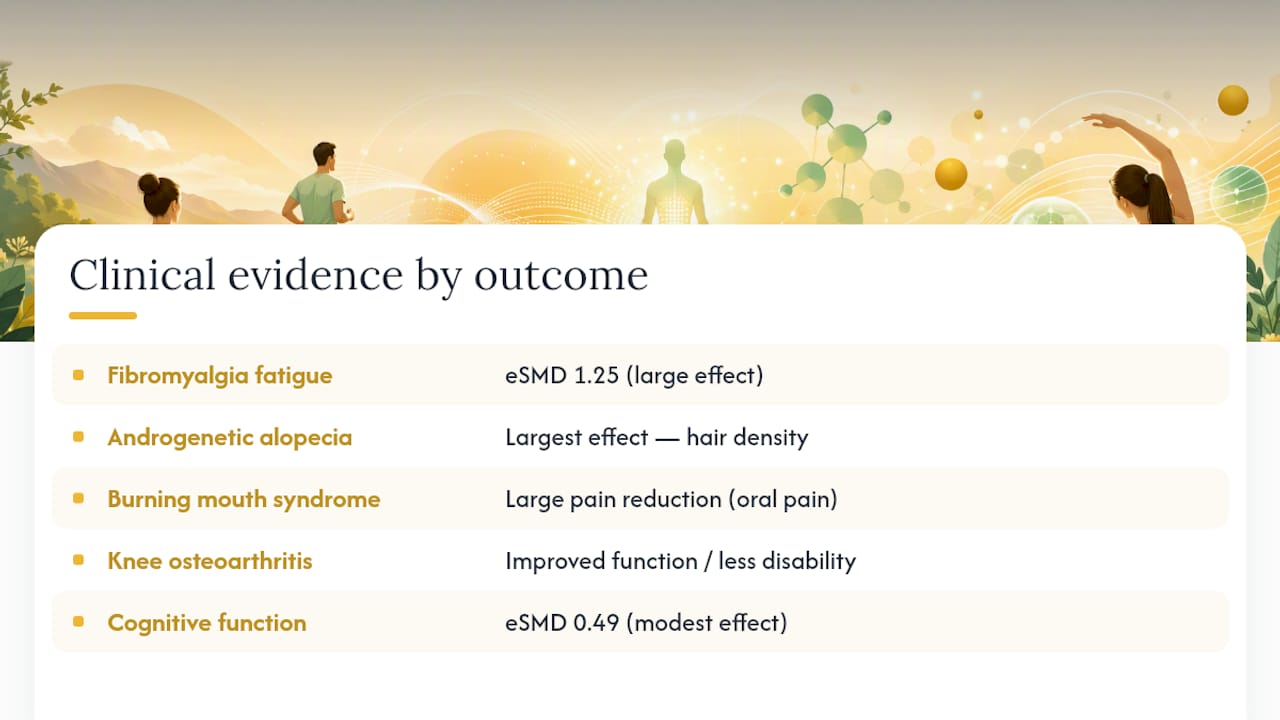
The strongest current evidence for photobiomodulation therapy effects comes from a large umbrella review pooling 15 meta-analyses, 204 randomized controlled trials, and more than 9,000 participants across 35 health endpoints. That review found moderate-certainty evidence for benefit in five specific outcomes, each reported as an effect size (eSMD, or estimated standardized mean difference) drawn from the umbrella review of PBM effects.
For context, an eSMD above 0.8 is generally considered a large effect in behavioral and clinical research, while values between 0.5 and 0.8 count as moderate. That puts the fibromyalgia fatigue and alopecia hair density numbers in “large effect” territory, at least by the pooled data.
Burning mouth syndrome. This chronic oral pain condition, which disproportionately affects postmenopausal women, showed one of the largest pain reductions in the entire review. Trials generally used intraoral or extraoral LED or laser applications several times weekly over a period of weeks.
Knee osteoarthritis. The disability improvement here doesn’t mean PBM reverses joint damage. It means people reported meaningfully better function and less disability on standardized scales, likely tied to the anti-inflammatory and analgesic effects described in reviews of PBM for musculoskeletal pain. Trial populations were mostly older adults with diagnosed osteoarthritis rather than acute injury patients.
Fibromyalgia fatigue. An eSMD of 1.25 is a striking number for a condition that is notoriously hard to treat with any single intervention. Fibromyalgia trials in the review measured fatigue specifically, not the syndrome’s full symptom cluster, so this finding shouldn’t be read as PBM curing fibromyalgia broadly.
Androgenetic alopecia. Hair density gains were the single largest effect size in the moderate-certainty group. This aligns with a Stanford Medicine review of red light therapy, which independently flags hair growth as one of the better-supported dermatologic applications, while cautioning that many other skin claims run ahead of what trials actually show.
Cognitive function in older adults. An eSMD of 0.49 is modest but notable given how few interventions show any measurable cognitive benefit in aging populations. Protocols here typically involved transcranial near-infrared exposure rather than the LED panels used for skin or joint applications.
Outside these five, evidence gets thinner fast. Wound healing, several neuropathic pain conditions, and various inflammatory skin conditions show PBM benefits in individual trials, but pooled certainty drops to low or very low, usually because trial numbers are small or protocols vary too much to combine confidently. The populations best represented across this research skew toward adults with chronic musculoskeletal pain, dermatology and hair-loss patients, and older adults being tested for cognitive outcomes. If your condition falls outside that cluster, the honest answer is that the evidence base is thinner and less consistent.
Why “Moderate Certainty” Doesn’t Mean “Proven”
Moderate certainty is a specific term in evidence grading, not a hedge. It means researchers are fairly confident in the effect size but acknowledge real limitations that could shift the estimate with better data. Low or very low certainty means the true effect could be substantially different from what trials currently suggest, sometimes even nonexistent.
The recurring problems across photobiomodulation research are predictable ones. Many trials enroll fewer than 50 participants, which inflates the odds of an exaggerated effect size simply by chance. Protocols vary wildly from study to study. One trial for knee osteoarthritis might use 808 nanometer laser light at a given dose for six minutes, while another uses 850 nanometer LED for fifteen minutes at a different power density, and both get labeled “photobiomodulation” in a meta-analysis. That heterogeneity, flagged repeatedly in clinical syntheses on PBM protocol variability, makes it genuinely hard to say what “the” optimal treatment looks like for any given condition. Follow-up periods also tend to be short, often weeks rather than months, so durability data lags behind the initial efficacy signal.
There’s also a quieter issue: publication bias. Small positive trials tend to get published more readily than small null trials, which can inflate pooled effect sizes in early-stage research fields. This doesn’t mean the effects aren’t real. The umbrella review’s moderate-certainty ratings already account for some of this risk. It does mean marketing claims that cite “clinically proven” results deserve a skeptical read.
If you want to evaluate a study yourself, check three things: was it randomized and placebo-controlled (a sham light device, not just no treatment), was the protocol pre-registered before data collection, and does the paper report exact wavelength, irradiance, and total dose rather than vague terms like “red light exposure.” Papers missing that last detail are hard to replicate and hard to trust.
Is Photobiomodulation Safe? Side Effects and Contraindications
Photobiomodulation for pain and other applications carries a favorable safety record across the randomized trials reviewed to date. Serious adverse events are rare in the clinical literature, and most side effects reported are mild and temporary.
- Localized redness or warmth at the treatment site, usually resolving within hours.
- Mild itching or tingling during or after a session.
- Rare reports of headache with transcranial or scalp applications.
Contraindications matter more than side effects here, and they’re worth taking seriously rather than treating as fine print.
- Active cancer at or near the treatment site, since stimulating cellular activity in a tumor environment is not something trials have tested for safety.
- Active infection at the treatment area.
- Pregnancy, specifically for thoracoabdominal or pelvic-region treatment, due to insufficient safety data in that population.
- Photosensitive skin conditions or use of photosensitizing medications, which can amplify skin reactions to light exposure.
The Stanford Medicine summary on red light therapy echoes this pattern: RCTs report few serious harms, but formal contraindications still apply and shouldn’t be waved off because the general side-effect profile looks mild.
Eye protection is standard practice for any high-irradiance device, particularly near-infrared lasers used in clinical settings, since NIR light isn’t always visible even when it’s intense enough to cause retinal damage.
Pro Tip: Before booking any red light therapy or PBM session, ask the clinic for written documentation of contraindications and device specifications. A provider that can’t produce this on request is a provider skipping a step that matters. If you want a written reference on this before you go, this rundown of red light therapy contraindications covers who should sit sessions out.
Dosage and Devices: Why Wavelength and Power Density Matter
The uses of photobiomodulation only make sense once you understand four variables that define a “dose”: wavelength (measured in nanometers, typically red or near-infrared), irradiance or power density (measured in milliwatts per square centimeter, mW/cm²), fluence or total dose (measured in joules per square centimeter, J/cm², which is irradiance multiplied by time), and session frequency.
Here’s where the Arndt-Schulz principle comes in, a century-old pharmacology concept that applies surprisingly well to light dosing: weak stimuli increase physiological activity, strong stimuli inhibit it, and excessive stimuli can suppress the response entirely. In practice, this means doubling your fluence doesn’t double your benefit. Past a certain threshold, more energy delivered to tissue can flatten or even reverse the effect, which is part of why trial protocols cluster around specific dose ranges rather than maximizing output.
This is also where clinical devices and consumer devices genuinely diverge, and it’s worth understanding why rather than just taking that gap on faith.
- Clinical-grade lasers and high-power LED arrays typically deliver higher, more consistent irradiance across a treatment area, matching the doses used in the trials behind the effect sizes discussed earlier.
- Consumer panels and wearable caps vary enormously in actual output. Marketed wattage numbers don’t always reflect irradiance at the skin, which depends on distance, panel design, and diode density.
- Session reproducibility is harder to guarantee at home. A clinic device delivers close to the same dose every time; a handheld consumer unit depends on the user holding distance and angle consistently.
If you’re evaluating any device, clinical or consumer, ask for the actual wavelength range, irradiance at treatment distance, and total session fluence rather than accepting generic marketing language. A red light therapy dosage guide is a useful reference point for comparing what’s being offered against protocols used in published trials. For conditions with actual medical stakes, meaning joint disease, chronic pain, or anything beyond cosmetic use, clinical supervision matters because the person running the device can adjust parameters based on how tissue responds, something a fixed home unit can’t do.
How Long Does It Take to See Results, and Do They Last?
Timelines vary by outcome, and this is one area where patience matters more than people expect. Pain-related benefits, including the burning mouth syndrome and osteoarthritis findings from the umbrella review, often show measurable improvement within two to four weeks of consistent sessions, typically two to three times per week. Fibromyalgia fatigue trials followed a similar cadence.
Dermatologic and hair outcomes move slower. Androgenetic alopecia protocols in the research typically ran for several months before hair density improvements became apparent, which tracks with how hair growth cycles work biologically. Cognitive improvements in older adults were also measured after weeks-to-months of transcranial sessions rather than a single treatment.
The harder truth is what happens after you stop. Dermatologic and hair benefits tend to regress once treatment ends, since the underlying physiological stimulus goes away, a pattern confirmed in Stanford’s review of red light therapy. Chronic pain improvements can behave similarly. Many people who benefit from PBM for osteoarthritis or fibromyalgia find they need maintenance sessions, whether weekly or biweekly, to hold onto the gains rather than a fixed course that “cures” the condition permanently. This isn’t unique to light therapy. It’s a common pattern in chronic disease management generally, where an intervention manages symptoms rather than resolving the underlying condition.
Nitric Oxide, ROS, and the Pathways Beyond Mitochondria
The mitochondrial story explains a lot, but it isn’t the whole picture. Photobiomodulation also triggers the release of nitric oxide from cellular stores, including from cytochrome c oxidase itself, which can bind nitric oxide and block it from doing its normal job during periods of cellular stress. Light exposure frees that bound nitric oxide, and once released, it acts as a vasodilator, widening blood vessels and improving local blood flow. That’s part of why some practitioners describe an almost immediate warming or flushing sensation during certain treatments.
Reactive oxygen species play a more nuanced role than the phrase “oxidative stress” usually implies. In small, transient amounts, ROS act as signaling molecules that activate transcription factors involved in cell survival and adaptive responses, a process sometimes called mitohormesis. Too much light, delivered too intensely, tips that balance toward genuine oxidative damage instead of a beneficial signal, which loops back to why the Arndt-Schulz dose-response curve matters so much in practice.
Together, these pathways mean photobiomodulation isn’t a single-mechanism therapy. It’s better understood as a light-triggered cascade touching energy metabolism, vascular tone, and cellular signaling simultaneously, which is also why its effects show up across such different conditions.
How Does PBM Compare With Other Treatments for the Same Conditions?
For knee osteoarthritis, the usual alternatives are NSAIDs, physical therapy, corticosteroid injections, and eventually joint replacement in advanced cases. PBM’s effect size for disability improvement sits in a similar range to what physical therapy alone produces in many trials, without the gastrointestinal or renal risks associated with long-term NSAID use. It doesn’t replace structural treatment for severe joint degeneration.
For fibromyalgia fatigue, standard approaches include graded exercise, cognitive behavioral therapy, and medications like duloxetine or pregabalin, none of which reliably solve fatigue on their own. PBM’s reported effect size here is notably large relative to how modestly most fibromyalgia interventions perform, which is part of why it’s drawn clinical interest as an adjunct rather than a replacement.
For androgenetic alopecia, the established medical options are topical minoxidil and oral finasteride, both with decades of trial data behind them. PBM’s hair density effect size is comparable to what’s reported for minoxidil in some analyses, and the two are frequently used together rather than as competitors, since they work through different mechanisms.
Low-dose oral minoxidil requires medical supervision: it can cause fluid retention, a faster heart rate, and lowered blood pressure, so clinicians typically monitor blood pressure and ask about heart conditions before prescribing. It is not recommended during pregnancy or breastfeeding. Discuss these risks with a physician before starting.
Finasteride is FDA-indicated for men only. Women who are or may become pregnant must not handle crushed or broken finasteride tablets, due to the risk of harm to a male fetus. It can also cause sexual side effects (reduced libido, erectile dysfunction) in a minority of men, which usually resolve after stopping treatment. Discuss these risks with a physician before starting.
The general pattern across conditions: PBM tends to perform as a reasonable adjunct alongside established care, not a wholesale replacement for it.
Does PBM Keep Working Over Time?
Long-term durability data is the weakest link in the entire evidence base. Most trials feeding into the umbrella review followed participants for weeks to a few months, not years, so claims about multi-year efficacy outrun what’s actually been measured.
What existing data suggests is a maintenance pattern rather than a one-time fix. Chronic pain conditions like osteoarthritis and fibromyalgia appear to need ongoing sessions to sustain benefit, similar to how physical therapy gains fade without continued activity. Dermatologic and hair outcomes follow the same logic, regressing once treatment stops, as covered earlier. The honest framing is that photobiomodulation behaves more like an ongoing management tool than a cure, which matters when weighing it against a one-time procedure or a short medication course.
Who Responds Best to Photobiomodulation?
Not everyone gets the same benefit from identical treatment, and the tissue-context principle from the mechanism section explains much of why. People with active inflammation, chronic pain, or measurable tissue dysfunction tend to show a stronger response than healthy individuals seeking a general wellness boost, since PBM’s mitochondrial nudge matters most where cellular energy production is already compromised.
Condition severity, treatment adherence, and consistency of dosing all shape outcomes. Someone attending sessions twice weekly for the full protocol length used in trials is far more likely to see the effect sizes reported in research than someone attending sporadically. Age and baseline tissue health matter too, particularly for cognitive and dermatologic applications where slower-turnover tissue needs a longer stimulus window.
Practitioners are increasingly moving toward personalized dosimetry, adjusting wavelength and dose based on tissue depth and the specific condition, rather than running everyone through an identical protocol. This shift reflects a broader recognition that “one dose fits all” undersells how variable individual tissue response can be, and it’s a reasonable factor to ask about when evaluating any provider.
A Clinical Wellness Perspective on Where PBM Fits
Photobiomodulation earns its place in a wellness setting when it’s treated as one tool among several, not a stand-alone miracle. Some health and wellness centers offer red light therapy alongside osteogenic loading, PEMF, and other recovery modalities because chronic musculoskeletal complaints rarely respond to a single intervention. The evidence supports PBM as a reasonable adjunct for pain and fatigue outcomes, not a replacement for the mechanical loading that actually stimulates bone density gains.
Patient selection matters more than marketing suggests. Someone with active joint inflammation or documented fatigue is a better candidate than someone chasing a vague wellness upgrade. Realistic expectations, meaning gradual improvement over weeks, not instant results, tend to separate satisfied clients from disappointed ones.
— Aaron
Where Supervised Red Light Therapy Fits Into a Wellness Plan
Consumer red light panels are everywhere now, but power density and dose consistency are exactly where home units tend to fall short of what trials actually used. Some centers offer supervised red light therapy alongside osteogenic loading sessions, PEMF mats, the PureWave VEMI lounge, compression therapy, vibration plates, and hydromassage, giving members access to clinic-grade equipment and staff oversight rather than guessing at dose from a home device.

This matters most for anyone using PBM as more than a wellness extra, particularly people managing osteoporosis, osteopenia, or joint pain who want a therapy stack applied consistently rather than piecemeal. Sessions may be supervised, which means someone trained on the equipment can adjust parameters like session timing rather than leaving dosing entirely up to users. If you’re weighing the evidence covered here against what’s realistic to do at home, find an Osteostrong location near you and ask about combining red light therapy with a weekly osteogenic loading session to see how the two work together.
This article is general information, not a substitute for advice from a qualified doctor. Consult a qualified healthcare professional about your own circumstances before acting on anything here.
Sources
- Umbrella review of PBM effects across multiple health endpoints
- Photobiomodulation—Underlying mechanism and clinical applications
- Red light therapy: What the science says — Stanford Medicine
FAQ
Who Should Not Use Photobiomodulation?
People with active cancer at the treatment site, active infections in the treatment area, or photosensitive skin conditions should avoid it, as should pregnant individuals considering thoracoabdominal or pelvic treatment. Anyone on photosensitizing medications should check with a clinician first.
How Long Does It Take for Photobiomodulation to Work?
Pain-related benefits often appear within two to four weeks of consistent sessions, while hair density and cognitive improvements typically take several months to become measurable. Most gains reported in trials required ongoing sessions rather than a single treatment.
Why Don’t More Doctors Recommend Red Light Therapy?
The main hesitation comes from protocol heterogeneity: trials use inconsistent wavelengths, doses, and session schedules, which makes it hard to issue a single standardized recommendation. Evidence is also only moderate certainty for a small set of conditions, so many physicians treat it as a reasonable adjunct rather than a first-line therapy.
Is Photobiomodulation the Same as Red Light Therapy?
Yes, in practice the terms are used interchangeably, with photobiomodulation being the broader clinical and scientific term covering red and near-infrared light treatment for pain, healing, and tissue effects.
Can Photobiomodulation Replace Physical Therapy or Medication?
No. The evidence positions it as an adjunct that can reduce pain and disability alongside standard care, not a replacement for physical therapy, prescribed medication, or structural treatment for advanced joint disease.