
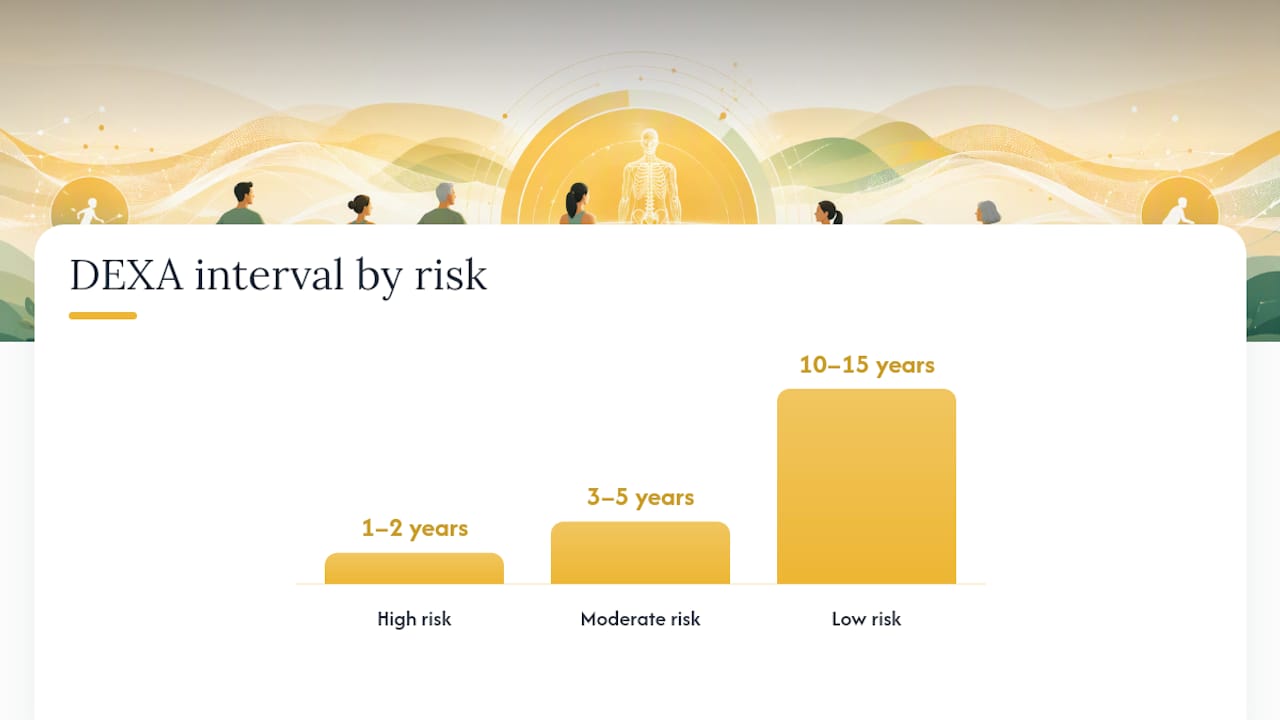
Most people need a DEXA scan every 2 years if they’re on osteoporosis treatment or at high risk, every 3 to 5 years at moderate risk, and as infrequently as every 10 to 15 years at low risk. The U.S. Preventive Services Task Force (USPSTF) recommends screening women 65 and older, with earlier screening for postmenopausal women who have risk factors. Medicare Part B pays for one scan every 24 months, though it will cover a repeat sooner if your doctor documents medical necessity.
Here’s how that breaks down by risk group:
- High risk or active treatment: every 1 to 2 years
- Moderate risk: every 3 to 5 years
- Low risk with a normal baseline: every 10 to 15 years, sometimes longer
Exceptions exist for anyone with a new fragility fracture, a change in medication, or a condition like hyperparathyroidism that accelerates bone loss. In those cases, a clinician can justify testing outside the standard window.
Statistic Callout: A DEXA scan takes 10 to 30 minutes and uses a very low radiation dose. Medicare covers one every 24 months, and more often only with documented medical necessity.
Key Takeaways
DEXA scan frequency should track your baseline T-score and risk category, not a fixed annual habit, with Medicare covering one scan every 24 months absent documented medical necessity.
| Point | Details |
|---|---|
| Interval depends on risk | High risk or active treatment needs scans every 1 to 2 years; moderate risk every 3 to 5; low risk every 10 to 15. |
| Medicare sets a 24 month floor | Coverage kicks in once every 24 months, with earlier repeats covered only when a physician documents medical necessity. |
| Watch for LSC, not small shifts | Least significant change means a small score difference between scans is often measurement error, not real bone loss. |
| Certain events justify earlier repeat | A new fracture, a new bone medication, or a condition that accelerates bone loss can move up the timeline. |
| Osteostrong supports the years between scans | Weekly osteogenic loading sessions and complementary therapies help clients stay active on bone health between DEXA follow-ups. |
Table of Contents
- Who Needs a Baseline DEXA and When to Start Screening
- How Often Should You Repeat a DEXA Scan?
- Does Medicare Cover DEXA Scans Every Year?
- How Do You Read a DEXA Scan Result?
- What Do the Studies Actually Say About Testing Intervals?
- Frequently Asked Questions
- Sources
Who Needs a Baseline DEXA and When to Start Screening
The USPSTF sets the clearest starting line: women 65 and older should get screened, full stop. Postmenopausal women younger than 65 get screened selectively, based on a risk calculation rather than age alone. Men fall into a grayer zone. Mayo Clinic’s guidance notes that men under 70 without risk factors typically don’t need routine testing, while men 70 and older often do.
Age is the easy variable. Risk factors are what actually move the needle for younger people. A handful of things push the starting age earlier, sometimes by decades:
- A prior fragility fracture (a break from a fall at standing height or less)
- Long-term glucocorticoid use, such as prednisone taken for months at a time
- Conditions like rheumatoid arthritis, celiac disease, or hyperthyroidism
- A body mass index under 19
- Heavy smoking or regular heavy alcohol use
Any one of these can justify a baseline scan well before the standard age thresholds kick in. A 45-year-old on chronic steroids for an autoimmune condition has more in common, bone-wise, with a 70-year-old than with a healthy peer.
Once you have that baseline, the T-score and Z-score on the report become the reference point for everything that follows. A T-score compares your bone density to a healthy 30-year-old of the same sex. A Z-score compares you to people your own age. The baseline number doesn’t just diagnose you. It sets the clock for when a repeat scan is actually likely to show something meaningful, which is the entire logic behind interval recommendations. Someone who tests at a T-score of −1.0 is on a completely different timeline than someone who tests at −2.4, even though neither has osteoporosis yet.

How Often Should You Repeat a DEXA Scan?
The interval that makes sense for you depends almost entirely on where your baseline score sits and how fast your bones are likely to change. MedlinePlus summarizes the common pattern this way: every 2 years for high risk, every 3 to 5 years for moderate risk, and every 10 to 15 years for low risk. Those aren’t arbitrary numbers. They come from how quickly bone density typically shifts at each starting point.
Consider the math behind it. A woman with mildly low bone density is moving toward osteoporosis at more than three times the pace of a woman with normal density. That gap is the entire reason a single blanket interval doesn’t work.
Statistic Callout: Cohort and review evidence indicates that repeating BMD testing every 4 to 8 years for routine screening often adds little to fracture prediction in people who started with normal or near-normal density.
Here’s roughly what that looks like across risk tiers:
- Low risk (normal baseline, no major risk factors): 10 to 15 years, sometimes longer
- Moderate risk (osteopenia, some risk factors): 3 to 5 years
- High risk or on active bone-active therapy: 1 to 2 years
There’s a technical reason short intervals often backfire: least-significant change, or LSC. Every DEXA machine has a margin of measurement error, and that margin depends on the specific scanner and the technologist’s positioning. A technical review of serial bone densitometry makes the point that scans should ideally be compared on the same machine, since even small differences in calibration can mimic a real change in bone density. If you rescan too soon, before your actual bone loss exceeds that error margin, the report can show a “change” that’s really just noise. That’s not a hypothetical problem. It’s the single biggest reason clinicians resist the instinct to test every year “just to be safe.”
A handful of situations genuinely call for shortening the interval regardless of what the risk category suggests:
- A new fragility fracture at any point, which signals the skeleton is weaker than the last scan implied
- Starting or switching a bone-active medication, since many clinicians want a follow-up scan within 1 to 2 years to confirm the drug is working
- A new diagnosis or medication known to accelerate bone loss, such as long-term steroid therapy
- A prior scan that showed a rapid, unexplained decline
Outside of those triggers, patience is usually the better strategy. Bone remodels slowly. A scan taken 18 months after the last one, absent a specific reason, is more likely to generate confusing noise than a useful answer.
Does Medicare Cover DEXA Scans Every Year?
No. Medicare Part B covers a bone mass measurement once every 24 months for eligible beneficiaries. That’s the baseline rule, and it lines up with what most guidelines already recommend for moderate-to-low risk patients. If your clinician wants to scan you more frequently than that, Medicare will still cover it, but only when medical necessity is documented in your chart.
What counts as medical necessity in practice:
- Monitoring response to a new osteoporosis medication. If you started a bone-active drug in the past year, your doctor can document that a follow-up scan is needed to confirm the treatment is working.
- A recent fragility fracture. A break suggests your fracture risk has changed and needs reassessment sooner than the standard interval.
- A condition known to cause rapid bone loss, such as primary hyperparathyroidism or long-term corticosteroid therapy, where waiting the full 24 months could mean missing a serious decline.
If you think you fall into one of these categories, ask your clinician directly whether they can document medical necessity for an earlier scan, and confirm with your insurer (Medicare or private) how they define that term for coverage purposes. It’s also worth keeping copies of your prior DEXA reports. Having the actual numbers on hand, not just a memory of “my doctor said it was fine,” makes it much easier for a new clinician to judge whether an early repeat is justified.
How Do You Read a DEXA Scan Result?
Two numbers matter most on your report: the T-score and the Z-score. The T-score compares your bone density to a healthy young adult of the same sex, and it’s what defines the standard categories. A T-score of −1.0 or above is normal. Between −1.0 and −2.5 is osteopenia, meaning bone density is lower than ideal but not yet at the osteoporosis threshold. A T-score of −2.5 or lower meets the clinical definition of osteoporosis.
The Z-score compares you to people your own age and sex, and it matters more for younger patients or anyone whose bone loss seems out of proportion to their age. A low Z-score in a 40-year-old is a stronger signal to look for a secondary cause, like a thyroid disorder or medication side effect, than the same score would be in an 80-year-old.
Least-significant change is the concept that ties results together over time. It’s the smallest amount of change in bone density that a given machine can reliably detect above its own measurement error. If your center’s LSC is, say, 3%, a 1.5% shift between two scans isn’t meaningful. It’s noise. Clinicians generally wait for a change that clearly exceeds the LSC before concluding your bone density has actually shifted.
A few results should prompt a conversation about repeating sooner than planned:
- A T-score that drops into osteoporosis range for the first time
- Any new fragility fracture, regardless of what the score shows
- A change that appears to exceed your center’s LSC, especially after starting a new treatment
Pro Tip: Always try to get repeat scans on the same machine as your last one. Switching locations or scanner models introduces enough variability that comparing the two reports side by side can be misleading, even when nothing about your bones has actually changed.
What to Expect During a DEXA Scan
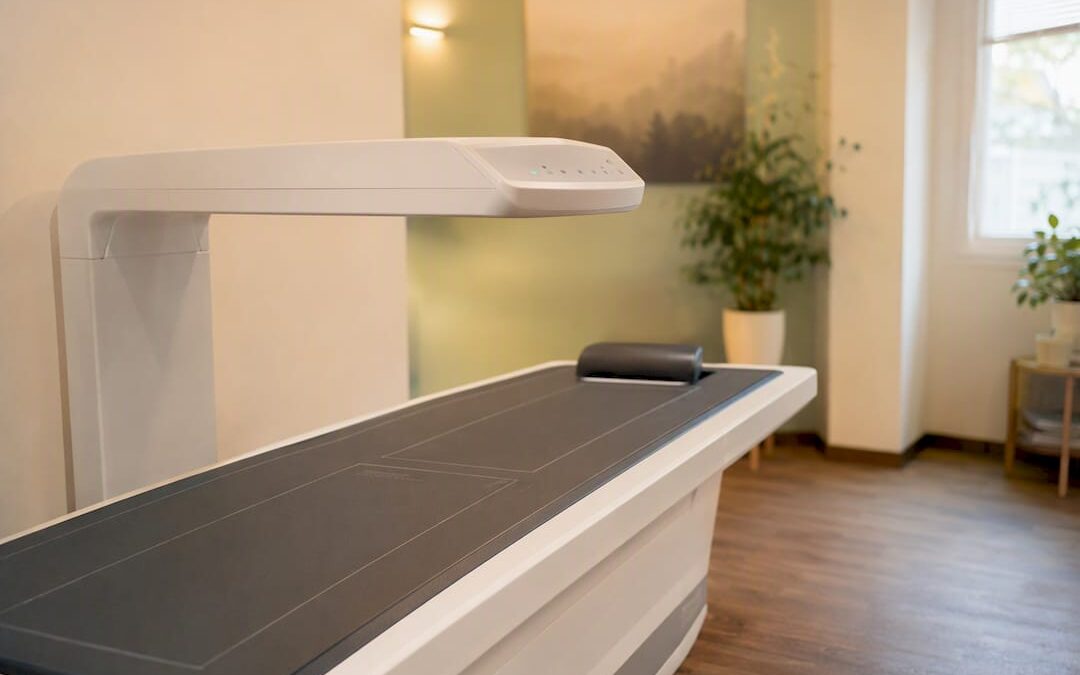
A DEXA scan is about as low-effort as diagnostic imaging gets. The scan itself takes 10 to 30 minutes and measures bone density at the hip and spine, the two sites most predictive of fracture risk. The radiation dose is very low, well below a standard chest X-ray.
A few practical notes before you go:
- Wear comfortable clothing without metal zippers, buttons, or underwire
- Remove jewelry, belts, and anything metallic that could interfere with the images
- Let the technologist know if you’ve had a barium contrast study or nuclear medicine scan recently, since that can interfere with results
- Tell your provider if there’s any chance you’re pregnant, since DEXA is generally avoided during pregnancy out of caution
One point of confusion worth clearing up: a central DEXA (hip and spine) is different from a body-composition DEXA scan, which measures fat and lean mass distribution. Some wellness programs use the body-composition version for fitness tracking. It’s not a substitute for the diagnostic scan your doctor orders to assess fracture risk.
What Do the Studies Actually Say About Testing Intervals?
Guidelines are more cautious about specific intervals than most people expect. The USPSTF itself states plainly that evidence on the ideal repeat interval is limited, which is why the recommendation leans on individualized judgment rather than a fixed schedule for everyone.
The strongest pushback against frequent rescanning comes from cohort data. A widely cited analysis found that repeating bone mineral density testing every 4 to 8 years often does little to improve fracture prediction for people who started with normal or mildly low bone density. The logic tracks with what we already covered on transition speed: someone starting near a normal T-score simply isn’t going to cross into osteoporosis fast enough for a scan taken a few years later to tell you much you didn’t already know.
Scans repeated too soon are unlikely to detect real change, because measurement variability and the naturally slow pace of bone loss mean the “difference” between two close-together scans is often just noise, not biology.
That same body of evidence flips the other direction for people with lower baseline scores. Women who start with a T-score between −1.50 and −1.99 progress to osteoporosis roughly three times faster than women with normal baseline density, based on the transition-time estimates the USPSTF cites. That’s the clinical justification for shortening intervals in that subgroup instead of applying a uniform rule to everyone.
A few things guidelines agree on, even while leaving specifics open:
- Central DXA remains the standard test for screening decisions
- Baseline T-score is the single strongest predictor of how soon a repeat scan might be useful
- No major guideline endorses annual screening for people without an active risk-changing event
The honest takeaway is that guidelines give you a framework, not a formula. The actual interval still comes down to a conversation between you and your clinician about where your numbers sit.
Balancing Monitoring Frequency With Patient Burden
Most people tend to test more often than medically needed. It is best to use the baseline T-score to determine testing intervals, moving the interval earlier only when there is a specific trigger like a fracture, new medication, or a condition that accelerates bone loss. Testing annually “just to check” rarely provides new information and adds unnecessary cost and radiation exposure.
At Osteostrong, we see clients between DEXA scans, so we coordinate around whatever interval a client’s physician has set rather than replacing it. Weekly osteogenic loading sessions give people a way to actively support bone density in the years between scans, and we encourage clients to bring their DEXA reports so we can talk through what the numbers mean for their program. The decision on when to rescan should always stay between you and your doctor.
How Osteostrong Supports Bone Density Between Scans
Whatever interval your doctor sets, the years between scans are where the real opportunity sits. Osteostrong’s core service is osteogenic loading: a weekly session that applies brief, targeted force through the skeleton to stimulate bone-building cells, the same biological pathway your body uses in response to high-impact activity, without the joint stress of running or jumping.

Clients also have access to red light therapy, PEMF mats, the BioCharger, the PureWave VEMI lounge, compression therapy, vibration plates, and hydromassage lounges, all aimed at supporting recovery and overall wellness alongside the core loading sessions. When clients bring in a new DEXA report, our team talks through what the T-score and Z-score mean in plain language and helps set expectations for the next monitoring cycle your physician recommends. If you’re curious how a loading routine complements what you’re already doing, our osteogenic loading guide is a good place to start, or find your nearest location to schedule a visit and get a baseline sense of where your bones stand today.
Frequently Asked Questions
How often should you get a DEXA scan after age 65?
Women 65 and older are typically screened per USPSTF guidance, with repeat intervals of 3 to 5 years if the baseline is normal to mildly low, or every 1 to 2 years if osteoporosis is already diagnosed or treatment has started.
Does insurance ever cover a DEXA scan more than once every 2 years?
Yes. Medicare and most private insurers will cover a repeat scan sooner than 24 months if your physician documents medical necessity, such as a new fracture or a recently started bone medication.
Can you get a DEXA scan too often?
Testing too frequently mostly wastes money and adds unnecessary radiation exposure without medical benefit, since scans done before the least-significant-change threshold is reached usually can’t detect real bone change.
What’s the difference between a T-score and a Z-score?
A T-score compares your bone density to a healthy young adult of the same sex and defines osteopenia and osteoporosis categories; a Z-score compares you to people your own age and helps flag unusual bone loss in younger patients.
Do men need DEXA scans as often as women?
Guideline support for routine screening in men is weaker. Mayo Clinic guidance suggests men under 70 without risk factors generally don’t need routine testing, while men 70 and older or with risk factors typically do.