
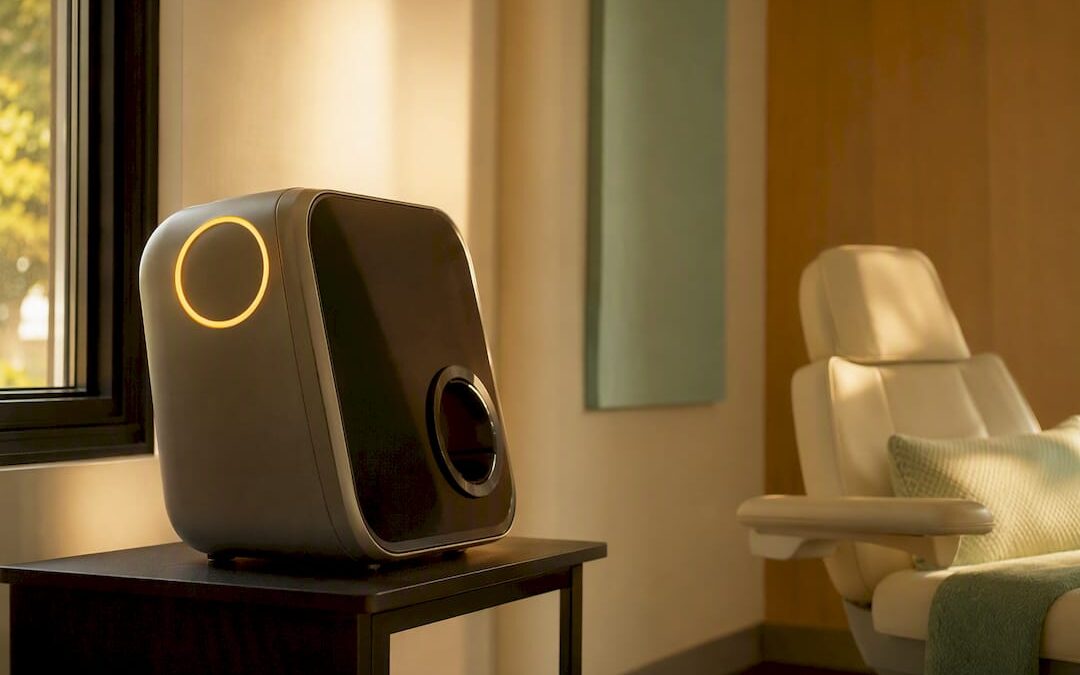
People who use BioCharger sessions commonly report better energy, clearer focus, improved sleep, faster recovery, and less everyday stress. Most of that evidence comes from user reports and the underlying frequency modalities, not large clinical trials on the device itself. The practical move: book a supervised 10 to 15 minute session, then track how you actually feel over the following days.
- Energy and focus: many notice a lift within the first few sessions
- Sleep and recovery: effects tend to build with consistent use
- Stress reduction: often reported as an immediate, in-session sensation
Key Takeaways
BioCharger sessions combine light, PEMF, frequency, and voltage modalities into short touchless sessions that most users report boost energy, sleep, focus, and recovery over time.
| Point | Details |
|---|---|
| Four combined modalities | Light, PEMF, frequencies, and pulsed voltage fields work together in one session instead of one at a time. |
| Evidence is mixed | Modality-level research supports plausible mechanisms, but device-specific clinical trials remain limited. |
| Effects build over time | Energy and stress relief can feel immediate; sleep and recovery gains usually take one to two weeks. |
| Safety is generally low-risk | Skip sessions if you have an implanted electronic device, are pregnant, or have an uncontrolled condition. |
| Osteostrong integrates it directly | Members pair BioCharger sessions with weekly osteogenic loading, red light therapy, and hydromassage in one visit. |
Table of Contents
- How Does BioCharger Technology Actually Work?
- What Benefits Do People Actually Report?
- What Happens During a BioCharger Session?
- Is There Scientific Evidence Behind These Claims?
- Are There Any Side Effects or Safety Concerns?
- Who Should Try a BioCharger and How Often?
- How Much Do BioCharger Sessions and Devices Cost?
- How Osteostrong Uses BioCharger Alongside Bone-Health Services
- Ready to Experience BioCharger at Osteostrong?
- Frequently Asked Questions
- Sources
How Does BioCharger Technology Actually Work?
A BioCharger doesn’t rely on one mechanism. It stacks four energy modalities into a single session, which is the core reason practitioners describe it differently from a standalone red light panel or PEMF mat.
- Light energy (photobiomodulation): plasma tubes emit light frequencies associated with cellular energy support.
- PEMF (pulsed electromagnetic fields): low-level magnetic pulses linked to circulation and tissue recovery research.
- Frequencies and harmonics: targeted frequency patterns drawn from a cloud-based recipe library.
- Pulsed electric and voltage fields: the visible plasma arc that radiates energy without touching the body.
Sessions run through myCloud, a recipe library with more than 1,200 curated programs covering everything from athletic recovery to relaxation, updated on an ongoing basis through software rather than hardware changes. Sessions are touchless and can run for individuals or small groups at once. Worth saying plainly: the device is marketed as a health optimization platform, not a medical device, and no BioCharger recipe is a substitute for diagnosis or treatment.
What Benefits Do People Actually Report?
Reported outcomes cluster into a handful of categories, and the strength of evidence behind each varies more than most marketing pages let on.
- Energy levels: mostly user-reported, often noticed within the same session or the next day.
- Sleep quality: cumulative effect reported over one to two weeks of consistent use.
- Mental clarity and focus: user-reported, sometimes immediate, tied to the relaxation response during a session.
- Physical recovery: partially explained by PEMF and photobiomodulation research on circulation and mitochondrial support, though platform-specific data is limited.
- Stress reduction: frequently described as immediate, similar to a short meditation or float session.
- Circulation and skin tone: anecdotal, occasionally linked to light-based modalities.
Manufacturer summaries note that many users notice changes within their first few sessions, though the pattern reported most often is cumulative rather than one-and-done. A midday reset session tends to target energy and focus. A post-workout session leans on recovery-oriented recipes. A pre-bed session usually runs calming frequencies meant to wind the nervous system down. The use case shapes the recipe, and the recipe shapes what you’re likely to feel.
What Happens During a BioCharger Session?
Walk into a session and the process is simple enough that most first-timers need no real instruction.
- Check in and share your goal for the day (energy, recovery, sleep, stress).
- Sit or stand within a few feet of the unit. No pads, no leads, no skin contact required.
- A practitioner selects a recipe from the library matched to your goal.
- Relax for 10 to 15 minutes while the plasma tubes cycle through the programmed frequencies.
Sessions can run individually or in small groups, since nothing attaches to your body. Most people describe feeling relaxed or subtly energized. Some feel nothing dramatic at all, which is normal. You may notice a faint audible tone or see the plasma arc glow inside the tube, both by design rather than a sign of anything unusual. Personal-use guidance from the manufacturer generally points toward 2 to 5 sessions per week depending on your goal, tapering as you settle into a routine.
Pro Tip: Book your first two or three sessions at the same time of day so you can compare how you feel under consistent conditions before changing anything else in your routine.
Is There Scientific Evidence Behind These Claims?
Here’s where an evidence-aware reader needs to slow down. PEMF and photobiomodulation each have a real research base behind them individually, mostly around circulation, tissue recovery, and mitochondrial activity. That research offers plausible mechanisms for some of what people report after a BioCharger session.
The gap worth understanding: modality-level science supports pieces of the story, but device-specific, peer-reviewed trials on the BioCharger platform itself remain limited. Most of what’s published comes from manufacturer resources, practitioner reports, and user testimonials rather than independent randomized trials.
That doesn’t make the reported benefits fake. It means you’re looking at a plausible mechanism plus a lot of self-reported experience, not a settled medical verdict. A few things to keep in mind before you read too much into any single claim:
- Manufacturer pages describe potential, not guaranteed, outcomes.
- Practitioner testimonials reflect real experiences but aren’t controlled studies.
- The most honest path is a trial run with your own tracking, not blind trust in either the marketing or the skepticism.
Are There Any Side Effects or Safety Concerns?
The touchless nature of a BioCharger session keeps the safety profile fairly simple. Most people report nothing beyond mild relaxation or a short-lived energy shift, and side effects are rare.
- Report any implanted electronic device, including pacemakers, before your session.
- Pregnant individuals and anyone managing a serious uncontrolled medical condition should consult a physician first.
- The device is sold as wellness technology, not a regulated medical device, so it isn’t positioned to diagnose or treat illness.
- Start with a shorter session if you’re sensitive to new sensory experiences, and follow your center’s specific guidance.
Readers with general concerns about electromagnetic field exposure can review the World Health Organization’s EMF guidance for broader safety context beyond any single device.
Who Should Try a BioCharger and How Often?
If your goal is more energy, better sleep, faster recovery, or lower everyday stress, a BioCharger session is a reasonable low-risk experiment. It isn’t a replacement for treating a diagnosed medical condition, and it works best as one piece of a broader routine rather than a stand-alone fix.
- Set a specific goal (energy, sleep, or recovery) before your first session.
- Start with 2 to 3 sessions per week for two weeks.
- Track sleep quality, perceived energy, and recovery time in a simple notes app or journal.
- Adjust frequency based on what your tracking actually shows.
Providers note that the biggest reported gains show up when sessions are paired with the basics: consistent sleep, solid nutrition, and regular movement. Athletes pairing sessions with recovery-focused nutrition timing tend to report the most noticeable recovery effects.
Pro Tip: Don’t judge the device after one session. Give it two weeks of consistent use before deciding whether it’s doing anything for you.
How Much Do BioCharger Sessions and Devices Cost?
Drop-in sessions at wellness centers typically run as a per-visit fee, with group sessions or multi-visit packages bringing the per-session cost down meaningfully. Buying a unit outright is a serious investment, one that practitioners generally frame as worthwhile mainly for high-frequency personal users or businesses planning to offer sessions commercially.
- Drop-in sessions: priced per visit, lower per-session cost with packages
- Group sessions: often discounted versus individual bookings
- Full device ownership: a substantial purchase, rarely worth it for occasional use
- Best way to test the waters: a short trial package at a local wellness center
How Osteostrong Uses BioCharger Alongside Bone-Health Services
At Osteostrong, BioCharger sessions sit alongside PEMF mats, red light therapy, the PureWave VEMI lounge, and hydromassage as part of a broader recovery and energy toolkit. Members typically come in weekly for osteogenic loading and schedule a BioCharger session on the same visit or a separate day, depending on their goals.
- BioCharger paired with red light therapy for recovery-focused visits
- PEMF mats and hydromassage stacked for stress and circulation support
- Sessions scheduled flexibly around the weekly loading appointment
New members typically try a BioCharger session during their first few visits, then decide whether to build it into a regular weekly rhythm alongside their loading sessions.
A Practical Note on Where BioCharger Fits
BioCharger works best as a thoughtful add-on, not a fix-all. Try it, track your own results honestly, and let the data (yours, not just the manufacturer’s) decide whether it earns a permanent spot in your week. It’s a tool, not a substitute for medical care when something is actually wrong.
Ready to Experience BioCharger at Osteostrong?
If you’ve been weighing whether a BioCharger session is worth your time, the easiest way to find out is to feel it firsthand rather than keep reading about it. Osteostrong centers pair BioCharger sessions with weekly osteogenic loading, red light therapy, PEMF mats, the PureWave VEMI lounge, and hydromassage, so you’re not just testing one modality in isolation. You’re building a full recovery and energy routine in one visit instead of piecing it together across separate providers.
This setup suits anyone managing bone density concerns who also wants better energy, sleep, and recovery without adding five separate appointments to their week. If you’re curious how it fits your specific goals, find a nearby Osteostrong location and ask about scheduling a session alongside your next loading visit.
Frequently Asked Questions
What are the main biocharger benefits people report?
Users most often cite better energy, clearer focus, improved sleep quality, faster physical recovery, and reduced stress. Most of these come from consistent use rather than a single session.

How does biocharger work compared to a single-modality device?
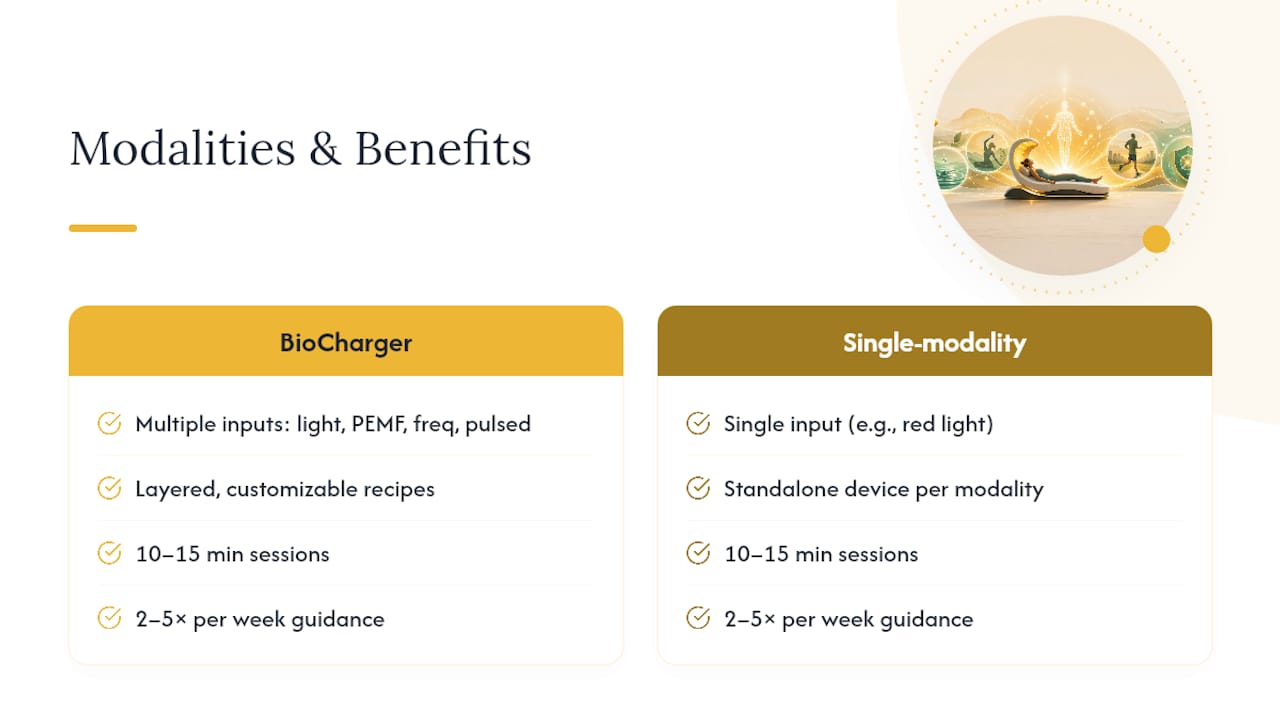
It layers four energy inputs, light, PEMF, frequencies, and pulsed voltage fields, into one session using a customizable recipe library, rather than relying on just one modality like a standalone red light panel.
How long before I notice biocharger effects?
Energy and stress relief are sometimes noticeable the same day. Sleep and recovery improvements tend to build over one to two weeks of consistent sessions, according to manufacturer-reported patterns.
Is there real scientific research on biocharger effects?
PEMF and photobiomodulation each have modality-level research behind them for circulation and cellular energy support. Large, independent trials specific to the BioCharger platform itself are still limited.
How often should I use a BioCharger for a health benefits boost?
Manufacturer and practitioner guidance generally suggests 2 to 5 sessions per week depending on your goal, with sessions running 10 to 15 minutes each.
Sources
- BioCharger Benefits: 12 Ways It Supports Energy & Recovery
- What Does a BioCharger Do? — INDRA Biomagnetism
- Electromagnetic fields — World Health Organization