
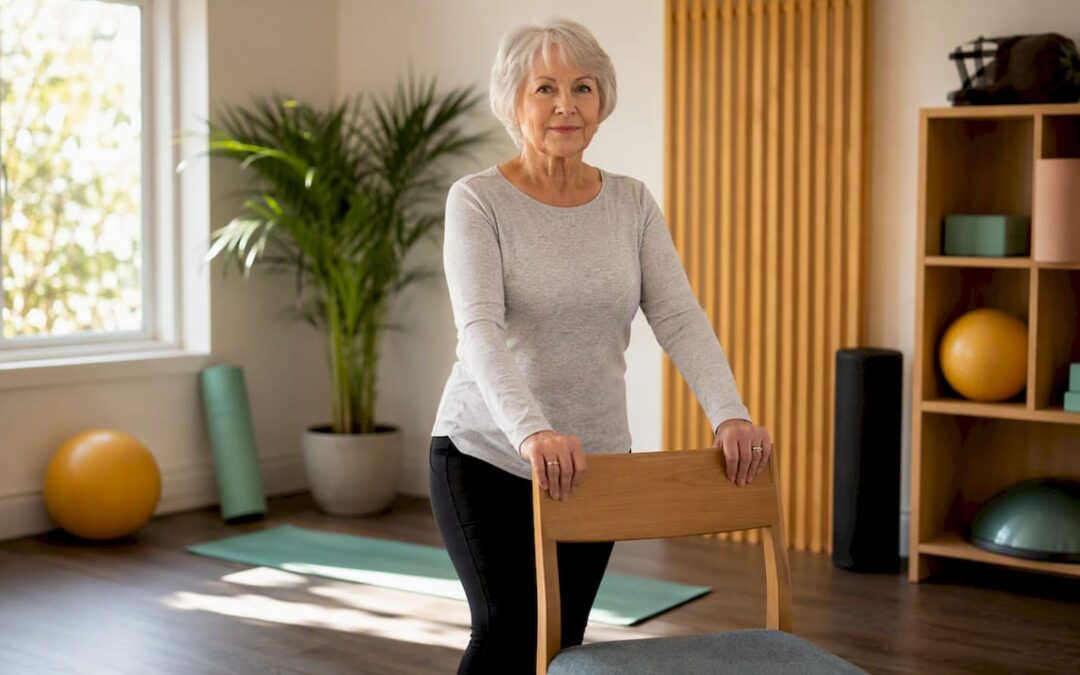
Start with short, daily balance drills plus twice-weekly strength work. That combination, backed by guidance from Johns Hopkins Medicine and the National Institute on Aging, is the most practical starting point for older adults who want to move more steadily and reduce fall risk.
Here is a three-step micro-plan you can begin today:
- Step 1 — Short daily practice: Spend 5–10 minutes on balance drills each morning, right after brushing your teeth.
- Step 2 — Use support: Keep a sturdy chair or countertop within arm’s reach for every exercise until you feel confident without it.
- Step 3 — Add one strength move: Finish each session with 10 chair sit-to-stands to build the leg power that catches you when you stumble.
Three starter exercises to try right now:
- Chair-supported single-leg stand: Hold the chair back, lift one foot an inch off the floor, hold 10 seconds, switch sides.
- Heel-to-toe walk: Place one foot directly in front of the other along a straight line, 10 steps forward and back.
- Weight shifts: Stand with feet hip-width apart, slowly shift your weight to the right foot, hold 5 seconds, then shift left.
Pro Tip: If you have had a fall in the past six months, feel dizzy when you stand up, or take medications that affect blood pressure, check with your doctor before starting any new exercise program.
Key Takeaways
Consistent balance training, paired with strength work and regular progress checks, is the most practical strategy older adults have for reducing fall risk and maintaining independence.
| Point | Details |
|---|---|
| Start with support | Use a chair or wall for every exercise until you can hold steady for two full sessions without it. |
| Pair balance with strength | Combining both reduces fall risk more than either approach alone, per Johns Hopkins Medicine guidance. |
| Practice 3x per week minimum | Structured programs running roughly three times weekly over several months show consistent balance improvements. |
| Test every 4–6 weeks | Track single-leg stand, TUG, and Functional Reach; a 30-second one-leg hold is the target for adults 70+. |
| Osteostrong complements balance work | Weekly osteogenic loading sessions strengthen bones to reduce fracture severity if a fall does occur. |
Table of Contents
- Why balance training matters for older adults
- Simple, safe balance exercises you can do at home
- How to build an 8–12 week balance program
- Safety checklist and when to stop
- Which structured programs have the strongest evidence?
- How to track your progress with simple home tests
- How bone density and balance training work together
- The habit matters more than the heroics
- Osteostrong can complement your balance practice
- Sources
Why balance training matters for older adults
Falls are the leading cause of injury among Americans 65 and older, and the consequences go well beyond a bruise. A broken hip, a fractured wrist, or even a near-miss can trigger a fear of falling that leads people to move less, which weakens the muscles and sensory systems that keep them upright in the first place. The National Institute on Aging notes that balance problems become more common with age because of changes in vision, inner-ear function, peripheral sensation, and muscle strength — but that targeted exercise can genuinely reverse much of that decline.
The mechanism matters. When you lose your footing, your body has roughly 300–400 milliseconds to mount a corrective response before you hit the ground. That response depends on three things working together: sensory input (vision, inner ear, foot sensation), muscle strength to execute the recovery step, and a practiced neural pathway that fires the right muscles fast enough. Balance training builds all three.
A systematic review published in MDPI found that multiple intervention types, including Tai Ji Quan, the Otago Exercise Program, multimodal strength-balance training, and perturbation-based reactive training, all reduce falls in community-dwelling older adults. Perturbation training, which involves practicing recovery from unexpected nudges or surface shifts, showed particularly strong effects on reactive stepping.
Key benefits of a consistent balance program for older adults:
- Reduced risk of falls and fall-related injuries
- Improved walking speed and steadiness on uneven surfaces
- Greater confidence moving through daily tasks (stairs, curbs, reaching overhead)
- Maintained independence longer
Simple, safe balance exercises you can do at home
The exercises below move from static holds to dynamic walking drills. Work through them in order during a single session, or pick two or three to practice daily. Always have a chair or wall within reach.
Chair sit-to-stand
Sit near the front edge of a firm chair, feet flat on the floor, hip-width apart. Cross your arms over your chest or hold the armrests lightly. Lean slightly forward, then press through your heels to stand fully upright. Lower back slowly. Start with a small number of repetitions. Progress by removing armrest support, then by slowing the lowering phase.
Weight shifts
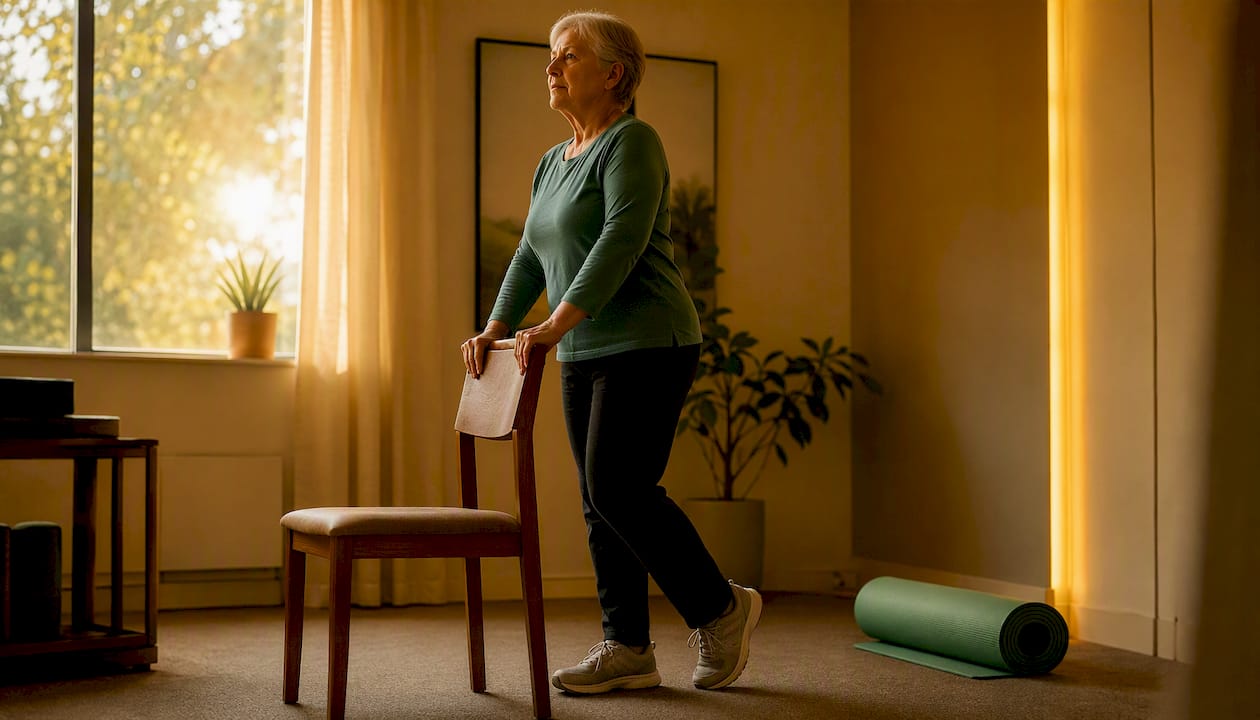
Stand behind a chair, hands resting lightly on the back. Shift your weight slowly to the right foot until the left foot feels nearly weightless. Hold 5 seconds, return to center, shift left. Do 5 repetitions each side. Progress by reducing finger contact to one finger, then no contact.
Heel-to-toe (tandem) walk
Stand near a wall. Place your right foot directly in front of your left so the heel touches the toe. Take several steps forward along an imaginary line, then turn carefully and walk back. Progress by moving away from the wall, then by carrying a light object.
Single-leg stand
Hold a chair back. Lift one foot 1–2 inches off the floor. Hold as long as comfortable, working toward 30 seconds per side. Johns Hopkins Medicine identifies 30 seconds as a practical benchmark for adults 70 and older; many people start at 10 seconds and build from there.
Side steps and grapevine
Step sideways 10 steps to the right, then 10 steps back to the left. For grapevine, cross the trailing foot alternately in front and behind as you travel sideways. Keep a wall nearby. This trains lateral stability, which is where many real-world stumbles happen.
Standing march
Stand behind a chair. Lift your right knee to hip height, hold 1 second, lower, then lift the left. Do 10 marches per side. Progress by slowing the lift, then by marching without holding the chair.
Step-ups
Use a bottom stair with a railing. Step up with the right foot, bring the left foot up to meet it, step down right, then left. Start with 5 repetitions per side. Progress by increasing reps, then by slowing the lowering phase.
Pro Tip: Most falls happen during movement, not while standing still. Practice turning, reaching for a shelf, or picking something up from the floor — all with a chair nearby — because those real-life movements are where balance training pays off most.
Progression at a glance
| Exercise | Beginner | Intermediate | Advanced |
|---|---|---|---|
| Single-leg stand | 10 sec, chair hold | 20 sec, fingertip touch | 30 sec, no support |
| Tandem walk | Along wall, 10 steps | Away from wall, 15 steps | Eyes closed briefly, 20 steps |
| Step-ups | 5 reps, railing hold | 8 reps, light touch | 10 reps, no railing |
How to build an 8–12 week balance program
Frequency matters more than session length. Research published in PMC shows that structured programs running roughly three times per week over several months consistently improve balance performance in older adults. Short daily practice on top of that accelerates gains.
A practical weekly structure:
- Daily (5–10 minutes): One or two static exercises, such as weight shifts or single-leg stands, paired with a daily habit like morning coffee or tooth-brushing.
- Monday and Thursday (20–30 minutes): Full balance session covering static holds, tandem walking, marching, and step-ups, followed by 10 minutes of lower-body strength work (chair squats, calf raises, seated leg lifts).
- Wednesday (20–30 minutes): Walking for 20 minutes at a comfortable pace, plus 5 minutes of cool-down stretching. The American Heart Association recommends combining aerobic activity with muscle-strengthening work as part of a weekly routine for older adults.
- Saturday (optional, 20 minutes): A Tai Chi class, a community balance class, or a light repeat of the Monday session.
Progression rules:
- Increase hold time or reps by no more than 10–15% per week.
- Reduce support (from two hands to one finger to no contact) only after you can complete the current level with steady, controlled form for two consecutive sessions.
- Add complexity (eyes closed, soft surface, dual task) one variable at a time, never two at once.
- At weeks 4–6, retest your single-leg stand and Timed Up and Go (see the tracking section below) to confirm progress before advancing.
- At weeks 8–12, reassess whether you need a supervised program or can continue independently.
If you have knee pain, substitute chair sit-to-stands with seated leg extensions and reduce step-up height. For vestibular symptoms (spinning, nausea), keep both feet on the floor and avoid head-turning exercises until you have spoken with a clinician.
Safety checklist and when to stop
A safe environment matters as much as the exercises themselves. Before each session, run through this quick check:
- Footwear: Wear supportive, non-slip shoes or sneakers. Socks alone on hardwood floors are a fall waiting to happen.
- Environment: Clear the path of rugs, cords, and clutter. Practice near a wall or sturdy chair, not in the middle of an open room.
- Medications: Some blood pressure medications, sleep aids, and diuretics increase dizziness. If you recently changed a prescription, go slower and keep support closer.
- Orthostatic symptoms: If you feel lightheaded when you stand up, pause for 30 seconds before starting any standing exercise.
- Support options: A walking frame or mobility aid can be a useful bridge while you build confidence, particularly after a recent fall or surgery.
Stop immediately and contact your doctor if you experience:
- New or sudden dizziness or spinning
- Chest pain or shortness of breath during exercise
- A near-fall or actual fall during practice
- Unexplained worsening of balance over two or more weeks
Pro Tip: Tape a strip of painter’s tape on the floor as a tandem-walk line. It costs nothing, gives you a visual guide, and makes it easy to practice safely in a hallway.
Consider a physical therapy referral if you have had more than one fall in the past year, have a neurological condition affecting balance, or feel that home practice is not producing any improvement after six weeks.
Which structured programs have the strongest evidence?
Home practice is a solid foundation, but group and supervised programs add something home practice cannot: real-time feedback. Here is what the evidence supports.
Tai Chi (Tai Ji Quan)
Mayo Clinic notes that Tai Chi and instructor-led balance classes provide feedback that improves safety and form, and Tai Chi has consistent evidence for reducing falls in older adults. Classes are widely available at community centers, YMCAs, and senior centers across the United States. Look for instructors certified through the Tai Chi for Health Institute or a similar credentialing body.
- Pros: Low impact, social, widely available, strong fall-reduction evidence
- Cons: Takes weeks to learn the forms; benefits require ongoing attendance
Otago Exercise Program
Developed in New Zealand and validated in multiple trials, the Otago program is a home-based strength and balance protocol typically delivered by a physical therapist. The MDPI systematic review includes Otago-style programs among the interventions with demonstrated fall reductions.
- Pros: Individually tailored, PT-supervised at the start, home-based after initial sessions
- Cons: Requires a PT referral; less social than group classes
Perturbation-based reactive balance training
This approach involves practicing recovery from unexpected balance challenges, such as a treadmill belt that suddenly shifts or a platform that tilts. It produces strong improvements in reactive stepping but is typically available only in clinical or research settings.
- Pros: Directly trains the recovery response that prevents falls
- Cons: Limited availability; requires supervised equipment
Questions to ask before joining any class or program:
- Is the instructor certified in fall prevention or senior fitness?
- What is the group size? Smaller groups (under 10) allow more individual feedback.
- Does the program include reactive or dynamic balance challenges, or only static holds?
- Is there a medical screening process before you start?
A supervised program is preferable to home practice alone when you have a history of two or more falls, a vestibular disorder, Parkinson’s disease, or other neurological conditions affecting movement.
How to track your progress with simple home tests
Testing every 4–6 weeks keeps you motivated and tells you when to advance or when to seek help. These three tests require no equipment beyond a chair and a tape measure.
How to perform each test:
- Single-leg stand: Stand near a chair. Lift one foot, start a timer, and stop when you touch down or grab support. Test both sides. Record the longer hold.
- Timed Up and Go (TUG): Sit in a chair with arms. On “go,” stand, walk 10 feet, turn, walk back, and sit. Record the time in seconds. Slower times suggest higher fall risk; most healthy older adults complete it in under 12 seconds.
- Functional Reach: Stand beside a wall. Extend one arm at shoulder height, make a fist, and mark where your knuckles start. Lean forward as far as you can without stepping. Mark where your knuckles end. Measure the distance. Reaching less than 6 inches is associated with higher fall risk.
Benchmark targets by function level
| Test | Beginner | Intermediate | Target |
|---|---|---|---|
| Single-leg stand | Under 10 sec | 10–20 sec | 30 sec |
| Timed Up and Go | Over 15 sec | 12–15 sec | Under 12 sec |
| Functional Reach | Under 6 inches | 6 inches | 10+ inches |
Log your results in a simple notebook or a phone note after each test session. If your scores plateau or decline over two consecutive test periods, that is a signal to schedule a clinical balance assessment rather than push harder on your own.
How bone density and balance training work together
Stronger bones and better balance address fall risk from two different angles, and they work best together. Balance training reduces the likelihood of a fall. Stronger bones reduce the severity of injury if a fall occurs. Neither replaces the other.
This distinction matters clinically. A person with osteoporosis who improves bone density through osteogenic loading still needs balance work to avoid the fall in the first place. Conversely, someone with excellent balance but low bone density faces serious fracture risk if they do fall.
For people with osteoporosis or osteopenia, a few clinical caveats apply when combining therapies:
- Avoid high-impact jumping or rapid direction changes until your treating clinician clears you for impact loading.
- Osteogenic loading sessions (such as those at Osteostrong) are brief and controlled, making them compatible with a balance training schedule on the same or adjacent days for most people.
- If you have severe bone disease (T-score below -3.0 or a recent fragility fracture), get explicit clearance from your physician before adding any new exercise, including balance drills.
Pro Tip: Schedule your osteogenic loading session and your balance practice on different days if you feel fatigued after loading. Fatigue compromises balance, and practicing while tired increases fall risk rather than reducing it.
The MDPI systematic review on fall prevention interventions supports multimodal approaches, combining strength, balance, and where appropriate, bone-loading therapies, as the most effective strategy for older adults managing skeletal health.
The habit matters more than the heroics
Consistency beats intensity every time. A five-minute balance drill done daily produces more lasting improvement than a 45-minute session done once a week, because the nervous system learns through repetition, not volume.
The most reliable way to build a daily balance habit is to attach it to something you already do without thinking. Stand on one foot while you wait for the kettle to boil. Do heel-to-toe steps down the hallway on the way to the bathroom. Shift your weight side to side while you brush your teeth. None of these require a gym, a mat, or a scheduled block of time.
Small wins compound. When you hit 20 seconds on a single-leg stand for the first time, write it down. That number is proof the system is working, and proof is what keeps people going when motivation dips.
Osteostrong can complement your balance practice
If you are already doing balance work at home and want to address the bone-strength side of the equation, Osteostrong offers weekly osteogenic loading sessions designed specifically for people managing osteoporosis, osteopenia, or proactive skeletal health. One session per week, lasting about 15 minutes, delivers the mechanical stimulus your bones need to grow stronger, without the joint stress of traditional weight training.
Osteostrong also offers vibration plates, PEMF mats, red light therapy, and compression therapy, all of which can support recovery and overall wellness alongside your balance program. These are not replacements for balance training; they are tools that work alongside it.
Visit Osteostrong Rancho Cordova East to schedule a free introductory session and ask how osteogenic loading fits your current exercise plan. As always, consult your physician before starting any new therapy, particularly if you have a recent fracture or severe bone disease.
Sources
- Fall Prevention: Balance and Strength Exercises for Older Adults | Johns Hopkins Medicine
- Taking balance training for older adults one step further – PMC
- Older adults and balance problems | National Institute on Aging (NIA)
- Balance exercises – Mayo Clinic
- AHA recommendations for physical activity in adults | American Heart Association
This article is general information, not a substitute for advice from a qualified doctor. Consult a qualified healthcare professional about your own circumstances before acting on anything here.