
A DEXA (dual-energy X-ray absorptiometry) scan is a quick, low-dose X-ray that measures bone mineral density (BMD) to diagnose osteopenia and osteoporosis. T-score thresholds guide interpretation, with higher scores indicating normal bone density and lower scores signaling osteopenia or osteoporosis, which may prompt a conversation about treatment.
Here’s what matters most before you read further:
- What it measures: Bone mineral density in grams per square centimeter (g/cm²), primarily at the lumbar spine and hip
- Who gets it: Women 65 and older, men 70 and older, and younger adults with risk factors like prior fractures or long-term steroid use
- What a result leads to: A T-score alone rarely drives a treatment decision; clinicians at institutions like the Hospital for Special Surgery (HSS) routinely pair it with the FRAX fracture risk tool to calculate your 10-year fracture probability before recommending anything
Table of Contents
- Why clinicians order a DEXA and who should be screened
- How to prepare and what NOT to do before a DEXA scan
- Radiation exposure and safety
- How to read your DEXA results: T-score, Z-score, and FRAX
- How often should you repeat a DEXA scan?
- How clinicians move from a DEXA result to a treatment plan
- Key Takeaways
- What a DEXA result actually means for you
- Osteostrong supports your bone health after a DEXA result
- Useful sources and where to learn more
Why clinicians order a DEXA and who should be screened
The most common reason a provider orders a DEXA is to diagnose osteopenia or osteoporosis before a fracture happens. Other indications include estimating fracture risk, monitoring how well a patient is responding to bone-protective medication, and establishing a baseline before starting drugs known to reduce bone density (such as long-term corticosteroids or aromatase inhibitors).
U.S. screening guidance generally recommends routine testing for older women and men, with earlier testing recommended for those carrying significant risk factors.
Common risk factors that prompt earlier screening include:
- Personal or family history of fragility fracture (a break from a minor fall or bump)
- Long-term glucocorticoid use (typically three months or more)
- Low body weight or a BMI under 20
- Current smoking
- Excessive alcohol consumption (more than two drinks per day)
- Hypogonadism or early menopause (before age 45)
- Conditions associated with secondary bone loss: rheumatoid arthritis, celiac disease, chronic kidney disease
There’s an important distinction between preventive screening and diagnostic use. Screening applies to asymptomatic adults who meet age or risk thresholds. Diagnostic use applies when someone has already had a fracture from minimal trauma and the scan confirms the underlying bone loss driving it.
How to prepare and what NOT to do before a DEXA scan
Getting the preparation right protects the accuracy of your results. A few specific mistakes can distort the reading or require rescheduling.
According to RadiologyInfo.org, the key pre-test rules are:
- Stop calcium supplements 24 hours before the scan. Undigested calcium in the gut can be read as bone by the scanner and falsely elevate your BMD. This applies to calcium carbonate and calcium citrate supplements, not dietary calcium from food.
- Avoid metal clothing and jewelry. Zippers, underwire bras, belt buckles, and body piercings all interfere with the image. Many centers provide a gown, but calling ahead to confirm saves time.
- Delay the scan after contrast imaging. If you’ve had a contrast-enhanced CT scan or a nuclear medicine study within the past 10–14 days, inform the technologist. Residual contrast agents can distort BMD readings, and the center may recommend rescheduling.
- Tell the technologist if you’re pregnant or possibly pregnant. DEXA uses ionizing radiation, and while the dose is very low, any unnecessary radiation exposure during pregnancy is avoided. Most centers ask all women of childbearing age before proceeding.
What to bring with you:
- Any prior DEXA reports or imaging (so the technologist can compare to the same machine or flag cross-machine variability)
- A current medication list, including supplements
- Your referral or insurance authorization if required by your plan
Radiation exposure and safety
DEXA uses a very small dose of ionizing radiation. According to the NHS, the radiation dose from a DEXA scan is much less than that of a standard chest X-ray, and no radiation remains in the body after the scan is complete.
Radiation context: A typical central DEXA delivers roughly 1–10 microsieverts of radiation. For comparison, you absorb a similar amount just from natural background radiation during a short flight. A standard chest X-ray delivers roughly 100 microsieverts. The DEXA dose is negligible for most adults.
There are no immediate physical risks from the scan itself. No contrast agent is injected, no radioactive tracer is used, and the machine never touches you. The one firm contraindication is pregnancy, where even low-dose radiation is avoided unless clinically urgent. For everyone else, the risk-to-benefit calculation is straightforward: the information gained from detecting bone loss early far outweighs the minimal radiation involved.
If you’ve had recent contrast imaging, the concern isn’t radiation from the DEXA itself — it’s that residual contrast in your system can distort the bone reading, producing an inaccurate result rather than a safety risk.
How to read your DEXA results: T-score, Z-score, and FRAX
Your DEXA report will include two scores. Understanding both prevents a lot of unnecessary anxiety or false reassurance.
T-score compares your BMD to the average peak bone density of a healthy young adult of the same sex. It’s the primary diagnostic number.
Z-score compares your BMD to the average for someone your age and sex. A Z-score below −2.0 suggests your bone loss is greater than expected for your age, which prompts investigation into secondary causes (vitamin D deficiency, hyperparathyroidism, malabsorption, etc.).
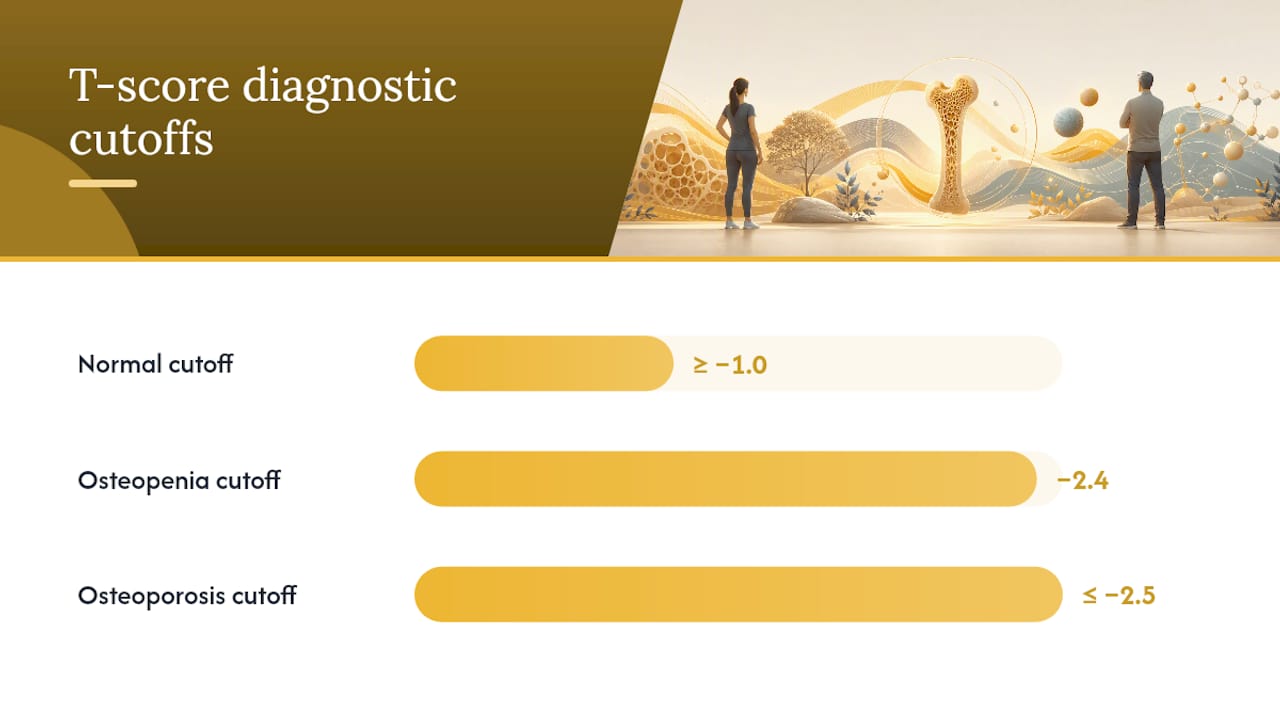
According to MedlinePlus, the standard T-score thresholds are:
| T-score range | Classification | Typical clinical implication |
|---|---|---|
| −1.0 or higher | Normal | Monitor; maintain bone-healthy lifestyle |
| Between −1.0 and −2.4 | Osteopenia | Lifestyle intervention; FRAX calculation to assess fracture risk |
| −2.5 or below | Osteoporosis | Discuss pharmacologic therapy; FRAX to confirm treatment threshold |
Where FRAX fits in: A T-score is a measurement. FRAX turns it into a risk estimate. The tool, developed by the University of Sheffield and widely used by U.S. clinicians, combines your BMD with clinical risk factors (age, sex, prior fracture, parental hip fracture, smoking, alcohol, glucocorticoid use, secondary osteoporosis, rheumatoid arthritis) to calculate your 10-year probability of a major osteoporotic fracture and a hip fracture specifically. Clinicians use it to move from a number to a decision, as HSS’s patient guide explains in its DEXA and FRAX overview.
Two real-world scenarios:
Scenario A: T-score of −1.4, no prior fracture, no glucocorticoid use, FRAX 10-year major fracture probability below treatment threshold. Recommendation: lifestyle modification (weight-bearing exercise, calcium, vitamin D), repeat DEXA in 2 years.
Scenario B: T-score of −2.6, or T-score of −2.4 with a prior wrist fracture and a FRAX score above the treatment threshold. Recommendation: discuss starting a bisphosphonate or other bone-protective medication alongside lifestyle changes.
The difference between these two patients isn’t just the T-score. It’s the full clinical picture that FRAX captures.
How often should you repeat a DEXA scan?
Repeat testing intervals depend on your baseline result, your treatment status, and your risk profile.
General guidance: if you’re starting or changing bone-protective medication, a follow-up scan in 1–2 years helps confirm the therapy is working. For patients who are stable and low-risk, every 2 years is a reasonable interval. If your initial scan is normal and you have no major risk factors, repeat testing every 5 years or longer may be appropriate. The goal is to detect meaningful change, not to scan frequently for its own sake.
After an abnormal result, common next steps include:
- Hormonal evaluation: For women approaching or in menopause, a midlife women’s blood panel can identify estrogen decline as a driver of accelerating bone loss, which informs both the urgency of treatment and the options available
Pro Tip: Before your follow-up appointment, ask your clinician to run a FRAX calculation with your updated BMD. If your score has crossed a treatment threshold since your last scan, that’s the moment to have a direct conversation about bone-protective medication rather than waiting for another cycle.
How clinicians move from a DEXA result to a treatment plan
The clinical flow after a DEXA result follows a clear sequence, and understanding it helps you participate in the decision rather than just receive it.
- FRAX calculated: — Clinical risk factors are entered alongside the BMD to generate a 10-year fracture probability. In the U.S., the National Osteoporosis Foundation (NOF) and the American College of Rheumatology both reference FRAX thresholds in their treatment guidelines.
Evidence-backed non-pharmacologic options include:
- Osteogenic loading: — A specific mechanical-loading strategy that applies brief, high-magnitude forces to the skeleton, targeting the load threshold needed to trigger bone formation. Research supports this as a stimulus for BMD improvement, particularly at the hip and spine
- Nutrition: Adequate calcium from food (dairy, leafy greens, fortified foods), protein, and magnesium; see foods that support bone density for practical targets
Pro Tip: If your T-score is borderline (between −1.5 and −2.4) and your FRAX is below the treatment threshold, ask your clinician whether a repeat DEXA in 12–18 months rather than 24 months makes sense. Borderline cases benefit from closer monitoring, and catching a meaningful decline early keeps more options on the table.
Key Takeaways
A DEXA scan gives you a T-score that classifies bone density, but the T-score only becomes a treatment decision when paired with FRAX and your full clinical picture.
| Point | Details |
|---|---|
| T-score thresholds | Normal ≥ −1.0; osteopenia between −1.0 and −2.4; osteoporosis ≤ −2.5, per MedlinePlus |
| FRAX changes decisions | A borderline T-score plus high FRAX often triggers treatment; a low T-score with low FRAX may not |
| Preparation matters | Stop calcium supplements 24 hours before; avoid metal clothing; delay scan 10–14 days after contrast imaging |
| DEXA measures density, not quality | Bone microarchitecture is not captured; a normal BMD does not guarantee fracture-proof bone |
| Osteostrong’s role | Osteostrong offers weekly osteogenic loading sessions as a non-pharmacologic option to support bone density after a DEXA result |
What a DEXA result actually means for you
Most people who get a DEXA scan are not prepared for the emotional weight of seeing a number that classifies their skeleton. A T-score of −2.1 sounds alarming. It isn’t necessarily a crisis, but it does deserve attention.
Here’s the perspective worth holding: a DEXA result is information, not a verdict. Osteopenia is common, especially in women over 50, and a large proportion of people with osteopenia never fracture. What the scan does is give you and your clinician a starting point. The FRAX calculation is where the real clinical picture emerges, so if your provider gives you a T-score without running FRAX, ask for it specifically.
On the practical side: check your insurance coverage before scheduling. Most U.S. insurers, including Medicare, cover DEXA for women 65 and older and for individuals with documented risk factors. Out-of-pocket costs vary widely by facility, but the scan is generally available at hospital imaging centers, outpatient radiology practices, and some primary care offices. Costs without insurance typically range from around $100 to $300 depending on location and facility type, though this is not publicly standardized.
One thing the scan cannot tell you is how much bone you can rebuild. That depends on what you do next.
This article is for general educational purposes only and is not a substitute for professional medical advice. Consult your clinician or a qualified healthcare provider for guidance specific to your situation.
Osteostrong supports your bone health after a DEXA result
Getting a DEXA result that shows bone loss is the beginning of a plan, not the end of one. For adults who want to take an active, non-pharmacologic approach to improving bone density, Osteostrong offers weekly osteogenic loading sessions designed to apply the kind of brief, high-magnitude mechanical force that stimulates bone formation at the hip and spine — the same sites your DEXA measures.

A typical Osteostrong membership includes supervised osteogenic loading on specialized equipment, plus access to complementary therapies: red light therapy for bone density, PEMF mats, vibration plates, compression therapy, and hydromassage. These are not replacements for clinical care or prescribed medication. They work alongside whatever your clinician recommends, giving your skeleton a consistent mechanical stimulus between medical appointments.
Clients typically come once per week. Sessions are brief, low-impact, and suitable for adults with osteopenia or osteoporosis who want to do more than wait for their next scan. If you’re ready to act on your results, find an Osteostrong center near you and schedule a first session.
Useful sources and where to learn more
The following sources informed this article. Each covers a specific aspect of DEXA scanning and bone health:
- DXA (DEXA) bone density test patient guide — HSS
- Dual-Energy X-Ray Absorptiometry — StatPearls/NCBI
- Bone density scan: MedlinePlus
- Bone Density Scan (DEXA or DXA) — RadiologyInfo
- Bone density scan (DEXA scan) — NHS
Always consult your clinician or a qualified healthcare provider before making decisions based on your DEXA results. Guidelines and coverage criteria can change; verify current recommendations with your provider or the relevant professional society.