
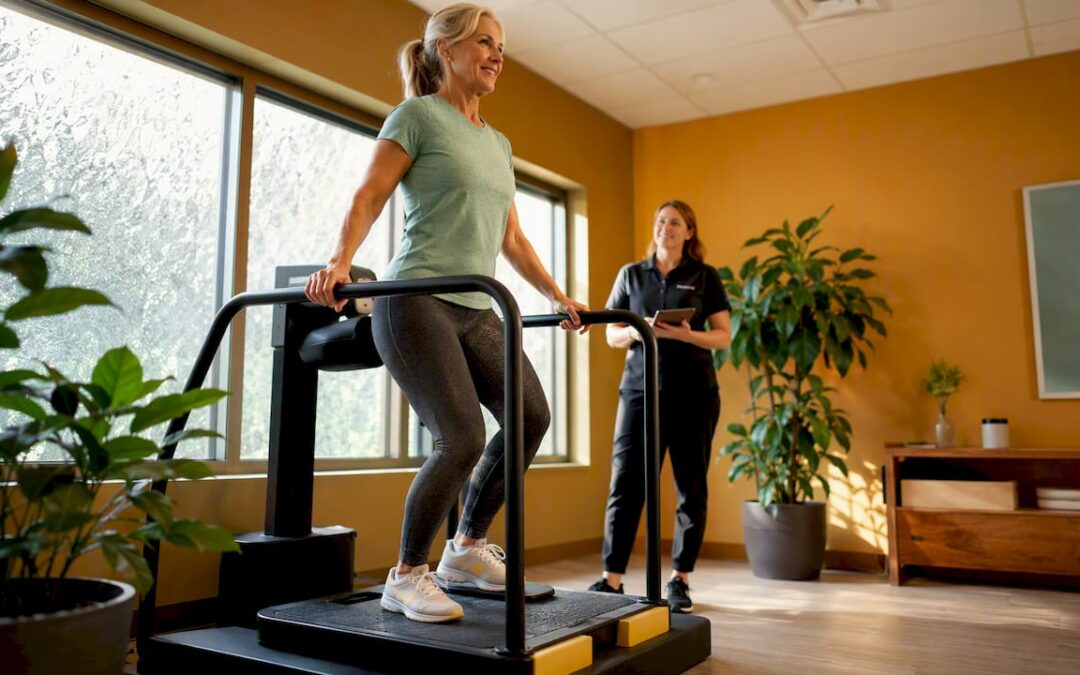
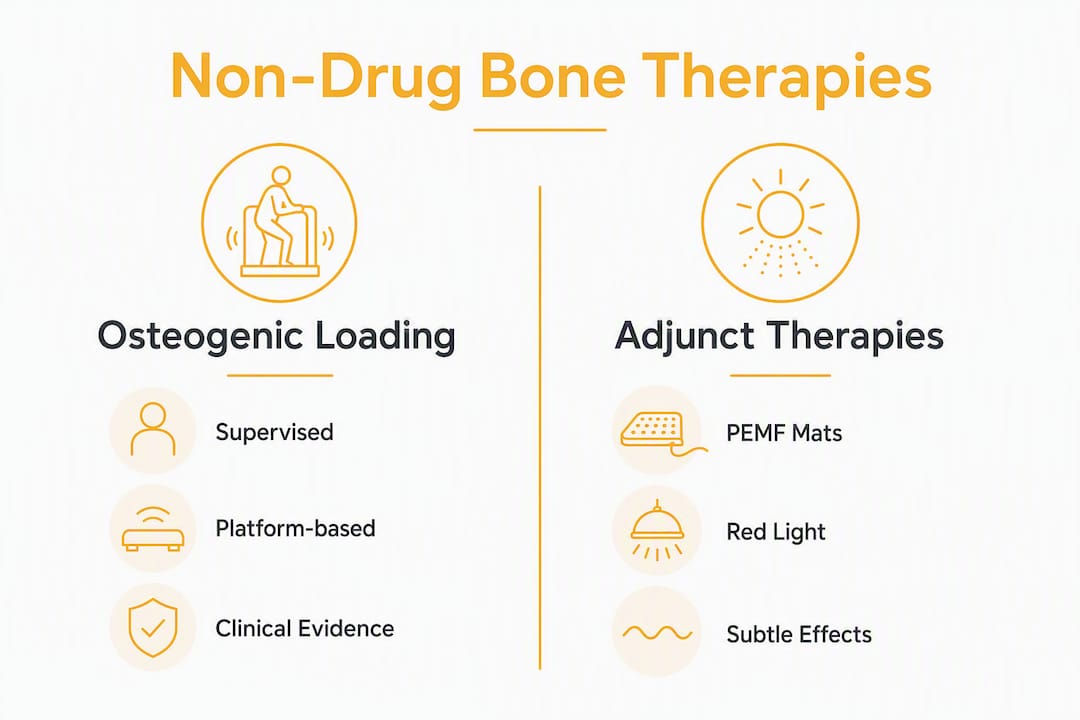
If you’re looking for Prolia alternatives that don’t involve injections or prescriptions, the most evidence-backed in-person option is supervised osteogenic loading, offered at clinics like Osteostrong. It works by applying brief, high-force isometric contractions through specialized devices, triggering the same bone-remodeling signal your skeleton responds to under heavy mechanical load. Paired with adjunct therapies such as PEMF, red light, vibration, and compression, these sessions form a complementary, non-pharmaceutical approach to improving bone density.
These are not substitutes for your physician’s care. They work alongside medical oversight, not instead of it.
Your immediate next step: Ask your doctor about supervised osteogenic loading, bring your most recent DXA scan to your first center visit, and schedule a follow-up DXA at 12 months to track change.
- Osteogenic loading: the primary, evidence-supported modality for stimulating bone growth in-person
- PEMF, red light, vibration, compression, and hydromassage: adjunct therapies that support recovery and may complement loading
- Weekly sessions over months to years, not one-off treatments
- DXA monitoring is the standard way to measure whether bone density is actually changing
Table of Contents
- What do in-person, non-drug bone-strengthening options actually look like?
- Who actually benefits, and when should you involve your doctor?
- How long before you see results, and how are they tracked?
- How do you choose a local in-person center?
- What does the peer-reviewed evidence actually show?
- Osteostrong is where this all comes together
- Key Takeaways
- What working with these therapies actually looks like over time
- Useful sources for further reading
What do in-person, non-drug bone-strengthening options actually look like?
Most people picture weight rooms or physical therapy when they hear “non-drug bone care.” What Osteostrong and similar centers offer is different.

Osteogenic loading is the centerpiece. Sessions typically run about ten minutes, once per week, using specialized devices that allow you to produce isometric forces many times your body weight in a controlled, low-impact position. Per Wolff’s law, bone remodels in response to mechanical stress. The devices make it possible to reach the force threshold needed for that adaptation without the joint impact of running or heavy lifting.
The adjunct modalities each play a supporting role:
- PEMF (Pulsed Electromagnetic Field) mats: Emit controlled electromagnetic pulses that may stimulate osteoblast activity and reduce osteoclast activity. A systematic review of 8 trials found PEMF non-inferior to conventional approaches for short-term BMD maintenance and significantly better for balance measures in older adults with primary osteoporosis.
- Red light therapy (photobiomodulation): Reduces inflammation and supports tissue recovery, which helps you tolerate loading sessions better. Research shows it works best as a complement to mechanical loading, not as a standalone bone-builder.
- Vibration plates: Low-amplitude whole-body vibration may support bone and muscle activation, particularly in older adults.
- Compression therapy: Promotes circulation and recovery between sessions.
- Hydromassage and recovery lounges (BioCharger, PureWave VEMI): Support nervous system recovery and reduce session-related soreness, helping clients stay consistent.
Pro Tip: None of these therapies produce results from a single visit. PEMF and red light in particular feel subtle during a session. The cumulative effect over months of consistent attendance is what drives measurable change, so adherence matters more than intensity on any given day.
Who actually benefits, and when should you involve your doctor?
These services fit a specific profile. You’re a good candidate if you have osteopenia or early-stage osteoporosis, if you’re looking to complement an existing medication plan, or if you prefer to delay or avoid certain prescriptions while your bone density is still in a manageable range. People already on medication often use these sessions as an add-on to maximize their response.
Before starting, bring this information to your first evaluation:
- Your most recent DXA scan results (T-scores for lumbar spine and femoral neck)
- A list of current medications and supplements
- Any fracture history, including vertebral fractures found incidentally on imaging
- Your physician’s contact information for care coordination
- Any implanted devices (pacemakers, cochlear implants, metal hardware)
That last point matters for PEMF specifically. PEMF is contraindicated for people with implanted electronic devices such as pacemakers or cochlear implants, and it should be avoided during pregnancy. Anyone with active cancer, recent surgery near a treatment area, or uncontrolled epilepsy should get physician clearance before using PEMF. Credentialed staff at a reputable center will screen for all of these before your first session.
Statistic to know: The PEMF meta-analysis covering over four hundred participants found significant improvements in balance measures including the Berg Balance Scale and Timed Up and Go test, which matters because falls, not just fractures, are the proximate risk for most osteoporosis patients.
How long before you see results, and how are they tracked?
Weekly osteogenic loading is the anchor. Most adjunct therapies (PEMF, red light) are used regularly at some centers, though protocols vary. The honest timeline for measurable bone density change is longer than most people expect.
| Timeframe | What to expect |
|---|---|
| Weeks 1–4 | Familiarization, baseline intake, initial supervised sessions |
| Months 1–3 | Improved balance, reduced soreness, better session tolerance |
| — | Functional gains (strength, stability) may be noticeable |
| Months 9–12 | First meaningful window for DXA re-scan to detect BMD change |
| Year 2+ | Continued loading needed to sustain and build on gains |
DXA rescans are typically recommended at 12-month intervals for people in active bone-health programs. Some physicians order them at 18–24 months if baseline scores are stable. Either way, a single DXA at the start and one at 12 months is the minimum tracking standard.
What a center should be measuring between DXA scans:
- Session load progression (are the forces you’re producing increasing over time?)
- Balance assessments (functional improvement is an early indicator)
- Subjective pain and mobility scores
- Attendance consistency (the single strongest predictor of outcome)
How do you choose a local in-person center?
Not every wellness center offering “bone health” services is running the same program. Here are the questions worth asking before you commit:
- Who supervises sessions? Look for credentialed health professionals or certified technicians trained specifically on osteogenic loading devices, not general fitness staff.
- Do you track DXA outcomes? A center that cannot show you aggregate outcome data or help you interpret your own DXA results is operating without accountability.
- How do you handle contraindications? Ask specifically about PEMF screening. A good center has a written intake protocol.
- What does session progression look like? Load should increase incrementally as your capacity improves. Static protocols that never change are a red flag.
- Can you speak with a current member? Referrals from existing clients tell you more than any brochure.
Red flags: promises of rapid bone density reversal (months, not years), no clinical tracking, staff who cannot explain how the devices work, or pressure to purchase long-term packages before you’ve completed a trial.
Pricing models vary. Most centers offer monthly memberships (typically the most cost-effective for long-term users), session packages, or single-visit rates. Membership pricing at Osteostrong-style centers generally runs similar to typical gym memberships, though exact figures vary by location.
Insurance rarely covers osteogenic loading or PEMF as standalone wellness services. However, some HSA and FSA accounts may be used for these services depending on your plan and a physician’s recommendation. Ask your center for a superbill or itemized receipt, and check with your benefits administrator.
| Pricing model | Best for | Typical commitment |
|---|---|---|
| Monthly membership | Long-term users, weekly sessions | Month-to-month or annual |
| Session package | Trying the program, occasional use | Fixed number of visits |
| Single session | First visit, evaluation only | One-time |
What does the peer-reviewed evidence actually show?
The evidence for osteogenic loading is promising but still maturing. A quasi-experimental case-series study found significant lumbar spine BMD and trabecular bone score improvements at 9–12 months in treated groups compared with non-exercise controls. A separate clinical report confirmed statistically significant improvements in lumbar spine BMD and TBS after weekly sessions. These are not large randomized controlled trials, and that limitation matters. The effect sizes are real in the cohorts studied, but replication in larger, more diverse populations is still needed.
For PEMF, the meta-analysis of several trials showed non-inferior effects on lumbar and femur neck BMD compared to conventional approaches, with moderate-to-low certainty evidence. The catch: PEMF trial parameters vary enormously, from 8–100 Hz and 1.2–5 mT, with session counts ranging from 4 to 36 across studies. That heterogeneity makes it hard to specify an optimal clinical protocol. Red light therapy supports tissue recovery and inflammation reduction but is not a primary bone-building intervention on its own.
The bottom line on evidence: osteogenic loading has the strongest clinical rationale and the most direct mechanistic link to bone remodeling. Adjunct therapies improve the overall program by supporting recovery and adherence. No single modality replaces the others, and none replaces physician oversight.
Osteostrong is where this all comes together
Osteostrong centers offer the full stack: supervised osteogenic loading sessions, PEMF mats, red light therapy, vibration plates, compression therapy, BioCharger, PureWave VEMI lounges, and hydromassage, all under one roof with staff trained to screen for contraindications and track your progress.
Your first visit includes a medical intake review, a look at your baseline DXA results, and a supervised osteogenic loading session so you experience the protocol before committing. From there, most members settle into a weekly session rhythm with adjunct therapies layered in based on their goals and any contraindications. Membership and package options are available; pricing is discussed at your evaluation. You can also explore foods that support bone density and PEMF therapy side effects to prepare for your first conversation with staff.
Find an Osteostrong center near you and book your evaluation. Bring your DXA results and your medication list.
Key Takeaways
Supervised osteogenic loading at a credentialed center like Osteostrong is the most evidence-backed in-person, non-drug approach to improving bone density for adults with osteopenia or osteoporosis.
| Point | Details |
|---|---|
| Non-drug, not non-medical | These therapies complement physician care; never stop or replace prescribed treatment without medical guidance. |
| Realistic timeline | Measurable BMD changes typically appear after several months; plan for a DXA rescan about a year from starting. |
| PEMF safety screening | PEMF is contraindicated for pacemakers, cochlear implants, and pregnancy; always disclose implants before starting. |
| Evidence quality | Osteogenic loading studies show real BMD improvements in treated cohorts; however, larger randomized controlled trials are still needed. |
| Osteostrong next step | Book an evaluation at a local Osteostrong center, bring your DXA scan, and ask about weekly membership options. |
What working with these therapies actually looks like over time
The clients who get the most out of weekly osteogenic loading are the ones who treat it like a long-term investment rather than a short-term fix. Adherence patterns matter more than any single session. What tends to show up first, before any DXA number changes, is functional: better balance, less fatigue on stairs, a sense of stability that wasn’t there before. Those early functional gains are worth tracking because they reflect real neuromuscular and skeletal adaptation happening beneath the surface.
The centers that do this well are the ones that connect those functional markers to clinical outcomes, using DXA at 12 months to confirm what the body has already started signaling. Credentialed staff supervision is not a formality. The physiological stimulus in a properly executed osteogenic loading session is genuinely high, and getting the positioning and force application right from session one is what separates a productive program from one that stalls.
Useful sources for further reading
Share these with your physician when discussing a non-drug bone health plan.
- Brief, Low-impact, High-intensity Osteogenic Loading in Postmenopausal Osteoporosis (PubMed): Quasi-experimental case-series reporting BMD and TBS improvements at 9–12 months with weekly osteogenic loading.
- THU425 Osteogenic Loading Training Improves BMD in Women With Osteoporosis (PMC): Conference and clinical report confirming lumbar spine BMD and TBS gains in treated cohorts.
- Osteogenic Loading Case-Series Study, JCEM: Prospective study showing statistically significant lumbar spine BMD increases after once-weekly sessions over 12 months.
- PEMF for Primary Osteoporosis: Systematic Review and Meta-Analysis: Analysis of 8 trials (411 participants) on PEMF effects on BMD and balance; includes parameter heterogeneity data.
- PEMF Bone Healing Meta-Analysis: Pooled fracture-healing data showing increased healing rates and pain reduction with PEMF.
- PEMF Cellular Mechanisms of Skeletal Response (PMC): FDA-approved PEMF background and mechanistic review of osteoblast/osteoclast signaling.
- Red Light Therapy for Osteoporosis Overview (Healthline): Clinical overview framing photobiomodulation as adjunctive, not primary, bone therapy.
- Photobiomodulation at 650 nm and Osteogenic Differentiation (PubMed): Cell-level research on how red light may support bone marrow stem cell activity in osteoporotic models.
- Long-term Integration of Non-drug Therapies for Bone Health: Emphasizes adherence and multimodal program design for best outcomes.
- PEMF Cellular Effects and Adherence (Frontiers): Reviews why PEMF benefits are cumulative and why patient expectation-setting matters.
This article is general health information, not medical advice. Consult your physician or a qualified bone health specialist before starting any new therapy or changing your current treatment plan.