

Sun exposure triggers vitamin D production in your skin, and that vitamin D directly supports the bone remodeling that osteogenic loading programs depend on. Without adequate serum 25(OH)D, your bones can’t fully respond to the mechanical stress that drives density gains. The clinical standard for assessing your status is a serum 25(OH)D blood test; many researchers consider levels above 30 ng/mL (75 nmol/L) associated with broader health benefits, including extra-skeletal outcomes.
- Short, regular outdoor exposures (roughly 5–30 minutes near midday, most days) suffice for many people with lighter skin during summer months.
- Test first, then act: get a 25(OH)D blood test, especially if you’re in a bone-density program, and supplement under clinician guidance when sunlight is insufficient.
“The same DNA-damaging, sunburn-causing UVB wavelengths that sunscreens are designed to block also do some good: they kick off the chemical and metabolic chain reaction that produces vitamin D.” — Harvard Health
Table of Contents
- How does sunlight actually make vitamin D in your body?
- What factors change how much vitamin D your skin makes?
- How much sun do you actually need, and how do you do it safely?
- When should you test your 25(OH)D, and what do the numbers mean?
- When sunlight isn’t enough: food sources and supplements
- Sunlight does more than make vitamin D
- Sun safety: how to protect yourself while still getting the benefits
- How sun exposure and vitamin D fit with in-person bone therapies
- A simple action plan to follow this month
- Key Takeaways
- Sun exposure, vitamin D, and what I actually tell clients
- Osteostrong in El Dorado Hills: build bone density with a complete protocol
How does sunlight actually make vitamin D in your body?
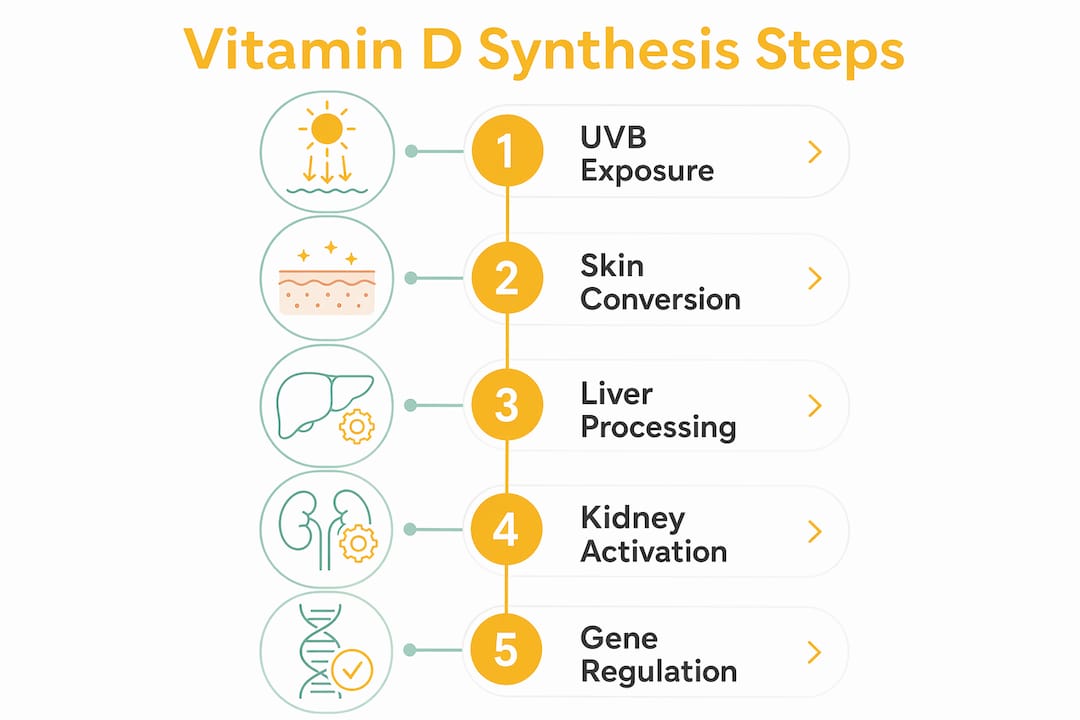
UVB radiation (approximately 290–320 nm) is the specific wavelength that converts 7-dehydrocholesterol in your skin into previtamin D3. That compound then becomes vitamin D3, travels to the liver for its first hydroxylation into 25(OH)D (calcidiol), and gets a second hydroxylation in the kidneys to form 1,25(OH)2D (calcitriol), the biologically active hormone. The 25(OH)D form is what your blood test measures, which is why it’s the clinical standard for assessing status.
Two things most people get wrong: sitting by a sunny window does nothing for vitamin D because UVB doesn’t penetrate glass, and longer sun exposure doesn’t keep raising your vitamin D indefinitely. Skin has a self-limiting mechanism where excess UVB breaks down surplus vitamin D3 into inactive compounds. Past a threshold, you’re only adding skin damage, not more vitamin D.
Pro Tip: At least 1,000 different genes are thought to be regulated by the active form of vitamin D, including those governing calcium metabolism and immune function. This is why optimizing your 25(OH)D level matters well beyond bone density alone.
What factors change how much vitamin D your skin makes?
Several variables interact to determine whether a given amount of sun exposure actually raises your 25(OH)D:
- Season and latitude: At temperate to higher latitudes, UVB is insufficient for meaningful vitamin D synthesis during winter months, often October through March in much of the U.S. El Dorado Hills sits at roughly 38°N, which means winter sun angles are low enough to limit synthesis significantly.
- Time of day: UVB is strongest between 10 AM and 4 PM. Outside that window, the sun angle filters out most UVB before it reaches your skin.
- Skin pigmentation: Melanin acts as a natural UVB filter. People with darker skin require substantially longer exposures to synthesize the same amount of vitamin D as people with lighter skin.
- Cloud cover and air pollution: Heavy cloud cover and smog reduce UVB reaching the surface.
- Clothing and sunscreen: Both block UVB. Sunscreen reduces synthesis, though typical real-world application usually still allows some production.
- Age: Older adults produce vitamin D less efficiently from the same UVB dose.
- Body surface area exposed: More skin exposed means faster synthesis.
Pro Tip: Check your local UV Index before heading out. A UV Index of 3 or higher generally indicates enough UVB for vitamin D synthesis. Most weather apps show it daily. In El Dorado Hills, the UV Index is high in summer and typically lower in winter months.
How much sun do you actually need, and how do you do it safely?
Research using microsimulation modeling suggests that in summer, 5–10 minutes outdoors most days with about 35% of body surface area exposed (arms, legs, face) can maintain adequate 25(OH)D for many people. In winter at mid-to-high latitudes, the same outcome may require more than 45 minutes with only 10% body surface area exposed, which is often impractical.

Skin tone matters significantly. Summer midday sun exposure initiates vitamin D release, with lighter-skinned individuals producing more vitamin D than those with darker skin. These differences illustrate why exposure time should be adjusted by skin type. These are not supplementation targets; they illustrate why exposure time must be adjusted by skin type.
| Skin Tone | Summer (mid-day, ~35% BSA) | Winter (mid-day, ~10% BSA) |
|---|---|---|
| Light (burns easily) | 5–10 minutes | Often insufficient |
| Medium (tans moderately) | 10–20 minutes | Often insufficient |
| Dark (rarely burns) | 20–30+ minutes | Often insufficient |
Individual variability is high. These are rough estimates, not prescriptions. Never aim for a tan or allow sunburn.
Pro Tip: Expose arms and legs rather than just face and hands. Larger surface area means faster synthesis at shorter durations, reducing your cumulative UV damage per unit of vitamin D produced.
When should you test your 25(OH)D, and what do the numbers mean?
A serum 25(OH)D blood test is the only reliable way to know whether your sun exposure is actually working. Deficiency is generally defined as below 20 ng/mL; sufficiency per standard guidelines is 20–30 ng/mL. Many researchers focused on extra-skeletal benefits recommend targeting above 30 ng/mL, particularly for people in active bone-density programs.
| Statut | Niveau de 25(OH)D sérique |
|---|---|
| Déficient | En dessous de 20 ng/mL |
| Insuffisant | 20–30 ng/mL |
| Suffisant (standard guidelines) | 20–30 ng/mL |
| Optimal (nombre de chercheurs) | Plus de 30 ng/mL |
Test in late winter (February or March) to catch your seasonal low, and again in late summer to see your peak. That range tells you whether sunlight alone is carrying you through the year or whether you need supplemental support.
Pro Tip: Always consult a clinician before starting high-dose vitamin D therapy. Toxicity from over-supplementation, while uncommon, is real and requires medical management.
When sunlight isn’t enough: food sources and supplements
Federal supplement recommendations are built on the assumption of minimal sun exposure, which means they’re designed as a floor, not a ceiling. Food sources of vitamin D include fatty fish (salmon, mackerel, sardines), fortified milk, fortified cereals, and egg yolks, but dietary intake alone rarely raises 25(OH)D to the levels researchers associate with bone and systemic benefits.
For maintenance, typical daily supplementation ranges from 1,000–2,000 IU of vitamin D3. Clinician-supervised loading doses for correcting deficiency can run considerably higher. Note that 1 mcg of vitamin D equals 40 IU, so a 25 mcg supplement equals 1,000 IU.
Pro Tip: Take vitamin D3 (cholecalciferol) rather than D2 (ergocalciferol) when supplementing. D3 raises serum 25(OH)D more effectively and is the same form your skin produces. Pair it with a meal containing fat for better absorption.
A proactive wellness approach that combines tested supplementation with regular sun exposure and in-person therapies tends to outperform any single strategy on its own.
Sunlight does more than make vitamin D
Moderate sun exposure triggers nitric oxide release from the skin, a pathway entirely independent of vitamin D. Research highlighted by Dr. Richard Weller shows this nitric oxide release can lower blood pressure and reduce cardiovascular risk, which matters for bone-health biohackers because cardiovascular fitness supports exercise capacity and recovery.
“There may be other health benefits [of sunlight] that have gone largely overlooked in the debate over how much sun is needed for good health.” — PMC, Benefits of Sunlight
Morning daylight also resets your circadian clock, improving sleep quality and cortisol regulation. Both affect bone remodeling: poor sleep elevates cortisol, which suppresses osteoblast activity. Getting outside within an hour of waking, even on cloudy days, delivers enough light signal to anchor your rhythm.
Sun safety: how to protect yourself while still getting the benefits
Avoiding sunburn is the single most important safety rule. A single burn increases long-term skin cancer risk, and cumulative UV damage accelerates photoaging regardless of vitamin D gains.
- Never burn. If you’re going to be outside longer than your synthesis window, apply SPF 15 or higher sunscreen, wear a hat, and seek shade.
- Check your medications. Several common drugs (certain antibiotics, diuretics, retinoids) increase photosensitivity. Ask your pharmacist or clinician before extended sun exposure.
- Infants under 6 months should be kept out of direct sunlight entirely, per the American Academy of Pediatrics.
- Tanning beds are not a safe substitute. The risk-to-benefit profile for bone health is unfavorable.
“Longer sun exposures cause further sun damage to skin and increase the risk of photo-aging and skin cancer, but do not increase vitamin D production.” — PMC, Benefits of Sunlight
Skin has that self-limiting mechanism described earlier. Past a threshold, more UV only damages; it doesn’t add more vitamin D.
How sun exposure and vitamin D fit with in-person bone therapies
Vitamin D status directly influences how well your bones respond to osteogenic loading. Without adequate 25(OH)D, the calcium signaling and bone remodeling pathways that osteogenic stress activates are blunted. Correcting deficiency before or during a loading program is one of the highest-leverage steps you can take.
Osteostrong’s weekly osteogenic loading sessions apply brief, high-magnitude axial forces that stimulate bone formation. Adjunct modalities at the center, including red light therapy, PEMF mats, BioCharger, PureWave VEMI lounge, compression therapy, vibration plates, and hydromassage lounges, support recovery and circulation. These work best when your vitamin D status is optimized.
“Without vitamin D, bones can become soft, thin and brittle. Not having enough vitamin D is also linked to the bone-thinning condition osteoporosis.” — Mayo Clinic
Pro Tip: Schedule your brief midday sun exposure on the same days as your Osteostrong session. Morning light for circadian anchoring, a short midday UVB window for vitamin D, and your weekly loading session create a compounding effect on bone remodeling signals.
A simple action plan to follow this month
- Get a 25(OH)D blood test. Ask your clinician for a serum vitamin D test. Know your baseline before adjusting anything.
- Build a daily sun window. Aim for 5–30 minutes near midday with arms and legs exposed, adjusted for your skin tone. Skip days when the UV Index is below 3.
- Supplement if needed. If your level is below 30 ng/mL, discuss a D3 supplement with your clinician. Most clinicians recommend supplementing to reach at least 30 ng/mL or higher, depending on your bone health goals.
- Start or continue weekly osteogenic loading. Pair corrected vitamin D status with a structured loading program.
- Protect from burn. Apply sunscreen for any outdoor time beyond your synthesis window.
- Re-test at 3 months. Bring your updated 25(OH)D result to your next clinician visit and to your Osteostrong session.
Bring your lab results to your first visit. The staff can align your session programming with your current status and refer you to a clinician if your levels need medical management.
Key Takeaways
Sun exposure produces vitamin D through UVB-driven skin synthesis, but testing serum 25(OH)D is the only reliable way to confirm your levels are adequate for bone health and osteogenic loading response.
| Point | Details |
|---|---|
| UVB drives synthesis | Only UVB (290–320 nm) produces vitamin D; indoor light and windows provide none. |
| Test your baseline | A serum 25(OH)D test reveals whether sun exposure is meeting your needs. |
| Exposure windows vary | Summer: 5–10 minutes (light skin) to 30+ minutes (dark skin); winter at mid-latitudes is often insufficient. |
| Never burn | Sunburn increases skin cancer risk without adding vitamin D benefit past the synthesis threshold. |
| Osteostrong integration | Correcting vitamin D deficiency before weekly osteogenic loading sessions maximizes bone remodeling response. |
Sun exposure, vitamin D, and what I actually tell clients
At Osteostrong, the first question we ask clients who are serious about improving bone density is whether they know their 25(OH)D level. Most don’t. That single number shapes everything: how their bones respond to our osteogenic loading sessions, how quickly they progress, and whether adjunct therapies like PEMF and red light are working in a well-supported system or fighting an uphill battle against deficiency.
The guidance I give is straightforward: get tested, get outside for short midday exposures when the UV Index supports it, and supplement under clinician guidance if your level is below or not yet above 30 ng/mL, in line with many researchers’ recommendations for optimal bone and broader health. Bring your results to your sessions. The wellness concerns that bring most people to us, including osteoporosis and osteopenia, respond far better when vitamin D is part of the protocol from day one. Sun exposure is free, accessible, and carries systemic benefits beyond bone health. Use it deliberately, protect your skin, and let the in-person work amplify the results.
Osteostrong in El Dorado Hills: build bone density with a complete protocol
If you’re ready to move beyond passive strategies, Osteostrong offers the most direct path to measurable bone density gains in El Dorado Hills. One weekly session of osteogenic loading applies the precise mechanical stimulus your bones need to remodel, and the center’s full suite of adjunct therapies, including red light therapy, PEMF mats, BioCharger, PureWave VEMI lounge, compression therapy, vibration plates, and hydromassage lounges, supports recovery and overall wellness in a single visit.
Bring your most recent 25(OH)D lab result to your first session. The team will align your program with your current vitamin D status and connect you with a clinician if your levels need correction before loading begins. Visit Osteostrong to book your first session and start building the foundation your bones actually need.